
• Skip to primary navigation
  • Skip to main content
  • Skip to primary sidebar
  • Skip to footer

KB6NU's Ham Radio Blog

KB6NU's Ham Radio Blog
  • HOME
  • Study Guides
  • Teach a One-Day Tech Class
  • W8SRC Repeater Guide
  • Advertise
  • Hire Me

Dan KB6NU

Book Review: AC6V’s Dxing 101

November 29, 2002 By Dan KB6NU Leave a Comment


226 pages, comb-bound
©2002 Rod Dinkins

$24.95 list price, QTB price $23.70 ORDER IT NOW!

226 Pages, comb-bound, 8-1/2 x 11
� Rod Dinkins, AC6V

While this book’s title might lead you to think it’s just about DX, it’s really about HF operation, in general. In Chapter 2, for example, Rod talks about equipment specifications. This is all good stuff to know even if you only plan to rag chew once in a while. Here’s an excerpt:

2-1. SENSITIVITY
Sensitivity is the capability of a receiver circuit to detect weak signals and the major factor in receiver sensitivity is the signal-to-noise considerations. Due to the resistance and temperature of various components, receiver noise is inherent in any receiver. In lab measurements, the amount of signal input required to produce a signal to noise ratio of 10 dB is generally used to specify the receiver sensitivity specification.

In modern transceivers, this is typically a few tenths of a microvolt to a few microvolts depending on the input frequency, mode, and bandwidth of the receiver. Another figure of merit used in determining sensitivity is the noise floor, which is another way to express the receiver noise. Typical values are �€“130 dBm to �€“140 dBm depending on the mode, filtering and preamplifiers used.

However atmospheric and man-made noise enters into the real environment so that the minimum required sensitivity is something quite different than the lab measurement. On the lower bands the noise can be quite heavy, an S-Meter reading of S7 of noise is not uncommon. So even though the receiver has excellent sensitivity, it is unusable in the presence of atmospheric and man-made noise. Using well-designed DSP units and low noise antennas (beverages and loops) are necessary, particularly on the lower bands. Increased sensitivity is gained at the expense of dynamic range, the latter being of greater importance in today�€™s crowed bands and the noise, both atmospheric and person-made noise.

Discerning weak signals generally requires a signal to noise ratio of 10 dB. The noise is a combination of atmospheric noise, receiver noise and circuit design. Note that many CW operators can typically copy code at a signal to noise ratio of almost 0 dB perhaps accounting for the superiority of CW over phone under minimal signal conditions.

2-2. DYNAMIC RANGE
Dynamic range is expressed in dB where the lower limit is the smallest discernable signal (receiver noise floor) and the upper limit is the point where intermodulation products become noticeable. It is an important specification as it gives a figure of merit for evaluating the strong signal handling characteristics of a receiver. Values of 103 dB are typical. The use of front-end attenuation and an AIP circuit can help reduce the effects of intermodulation. The receiver noise floor can be affected by receivers using synthesized tuning schemes. This has improved considerably with the new transceiver designs.

Chapter 4 is all about propagation. Again, this is stuff that all HF operators need to know whether you’re hot to work Pitcairn Island or Pitcairn, PA. Here’s another excerpt:

4-1. SOLAR FLUX , A INDEX , K INDEX
Propagation is tied to the number of sunspots on the surface of the sun, since the areas around sunspots emit large amounts of ionizing radiation – extreme ultraviolet radiation. Increased sunspots correlate closely with better worldwide radio propagation. When there are more sunspots, the sun emits radiation that charges particles in the earth’s ionosphere. Radio waves bounce off of (refract from) these charged particles, and the denser these clouds of ions, the better the HF propagation. The sunspot numbers are calculated by counting the spots on the visible solar surface and also by measuring their area.

Listening to WWV or checking propagation web sites will give the latest solar-terrestrial indices. It includes the 10.7cm solar flux index, Boulder A index and the Boulder K index. Solar Flux at 10.7cm is essentially a measurement of the thermal radiation of the sun, and contributes nothing to the ionization process. Solar flux is measured at several points on the earth, for example one is an observatory in Penticton, British Columbia using an antenna pointed toward the sun connected to a receiver tuned to 2.8 GHz, which is at a wavelength of 10.7 cm. The 12-month running average of 10.7cm solar flux correlates very well with the 12-month running average of the sunspot number �€“ called the smoothed sunspot number and abbreviated SSN. The higher the smoothed SFI number, the better. Typical daily SFI values have ranged from 67 (Jan 1997) to 370 (Jan 1991).

Other solar activity of concern to HF operators are solar flares and coronal holes, which can emit energetic protons and X-rays and cause a significant increase in the solar wind speed. Energetic protons can cause polar cap absorption events (PCAs). X-rays can cause blackouts on the daylight side of the Earth due to increased absorption in the D region. And a significant increase in solar wind speed can result in geomagnetic storms that generally depress MUFs.

The A Index is an averaged quantitative measure of geomagnetic activity derived from a series of physical measurements.

The Boulder A index in WWV announcements is linear in nature and ranges from 0 to 400, and is the 24-hour A index derived from the eight 3-hour K indices recorded at Boulder, Colorado. The K index is logarithmic in nature and ranges from 0 to 9, and is the result of a 3-hourly magnetometer measurement comparing the current geomagnetic field orientation and intensity to what it would have been under geomagnetically quiet conditions.

Suffice it to say that the geomagnetic activity, solar storms, X-Rays, flares, etc., can have an adverse effect on propagation. The Planetary A index relates to geomagnetic stability. Magnetometers around the world are used to generate a number called the Planetary K index. A one-point change in the K index is quite significant. K index readings below 3 generally mean good stable conditions, and above 3 can mean high absorption of radio waves. Each point change reflects a significant change in conditions. Generally the higher the latitude of the measuring station, the higher the K and A indices reported. This is because the effects of geomagnetic instability tend to concentrate toward the polar regions of the globe.

Oversimplification can be very misleading in the complex field of propagation, but in general for long distance HF, the rule of thumb is the higher the SFI and the lower the A and K indices, the better the conditions on the higher frequencies. The A index should be under 14, and the solar activity low to moderate. If the A-index drops under 7 for a few days in a row and the SFI is up, watch for some really exciting intercontinental conditions.

You can hear the SFI, A and K indices on WWV or WWVH or by calling 303-497-3235. Geophysical alerts are broadcast from WWV at 18 minutes after the hour and from WWVH at 45 minutes after the hour. Both stations operate in the high frequency (HF) portion of the radio spectrum. WWV and WWVH radiate 10,000 W on 5, 10, and 15 MHz. The radiated power is lower on the other frequencies: WWV radiates 2500 W on 2.5 and 20 MHz while WWVH radiates 5000 W on 2.5 MHz and does not broadcast on 20 MHz. Each frequency is broadcast from a separate transmitter. Although each frequency carries the same information, multiple frequencies are used because the quality of HF reception depends on many factors such as location, time of year, time of day, the frequency being used, and atmospheric and ionospheric propagation conditions. The variety of frequencies makes it likely that at least one frequency will be usable at all times.

These values are also available on all DX Packet Clusters (SH/WWV). Also you can find them on numerous pages on the internet, a good one is from WN6K at URL: http://members.cts.com/fort/w/wn6k/

Note that the K index reported on WWV is only updated every 3 hours and the A and SFI values are usually updated once a day at 21 UTC. The A index reported at 21 UTC is calculated from the last eight K index readings in Boulder, so it contains data that is 24 hours old when it is first posted.

For graphs that update every 5 minutes see http://www.sec.noaa.gov/today.html these show short term events long before they show in the WWV report. Also watch the K index graph at NOAA; it often differs from the WWV report, because the web page shows the estimated Kp (planetary K index) rather than just the reading from one site (Boulder) that is reported on WWV.

Classification of K-indices is as follows:

K0 = Inactive K5 = Minor storm
K1 = Very quiet K6 = Major storm
K2 = Quiet K7 = Severe storm
K3 = Unsettled K8 = Very severe storm
K4 = Active K9 = Extremely severe storm
As with the K-index, the higher the A-index, the more unstable propagation becomes. Classification of A-indices is as follows:

A0 – A7 = quiet
A8 – A15 = unsettled
A16 – A29 = active
A30 – A49 = minor storm
A50 – A99 = major storm
A100 – A400 = severe storm
There is, of course, plenty of information specific to DXers. Chapter 5 is all about DX operating procedures, including how to find DX, work pileups, and get awards. Chapter 7 is titled “”DX Secrets”” and has many practical operating tips, such as looking for DX on the 12m and 17m bands because they are generally less busy than 20m or 15m. There are also sections on working contests, QRP Dxing and CW DXing.

One unique feature of this book is that it’s continually being updated. AC6V prints the book on demand and is continually collecting equipment information and operating anecdotes. When you order it, he updates the book, and send you the absolute latest revision. The copy you buy today will be different than the copy your friend bought last year. This approach assures that you get the most up-to-date information available.

This book is really a great value, especially if you’re new to HF operation and DXing, but experienced DXers will find it valuable as well. Click here to see the complete table of contents.
Filed Under: DX

J-Poles

November 20, 2002 By Dan KB6NU 3 Comments

My biking and ham radio buddy, Mark, came over Monday evening. We had three objectives:

  1. measure the SWR of J-pole I built a couple of months ago,
  2. measure the SWR of the 2m/440 antenna I just purchased from Purchase Radio, and
  3. build a 2m J-pole for Mark

To measure the SWR, Mark brought over his MFJ 259 Antenna Analyzer. In some ways, it’s much nicer than the Autek Analyzer that I have. For one thing the display is much more informative. The Autek display consists of simply a five-digit numeric display, capable of displaying only one parameter at a time. The MFJ is a full alpha-numeric display and displays the test frequency, the measured SWR, and some other information simultaneously.

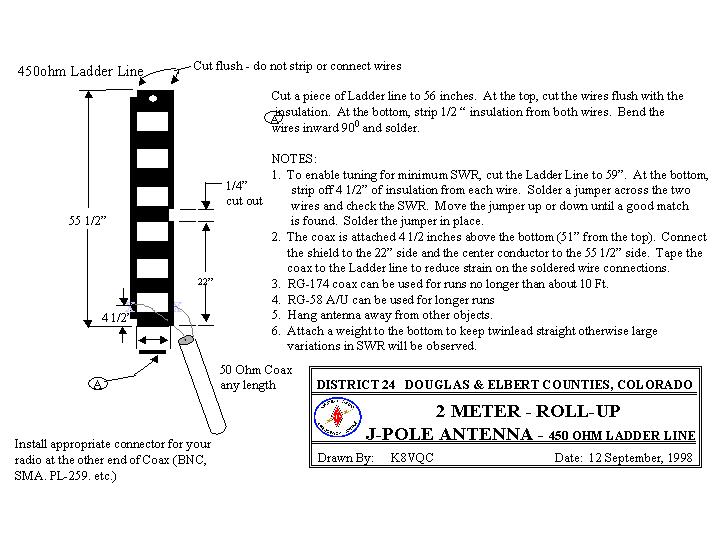
Here are the plans for the 2m j-pole antenna that we built.

The MFJ analyzer’s frequency range is also much greater. It covers the 2m and 440 MHz bands, while the Autek only goes up to 32 MHz. Mark doesn’t think it’s very accurate at 440, though.

The first thing we did was measure the SWR of the J-pole I’d built. I’ve been very happy with the antenna, so I was a little surprised that the first reading was slightly over 2.0. I did have it hanging very near to a fairly massive new barbecue grill we have, so surmising that the grill was detuning the antenna, I moved it away from the grill and the SWR did go down to about 1.5. Respectable in my opinion.

Next, we measured the SWR of the dual-band antenna. This antenna is a 5/8 wavelength antenna that I had mounted on a mast. Its SWR measured about 1.5 near the ARROW 2m repeater frequency of 14.96- MHz. I was happy with that, so we moved on to the antenna construction.

We built the J-pole from plans I found on the Net (shown above). You can build J-poles from 300 ohm twinlead, 450 ohm ladder line, and 1/2-in. copper pipe. The dimensions for each of these versions is slightly different, as the velocity factors are all different.

We opted to build ours with the ladder line because we each already had a hunk of it and it’s much easier to carve up some ladder line than solder up copper pipe. It’s not as sturdy, but it’s certainly sturdier than 300 ohm twinlead.

When I built mine, I did not have an SWR meter to tune the antenna with. So, I just built it to the recommended dimensions, and as mentioned earlier, it turned out to work pretty well. Since we had the analyzer when we built Mark’s we played around with the tuning stub, and it appears that he was able to get a slightly better match than I was.

Overall, it was mission accomplished.

Filed Under: Antennas

Get on the repeater!

November 10, 2002 By Dan KB6NU Leave a Comment

As previously reported, I just bought an IC-207 dual-band rig. It’s a great rig, but for the first two days I didn’t make a single contact on the local repeater. I was not, of course, monitoring the whole time, but you’d think I could raise someone on a Friday or Saturday night. Maybe not, though. I guess the other hams in the area have a life. :)

I did finally manage a contact Saturday night with a fellow who was on his way to Detroit. We had a nice chat, and I found out that he’s a local guy who’d just gotten his license in June. The interesting thing is that despite living in Ann Arbor for the last four years (as a University of Michigan student), he was not familiar with our club, nor of the fact that we owned and operated the repeater we were using.

Of course, I took the opportunity to invite him to our meeting this Wednesday (for more details, see our website), and I think there’s a good chance he’ll show up. I had a similar experience last month. On my way to the club meeting, I had a QSO with a fellow ham, and I mentioned that I was on the way to the meeting, we’d love to have him attend, too. He replied that he’d been meaning to come to a meeting and join, but for one reason or another, just never got around to it. I pressed the point, and he actually did show up. In fact, he brought his checkbook along and paid his dues as well.

My point is that one of the best ways to promote your club is to monitor your local repeater and talk up your club and its activities at every opportunity. Invite people to attend your meetings. Invite them to check in to your nets. If you don’t have a net, start one. If you do some of these things, I think you’ll be pleasantly surprised at the results.

Filed Under: Clubs, VHF/FM/Repeaters

Small Wonder PSK31

November 6, 2002 By Dan KB6NU Leave a Comment

A couple of years ago, I bought and built the SST-20 20m QRP rig from Wilderness Radio. While I haven’t had that much success with this rig–I attribute this to my poor antenna skills–the kit went together pretty easily and was fun to build. (If anyone wants to buy this from me, you can have it for the kit price: $85)

Now, I’m thinking of trying it again. This time with one of the PSK31 rigs from Small Wonder Labs. They make several different models, including one for 10m that looks relatively easy to put together. Apparently, these rigs interface directly to a 16-bit sound card.

As for the computer, I have an old Windows box that I was thinking of converting to Linux. Another possibility is to buy an old laptop for use in the shack. The advantage of the laptop is that it would take up less space in the shack. A third option is to try to get one of the Linux PSK31 packages to run on my Sharp Zaurus. A Google search for “linux psk31” turned up quite a few references to PSK 31 software running on Linux machines.

I have a couple of questions:

  • Has anyone built one of the PSK31 units? Having any success with them?
  • Am I crazy for thinking about the 10m unit? Should I go with one of the other bands?
  • Is anyone running PSK31 software on a Linux box? Which package do you think is best?

Filed Under: Digital Modes, Kits

A Tip For Using the Autek VA1

November 3, 2002 By Dan KB6NU 1 Comment

In the last entry, I mentioned not being able to tune the antenna for an SWR lower than 1.5:1. Well, it struck me last night as I was falling asleep why this was so. When calculating the SWR, the Autek VA1 assumes that you’re using a 50 ohm feedline. D’oh!

Fortunately, the Autek allows you to change that setting. You can program it to a number of different values from 25 ohms up to 450 ohms. Now, I’ll just have to remember to do that when working with RG-59 or ladder line or whatnot.

Filed Under: Antennas, Gear/Gadgets

Fun With Antennas

November 2, 2002 By Dan KB6NU 1 Comment

I got back on the shortwave bands in August, putting up a 20m dipole. While 20m is fun, I’ve wanted to try out some of the other bands, too. When I was a kid, I used to work 40m a lot, especially late at night. So, I decided to put up a 40m dipole.

I’m lucky in that I have a number of trees to use as an antenna support. While there’s not quite enough space to string an 80m dipole, I guesstimated that a 40m antenna would fit quite nicely.

So, I mail-ordered a bunch of stuff from RadioWorks. The stuff was very nice quality, but I was a little miffed that some of the prices were higher than advertised. I understand that prices can change, but they really should make an effort to update the ads they run in QST and other magazines. It looks to me like they haven’t been updated for more than a year.

At any rate, I got all the parts, and in rummaging through my junk boxes came across a 1:1 balun that someone had given me. I built the dipole using that balun instead of the RadioWorks balun that I’d just purchased. The antenna wire I bought is that fancy, flexible stuff. As advertised, it was very easy to work with, and looks to be quite strong, too. I also put together a 100′ RG 59 cable.

So, Saturday afternoon I get out into the backyard and string it up. Using the Autek VA1 antenna analyzer, I adjust the length for the lowest SWR I can manage. Oddly, it doesn’t seem as though I can get it much lower than about 1.5:1, but that’s OK. It should still work. (More about this later.)

Finally, I get the thing up in the air, and hurry down to the shack to give it the smoke test. I check the SWR again with the Autek, and it looks pretty good. I connect it to my rig–an Icom IC-735–and tune around for a clear frequency. Finally, I put the power to it, and adjust the internal SWR meter.

Wow. The SWR looks even better than it did with the Autek. I send out a few Vs, and then my wife comes rushing downstairs. “”You’re coming in loud and clear,”” she says, “”over the computer speakers! AND you’re making the garage door go up and down, to boot!””

Yipes. I didn’t have this problem with the 20m dipole at all, and I thought a balun was supposed to help reduce RFI.

At this point, it was almost dinnertime, so I just pulled the plug on the rig and decided to sleep on things. It’s too bad, too, because I had wanted to make a few contacts in the CW Sweepstakes Contest. Oh well.

Filed Under: Antennas, EMI/RFI Tagged With: dipole, rfi

My Icom IC-735

November 1, 2002 By Dan KB6NU 3 Comments

The rig I use on the HF bands is the Icom IC-735. I like it a lot, and while it doesn’t have some of the features found in the newer rigs, such as DSP or spectrum display, I really don’t feel the need to upgrade at this time.

The receiver is very good, and it puts out about 100W, which is sufficient for most operation. I also really like the break-in keying.

Having said that, it does have a few quirks. Several years ago, the backlight on the display quit and the power on-off switch is now intermittent. Anyone else out there have this problem? If so, is it an easy fix?

Filed Under: Gear/Gadgets Tagged With: backlight, IC-735, Icom

CQ CQ CQ de KB6NU

November 1, 2002 By Dan KB6NU Leave a Comment

My grandparents were responsible for getting me into ham radio. They had an old Philco console with an AM band, a shortwave band, and a built-in record player sitting in their basement. I used to love to go over there and listen to shortwave broadcasts from the BBC, Radio Canada, and all the other SW broadcasters of that era. The shortwave band included the 31m and 19 m broadcast bands as well as the 20m ham band.

One day while tuning from the 31m band to the 19m band, I asked my dad what those stations were that were sending Morse code. He replied, “Oh, those are ham radio operators,” and explained a little bit about amateur radio. As the radio did not have a BFO, I couldn’t really copy the CW or the sideband phone signals, but I still thought it was pretty cool that you could actually set up your own transmitter and make contact with stations all over the world.

It took me a while–mostly because our family didn’t know any amateur radio operators–but I finally obtained my first ham in 1971. In fact, my first license was dated July 16, 1971–the date of my sixteenth birthday. My first call sign was WN8KTZ.

I operated from the basement of my parents house, first using a Heathkit DX-60 transmitter with a Hammarlund HQ101 receiver. I soon upgraded both my license and my station, becoming WB8KTZ and buying and building a Heathkit HW101. My antenna was a Hy-Gain 14AVQ vertical.

College put a damper on my amateur radio activities, although I still operated from time to time. After receiving my BSEE from the University of Detroit, it was off to Sunnyvale, CA. My first job out of college was with Amdahl Corporation, then manufacturing a line of IBM-compatible mainframe computers. Being a recent graduate, I didn’t have much money for a place, so we ended up in at one-bedroom apartment. There wasn’t much space for antennas, and I wasn’t on the air at all from that QTH.

My immediate supervisor was Dave Roznar, W6TGE. Soon after starting there, we both decided to upgrade to Advanced class. We blew off work one day, took the train up to the San Francisco FCC office, where we both passed our Advanced written exam. That’s how I became KB6NU.

In light of the fact, that they are no longer issuing Advanced class tickets, I’m thinking of keeping mine for the duration. My goal is to become the last living Advanced class licensee in the US.

Despite having been licensed for so long (I even qualify for QCWA!), I really haven’t been all that active over the years. While in California, I lived in apartments and condos, and not being an antenna genius, I never could seem to get an antenna to work very well. When I moved back to Michigan, I just never got motivated to get back on the low bands. I bought an HT and worked the repeaters, but that never seemed like “real” ham radio to me.

Fun on Field Day
Now, however, I’ve seen the light.

What got me started was taking part in the ARROW 2002 Field Day. To be honest, I wasn’t going to go at all. I was feeling a little guilty about not helping set up, and Sundays are when I usually go bicycling (my other big avocation).

That Sunday, however, I was feeling lazy and it was really hot. So, I opted to go to Field Day instead. The first guy I met when I got there was Mark W8FSA, then president. He had been there most of the night and was just eating some breakfast. When he finished his bagel and coffee, he said, “Well, you didn’t come to hear me chatter. Let’s do some operating.”

He had set up his Kenwood transceiver in a trailer that someone had towed out to the site. He first suggested that we try 20m phone. The only problem he said was that the G5RV antenna that he had connected to the rig wasn’t really working all that well on 20m and the antenna tuner didn’t seem to be much help. After a fair amount of fiddling, he finally got the antenna tuned, but it was quickly apparent that we weren’t putting out much of a signal. We made a few contacts, but more often than not, stations we called did not come back to us.

That’s when I suggested we try CW. Neither of us had done much CW operating lately, but I reasoned that we’d have more success with our poor signal on CW than phone. Mark was kind of hesitant, but I said, “What the heck. We may not be the best CW ops, nor are we the most experienced contesters, but it will be fun.”

After prodding him a little more, he finally agreed. I went off to find a key. When I got back, he’d already gotten the rig tuned up on 15m (our other HF station was working 20m CW). We connected up the key and started tuning around. We soon found a station calling CQ FD.

“Call him,” I said, wanting to give Mark first honors. He pushed the key over to me and said, “You do it.” So I called and the guy came right back to me. How cool! It was the first CW contact I’d made in years. It took me a little while to figure out the CW contest protocol, but soon I felt pretty comfortable with it, and we started making contacts. If we could hear them, they generally could hear us. We were really rusty, though. Sometimes after we’d made a contact, we’d have to listen for a while to make sure we got the other station’s call right.

I’d like to say that we racked up hundreds of points that morning, but by the time we got on CW, it was already noon, so we only had a couple hours left. And because I wasn’t the most experienced contester, I only called stations that I heard calling CQ. All in all, I made 24 contacts from noon to 2 pm. Not a stellar performance, but it was a lot of fun.

Back on the Low Bands
That experience has prompted me to get back on the low bands. I dug out my Icom IC735, which had been languishing in the closet since I moved two and a half years ago, and found the box containing my antenna parts. Fortunately, I had enough wire and coax to build a 20m dipole. Consulting an old Handbook, I cut the elements so that the antenna would resonate about 14050 kHz. To install the antenna, I attached a pulley to my house about 25 feet up. The other end I attached to an obliging tree in my backyard. The length of RG-59 coax I had was just long enough to make it into the shack.

Now, as I’ve said, I’m no genius when it comes to antennas, so I was pleasantly surprised when the SWR was low enough to not blow the finals in my rig. It wasn’t resonant on 14050, but close enough, so I began tuning around for a CQ. The first station I heard was XE2AHN. I called him, and he came back. My first HF contact in years was a DX contact!

I’ve since filled up a page in my log book. Amazingly, almost half of the 30 contacts are DX contacts. I’ve worked Wales, Italy, Ukraine, Russia, England, Brazil, Colombia, and Spain. I’ve also worked a bunch of domestic stations, and chewed the rag with a couple of them. I’ve also joined FISTS, the International Morse Preservation Society. Seems like a pretty cool group. My FISTS number is 9342. My immediate goal is to improve my CW operating abilities enough to really rack up some points next year on Field Day.

Projects and Other Activities

  • I’m the treasure of the Arrow Communications Association. We operate several repeaters in Ann Arbor, MI; our 2m repeater is on 146.96(-) MHz. We also hold classes and volunteer license examinations. We’d love to have you as a member if you’re in the area.
  • I’m doing a little research into the Internet Radio Linking Project and what it would take to get our repeater linked up. I think it would be really cool to talk in on 146.96 and talk to someone in New Zealand or Great Britain.
  • The ARROW is now in discussion with the Hands-On Museum to set up a station at the museum to teach people about ham radio. If you’d be interested in helping with this project, please e-mail me and I’ll put you in touch with the right people.
  • I built a 20m Wilderness Radio SST QRP rig. I hope to take this out on a bike tour sooner or later.
  • I also need to work on some kind of multi-band antenna before the winter. I’d like to work 40m as well as perhaps 30m and 10m.

Filed Under: Everything Else Tagged With: bio, kb6nu

  • « Go to Previous Page
  • Page 1
  • Interim pages omitted …
  • Page 448
  • Page 449
  • Page 450

Primary Sidebar

No Nonsense Technician Class License Study Guide (for tests given between July 2026 and June 2030)

New No Nonsense Technican Class Study Guide now available!

The 2026 version of my Tech Class study guide is now available, and as always, the PDF version is FREE!. The ePub version costs $11.97, and a Kindle version and paperback version will be available on Amazon shortly.

Click here to get all of my "No Nonsense" study guides.

Also available: The CW Geek's Guide to Having Fun with Morse Code

W5SWL.Com
Retevis Ailunce H1 DMR Radio
DXpander: Cobweb antennas, Laser Cutting

You’ve got mail!

Enter your email address below and get an email every time I publish a new post.

Email


I frequently teach classes to help newcomers get their licenses. The next class will take place on Saturday, October 10, 2026 on the University of Michigan campus. Click here for more information.

If you can't make the class, subscribe to the mailing list to be notified of when the next class will be held.

You can always download my free study guide, and if you have any questions about the classes, or amateur radio in general, please feel free to email me directly.

Support KB6NU.Com

Donate $7.30 and get two of these cool stickers. Measuring 4.25-in. W by 2.75-in. H, it's perfect for your car, your shack, or wherever!

Contact me

If you have a question or comment about one of my blog posts, or a question about any of the material in my study guides, or just a question about ham radio in general, you can email me at [email protected].

Blogs You Should Also Read

  • AE5X: A CW-centric blog from Kingswood, Texas
  • K0LWC Blog
  • LA3ZA Ham Radio Blog
  • Little Radios, Big Fun – WB3GCK
  • Mr. Vacuum Tube's Blog
  • Radio Artisan – K3NG
  • The K0NR Weblog
  • VE3WDM's QRP Ham Radio Blog
  • W2LJ’s Blog

Ham Radio Websites

  • Dashtoons – The Hammin' Comedy by Jeff K1NSS

Podcasts

  • ICQ Podcast
  • Linux in the Ham Schack
  • No Nonsense Amateur Radio Podcast
  • Resonant Frequency Amateur Radio Podcast

Recent Comments

  • Dan KB6NU on The EMF Explorer: A badge for ham radio?
  • Travis Good on The EMF Explorer: A badge for ham radio?
  • MARTIN ROBERT ROTHFIELD on The EMF Explorer: A badge for ham radio?
  • Mike Chen on Operating Notes, January 5, 2026
  • Rob W4ZNG on The EMF Explorer: A badge for ham radio?

Meta

  • Log in
  • Entries feed
  • Comments feed
  • WordPress.org

Footer

Copyright © 2026 Daniel M. Romanchik, KB6NU · Log in