
• Skip to primary navigation
  • Skip to main content
  • Skip to primary sidebar
  • Skip to footer

KB6NU's Ham Radio Blog

KB6NU's Ham Radio Blog
  • HOME
  • Study Guides
  • Teach a One-Day Tech Class
  • W8SRC Repeater Guide
  • Advertise
  • Hire Me

Antennas

No VHF SWR Meter? No Problem.

November 17, 2008 By Dan KB6NU 61 Comments

On the HamRadioHelpGroup mailing list, a ham asked:

Will a CB SWR meter work on a 2 meter ham radio??

Mark, K5LXP, replied:

Yes and no.

I use a CB SWR meter to check 2M antennas all the time. There is a trick to it however.

If all you want to to is check SWR on your 2M antenna, you don’t necessarily have to buy a dedicated VHF/UHF SWR meter. What I keep in my toolbag for that is a cheapie $5 hamfest special CB SWR meter. They really don’t work well on 2M but there’s a trick you can do that will net a reasonably accurate SWR reading on 2M with one of these meters. What you do is connect up the meter as usual, key the rig with the switch in the forward power position, set the adjustment for full scale. Now, without touching anything, swap the coax connections so that the rig is connected to the “ANT” side of the meter, and the antenna is connected to the “XCVR” side. The reading you see on the meter will be very close to your real SWR. The closer to 1:1 your SWR is, the more accurate it will be. It would be more convenient to have a real SWR meter or antenna analyzer if you do a lot of testing, but for a quick antenna check after a mobile install or whatever, the $5 CB meters work OK.

When I asked his permission to use this, Mark said, “I don’t get the credit, I picked it up from some OF years ago.” (E-mail me if you don’t know what an OF is.) Well, Mark, you might not get the credit for thinking this up, but you certainly get the credit for passing it on. Thanks!

Filed Under: Antennas, VHF/FM/Repeaters

This Weekend on the Radio at KB6NU

October 20, 2008 By Dan KB6NU Leave a Comment

My ham radio weekend started early. Even though we were scheduled to start operating at the museum at 10 am, I thought I’d turn on the rig and see what condition 40m was in. One reason for doing this is that we intended to operate the Jamboree on the Air. I found that the band was in great shape, and I managed to work three stations—one on CW and two on SSB—all getting ready for JOTA.

I got to the museum just before 10 am. Jim, K8ELR, had brought his laptop and a power supply, and we not only set up the IC-746PRO to operate 40m, but we also had 2m and EchoLink setups. Unfortunately, only one Scout showed up, and he didn’t come until 12:30. Even so, he got to make several contacts, and that was a lot of fun.

It was partly our fault; we really didn’t make an effort to get Scouts to the museum. It was partly their fault, too. They didn’t contact us until a week before the event.

Another Ham on the Air
On Saturday afternoon, I went over to help Ian, N8SPE, set up the 40m/20m dipole that I sold him after Field Day. He had gotten it up into the trees, but wasn’t getting the SWR he expected.

Sure enough, when I got over there and put the antenna analyzer on it, the SWR at 7.000 MHz was about 5:1. Going outside to take a look, we found that one of the legs had come loose from its stake (he set it up in an inverted vee configuration) and was just laying on the ground. We got that straightened out, but the SWR was still rather high.

The readings indicated that it was too long. That seems to nearly always be the case when you cut an antenna using the 468/f(MHz) formula. It’s almost as though someone said way back when, “We’ll just tell everybody that the number is 468, and if they use that to calcuate the antenna length, the wires will be too long, and that’s certainly better than being too short.”

We first took a foot off each end. Still too long. Then, we took another three inches off each end. Closer, but still a little too long. Three more inches and we were pretty much right on the money. The SWR was 1:1 at about 7.200 and 1.5:1 at 7.300. We fired up the radio, called CQ, and got an answer to our first call. We even got a 59 report! As W might say, “Mission accomplished.”

I spent the day Sunday with my in-laws, but did get on a bit Sunday evening. I worked 6W/DL4JS, one of the stations preparing for the upcoming DX contest. That was my DX contact for the evening.

Later on, the band was really dead, but I heard K8KS calling CQ over and over. Kaz, K8KS, lives just a couple of miles away from me, but since it seemed that no one else was hearing him, I called him and we had a nice chat. He’s a good operator and a nice guy.

Filed Under: Antennas, Elmering

How we get kids (and parents) interested in Ham Radio

October 2, 2008 By Dan KB6NU 1 Comment

Barry, K2JV, wrote this for the ARRL’s Contact, an e-mail newsletter for PIOs:

The New Providence Amateur Radio Club of New Jersey has been actively introducing kids to Amateur Radio for about 5 years. The activities and events which we have mentored have been a source of considerable pleasure for the senior club members involved, but also require a considerable effort, both physical and mental.

Our formal programs include:

  • Kids Day twice a year, in cooperation with two township supported Recreation Commissions
  • Operating a GOTA station at Field Day
  • Running an after school Ham Radio Club at an elementary school
  • A program of “Ham Radio at Summer Camp,” also a Recreation Commission function
  • Mentoring ARISS QSOs, 4 contacts at various school levels.
  • Kids march with the Club in the annual Memorial Day Parade. They carry the Club banner and each has an HT on 2 meters using the callsign of and supervised by one of our licensed members.

These activities have given us an “insider’s look” at the behavior and interests of children, mostly of elementary and middle school age. Most of these programs include on the air operating on HF, and sometimes on VHF.

For programs of longer duration like the school radio club or at summer camp, it’s usually pretty easy to identify those kids who show a more than passing interest, and get them right on HF. It is frequently difficult to establish reliable, clear communication on 20 or 40 meters. The stations contacted are uniformly interested in speaking with the kids, but most operators don’t know how to speak with kids. The simple concept of speaking slowly, asking only one question at a time, and making that question something within the comprehension of a child, is something that most of us need a little time to grasp. The control op and mentor usually has to start the kids asking questions which will engage the person on the other end. Such questions include: “Do you have any pets?” or “Do you have any children?” or “What flavor ice cream is your favorite?” This clues the operator on the far end as to how to respond and how to ask a question which a kid can answer.

When we do “Ham Radio at Summer Camp” we are in competition with all the other activities which are going on. It soon becomes quite apparent however, that there are a few kids who will stay at the Ham Station for the whole day, and a few more who keep coming back – generally with the question “can I try it again?” These are the ones we are looking for to bring up the subject of Ham Radio at their schools and at home. We have prompted them when they return to school after the summer, and when their teacher asks “What did you do this summer?” to respond “Oh, I just spoke with a rancher in Arizona who raises Buffalo” or “I talked to a man who was in the jungle in Panama” or for our ARISS communicators “Oh, all I did was have a conversation with an astronaut on the International Space Station!”

One of the most important values of Ham Radio which we try to get through to parents and adults is that it teaches their kids how to speak with an adult who is not a family member, in sentences not monosyllables, and how to behave in the presence of a stranger. The science, technology, geography, etc. which they are learning even if they don’t know it – is purely collateral.

For Kids Day, in order to insure plenty of contacts we usually have a few “ringers” listening on a previously selected VHF repeater or simplex frequency. That way when a kid calls CQ he is likely to get an immediate and clear answer (kids have a short interest span). After that, it’s usually possible to get them on HF to make exchanges with other kids. Even the youngest, grasp the procedures for Kids Day almost immediately. We help them with a “crib sheet” which has the exchange written out, and they recognize the fact that the station contacted is sending them similar information. If conditions are poor, we have some “ringers” waiting on 20 meters too.

For an ARISS QSO, we have used “ringers” in preparing our Student Communicators. We usually do this on VHF simplex and one of our experienced Club Members becomes a “Simulated Astronaut.” This allows the kids not only to get familiar with the exchange protocol which will be used, but also lets them practice the questions which they have made up for the astronaut, and change the question when they hear the answer. This is done under the supervision of the Control Operator for the QSO who is one of our “graduate students” having communicated with the ISS, obtained a ham license, but is still in Middle School or High School.

We have a few “internal rules” for our ARISS QSOs:

  1. It’s all kids. Everyone including the control operator is a “kid” meaning High School or younger.
  2. No adults are visible on the stage, at least not to the audience.
  3. It is advertised as “a conversation with an Astronaut” and the kids respond after their question is answered, thank the astronaut, and pass the microphone to the next communicator.
  4. We introduce them early on, to a Satellite Tracking Program and the NASA website, which they are urged to use at home.
  5. To get more kids involved we do manual antenna train and elevate, and manual Doppler correction. A separate group of kids (usually boys) want to do this.

My Summary
After 5 years a few generalities as related to Ham Radio can be observed:

  • Little girls like to talk to each other. We set them up in small groups, each group with a handitalkie. Using proper protocols and callsigns the groups play games with each other like “battleship” or some games using LEGO blocks, etc.
  • Little boys like to play with electronic toys and love Morse code. They use computer based Morse training programs and soon learn to recognize their names and the names of their buddies. We have them build code oscillator kits and make them work.
  • Neither sex has the capability to carry on a conversation with a stranger. They have not yet learned to initiate a conversation with an adult. They don’t have this problem with their peers.
  • Both sexes tend to answer questions with monosyllabic answers. They can be prompted to answer in sentences, to speak slowly and clearly, but if not supervised they revert to their original style.
  • Girls have a much longer social interest span than do the boys. This is true for social gatherings like the games and communication exercises. The boys will work on the code for a long time, but this is a more solitary activity.
  • Boys like the complexities of games and puzzles more than girls. When on the air we can get them involved in the competitive and contest activities.
  • All children function better in a structured, organized environment. If the Ham Radio environment is made to feel like school, they can relate to it and will behave as though they are in school. Since most of their teachers are female, they all have far less problem conversing on the air with a YL (preferably a grandma) than with an OM of any age.

Filed Under: Antennas, Kids

New Agilent Analyzer Does It All

October 2, 2008 By Dan KB6NU 2 Comments

Want to be the coolest ham in your club? Then, you need the new Agilent N9912A FieldFox RF Analyzer. This baby does it all:
  • Cable and Antenna Analyzer
    • Frequency range: 2 MHz to 4 GHz and optional 6 GHz
    • Directivity: > 42 dB
    • Measurement speed: 1.5 ms / per point
  • Network Analyzer
    • 2 MHz to 4 GHz and optional 6 GHz
    • S11 magnitude and phase, S21 magnitude
  • Spectrum Analyzer
    • Frequency range: 100 kHz to 4 GHz and optional 6 GHz
    • DANL (displayed average noise level): -148 dBm / Phase noise: -88 dBc at 10 kHz
    • TOI (third order inter-modulation distortion): +18 dBm
    • Sweep speed: 1 second / full span (6 GHz)
  • Power Meter
    • 9 kHz to 24 GHz

And the price? Only $7,600! That’s really a great deal when you think about all that this thing can do.

Filed Under: Antennas, Building/Homebrew

Soldering PL-259s……Again!

August 21, 2008 By Dan KB6NU Leave a Comment

Threads on attaching PL-259s to coax are a mainstay of most amateur radio mailing lists. If you subscribe to as many as I do, you see at least five or six every year. This last week, yet another one popped up on the HamRadioHelpGroup. Below, is, imho, the most useful reply:

A good tool for this application is sold under the Weller/Cooper name at home centers and some larger craft stores. They market an 80 Watt pencil type iron for working with stained glass.

Unless you are installing lots of connectors every day I find this to be a really good tool. It has a thick, heavy tip that retains heat
well and is often much less expensive than what appears to be the same 80 Watt iron sold through electronics distributor type outlets. There are two models:

  • SP80L (Regular model)
  • SPG80L (“Stained Glass” model)

I bought mine 4 or 5 years ago in a cutesy pink and blue bubble pack at a Hobby Lobby store for under $20. The same iron at the online electronics places was about $45 if I recall.

Moral of the story: Go shopping with your wife occasionally. You can find useful stuff in the darnedest places!

Tim, N9PUZ

Pronto (a site I never heard of before) lists six sources for the SPG80L, including Amazon ($24.23 – the cheapest price) and Ace Hardware ($37.97 – the highest price). 

I think I want one of these. When I’m not soldering PL-259s, I can use it make stained glass windows.

Filed Under: Antennas, Building/Homebrew

If a J-Pole Antenna is Good for 2m, Would it be 3X as Good for 6m?

August 7, 2008 By Dan KB6NU 3 Comments

Nick, KD8IPE, one of the guys in my latest Tech class got interested in working 6m and asked me about 6m antenna. Well, having never worked 6m, I didn’t have a very good answer for him. Then, I thought about the J-pole antenna. I have built many 2m J-poles. They’re simple to build, and using my favorite set of plans, the SWR in the repeater portion of the band has always been 1.5:1 or less. So, I suggested he build a 6m J-pole.

Nick then turned the tables on me and suggested that we each build one. Then, he reasoned, he’d at least have someone to talk to. I took him up on that, and last night, we built one using plans developed by DK7ZB. This antenna differs from the 2m J-pole in a couple of ways. First, the radiator is made from antenna wire, not the 450-ohm ladder line, as in the 2m J-pole.

Second, the feed point seems to be at a different point. In the first set of plans, the feed point is approximately 20% up from the shorted end of the matching stub. In DK7ZB’s plans, the feedpoint is 5-10% from the shorted end. Since I’d had such good success with the first set of plans, we decided to go with the 20% figure and placed the feedpoint about 13.5-in. from the shorted end.

Third, the DK7ZB design uses a choke balun at the feedpoint. You rarely see this on 2m J-poles, although this is debated now and then.

After some discussion about whether to solder the coax directly to the ladder line or to install an SO-239 (we opted for the SO-239), we soldered it all together and then took it outside to hang it from a tree branch. We ran the coax inside and then hooked it up to my Icom IC-746PRO. I don’t have an SWR meter for 6m, but the 746PRO’s internal antenna tuner was able to find a match, so the SWR mustn’t be too bad.

Of course, 6m didn’t appear to be open at the time, so we didn’t work anyone. Heck, we didn’t even hear anyone or any of the beacons. Even so, it’s kind of cool to be able to say that I’m now capable of working 6m.

I do have some questions, though:

  • What’s up with the feedpoint? Why do the two designs differ as to where to place the feed point? I wish I had an antenna analyzer to make some measurements.
  • Is the balun necessary and/or useful? Does using a balun affect the feedpoint placement?
  • Does polarization matter? I’d guess if I were trying to operate a 6m FM repeater it would, but that it wouldn’t matter so much when working CW or SSB DX.

Filed Under: Antennas, VHF/FM/Repeaters

Add 17m to the Hustler Vertical

June 25, 2008 By Dan KB6NU Leave a Comment

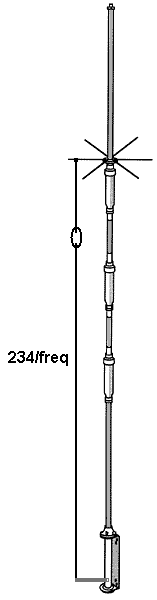
Add 17m to HustlerThe Hustler 4BTV, 5BTV, and 6BTV trap vertical antennas have been sold for as long as I’ve  been a ham (37 years now!). I’m sure they’ve sold thousands of them.  They are inexpensive, rugged, and when used with a good number of radials, great antennas.

The one problem is that they were designed before we got the WARC bands, and Newtronics has not updated the design to add these bands. Well, here’s an ingenious way to add 17m to the Hustler antennas.

Basically, all you do is add a quarter-wave of wire (about 13 feet) in parallel with the rest of the antenna. You connect one end to the base of the antenna, and then suspend the top from the capacitance hat, as shown in the figure at the right. Apparently, if you space it out at least six inches from the main element, the antenna will tune up just fine on 17m and not affect the tuning on the other bands very much.

You should be able to add a 12m element to the antenna in exactly the same way.

Filed Under: Antennas

J-Pole Analyzed

May 11, 2008 By Dan KB6NU 1 Comment

On qrp-l.org, there’s been a discussion of the J-Pole antenna. There were various short, incomplete explanations of how it works, some comparing it to a Zepp antenna. I can see the similarity to a Zepp, but must also admit that my understanding of how it works is incomplete.

Fortunately, Gary, N3GO, has done a very thorough analysis of the J-pole titled “From a J to a Zepp: The truth and its consequences.” While I haven’t puzzled through it all yet, it looks like a very thorough analysis, and includes a number of observations that the author says appear to be contrary to popular opinion:

  • Adjusting the feedpoint “tap” is not the proper way to tune a J-pole.
  • 300 ohms is the optimal transmission line impedance to use in the construction of J-poles.
  • 300 ohm TV twin-lead is minimally susceptible to RF current induced in the feedline coaxial cable, enabling the J-pole to perform well without a balun.
  • The “stub” portion of the J-pole is electrically longer than a quarter wavelength.
  • The J-pole “shorting bar” can be connected to an earth ground reference if and only if a balun is employed at the antenna feedpoint.
  • The velocity factor is the most critical transmission line parameter to consider when designing J-poles.
  • J-poles are easy to build, and tune (even by the inexperienced). As a consequence, they are easy to reproduce.

Filed Under: Antennas

Antenna Basics for Newbies (and Some Oldies)

April 4, 2008 By Dan KB6NU Leave a Comment

I’ve always said that I’m no antenna genius. And I readily admit as much when I teach the General Class license course. The main problem, of course, is that you can’t really see how an antenna works in the same way that you can see how a circuit works. It’s awfully hard to measure RF voltages and currents on a wire antenna 50 feet in the air. And even if you could, you’d still have to visualize how an antenna radiates an electromagnetic wave.

Even so, we still manage to make antennas work. We do this by standing on the shoulders of giants. L.B. Cebik, W4RNL, is one of those giants.

Last summer, he posted the article, Antenna Newcomers and the Language of Antennas, on his website. It describes:

  • basic conventions and concepts related to antenna representation;
  • some basic concepts applicable to antenna operation; and
  • some basic concepts of antenna performance in numerical and graphical form.

This, and the rest of W4RNL’s website is worthwhile reading.

Filed Under: Antennas

Look Ma, No Key!

March 10, 2008 By Dan KB6NU 1 Comment

Julius, N2WN, posted a link to this video of F8BBL working CW without a key on the Elecraft mailling list. He has pretty good technique, I think. Maybe in the next video, he’ll use three fingers in iambic mode. :)

Put on a PL-259 in Six Minutes!
While I was on YouTube, I also found a couple of videos that show you how to solder a PL-259 onto coax in six minutes!

  • PL-259 Installation Made Easy for RG213
  • PL-259 Installation Made Easy for RG8X

This guy is good. It takes me a lot longer than six minutes to solder on a PL-259.

Filed Under: Antennas, CW

  • « Go to Previous Page
  • Page 1
  • Interim pages omitted …
  • Page 29
  • Page 30
  • Page 31
  • Page 32
  • Page 33
  • Interim pages omitted …
  • Page 36
  • Go to Next Page »

Primary Sidebar

No Nonsense Technician Class License Study Guide (for tests given between July 2026 and June 2030)

New No Nonsense Technican Class Study Guide now available!

The 2026 version of my Tech Class study guide is now available, and as always, the PDF version is FREE!. The ePub version costs $11.97, and a Kindle version and paperback version will be available on Amazon shortly.

Click here to get all of my "No Nonsense" study guides.

Also available: The CW Geek's Guide to Having Fun with Morse Code

W5SWL.Com
Retevis Ailunce H1 DMR Radio
DXpander: Cobweb antennas, Laser Cutting

You’ve got mail!

Enter your email address below and get an email every time I publish a new post.

Email


I frequently teach classes to help newcomers get their licenses. The next class will take place on Saturday, October 10, 2026 on the University of Michigan campus. Click here for more information.

If you can't make the class, subscribe to the mailing list to be notified of when the next class will be held.

You can always download my free study guide, and if you have any questions about the classes, or amateur radio in general, please feel free to email me directly.

Support KB6NU.Com

Donate $7.30 and get two of these cool stickers. Measuring 4.25-in. W by 2.75-in. H, it's perfect for your car, your shack, or wherever!

Contact me

If you have a question or comment about one of my blog posts, or a question about any of the material in my study guides, or just a question about ham radio in general, you can email me at [email protected].

Blogs You Should Also Read

  • AE5X: A CW-centric blog from Kingswood, Texas
  • K0LWC Blog
  • LA3ZA Ham Radio Blog
  • Little Radios, Big Fun – WB3GCK
  • Mr. Vacuum Tube's Blog
  • Radio Artisan – K3NG
  • The K0NR Weblog
  • VE3WDM's QRP Ham Radio Blog
  • W2LJ’s Blog

Ham Radio Websites

  • Dashtoons – The Hammin' Comedy by Jeff K1NSS

Podcasts

  • ICQ Podcast
  • Linux in the Ham Schack
  • No Nonsense Amateur Radio Podcast
  • Resonant Frequency Amateur Radio Podcast

Recent Comments

  • Dan KB6NU on 2015 General Class study guide: Section G2E – Digital operating: procedures, procedural signals, and common abbreviations
  • Jimi on 2015 General Class study guide: Section G2E – Digital operating: procedures, procedural signals, and common abbreviations
  • Ali on Some Good Advice on Learning Morse Code
  • mike on Instant Character Recognition is the key to CW speed
  • Matt W1CDN on A completely different picture of Wayne Green, W2NSD (SK)

Meta

  • Log in
  • Entries feed
  • Comments feed
  • WordPress.org

Footer

Copyright © 2026 Daniel M. Romanchik, KB6NU · Log in