• Skip to primary navigation
  • Skip to main content
  • Skip to primary sidebar
  • Skip to footer

KB6NU's Ham Radio Blog

KB6NU's Ham Radio Blog
  • HOME
  • Study Guides
  • Teach a One-Day Tech Class
  • W8SRC Repeater Guide
  • Advertise
  • Hire Me

Antennas

Operating Notes

February 6, 2007 By Dan KB6NU 2 Comments

Here are a couple of items too short for an entry of their own:

RF in the Shack
I’ve been operating the random wire antenna at only 30W because I was afraid of RF in the shack. After all, the tuner is only about four fee from the radio, and the antenna starts at the back end of the tuner.

Up till now, I hadn’t really seen any evidence of RF in the shack. Yesterday, though, I was calling CQ using the radio’s memory keyer, and while the radio was calling CQ, I was trying to do something on the computer. As I tried to mouse around using the touch pad, the mouse just jumped all over the place. So, there is some RF in the shack after all.

QRP Net on EchoLink
On Sunday evenings, at 9 pm Eastern Time, the EchoLink QRP net convenes. I’ve checked in the last couple of sessions. They chat about all manner of ham radio topics, not just QRP. Check it out, especially if you’re a QRP op.
Filed Under: Antennas, Everything Else, Operating, QRP

Operating Notes

February 3, 2007 By Dan KB6NU 1 Comment

I’m surprised how well my random wire antenna seems to work. Even with only 30W, I’m making plenty of contacts. I’ve even made my first 80m DX contact—8P6JD in Barbados.

I thought I’d be making more short-distance contacts, though, because the max height of the random wire is only about 20 feet. Instead, I’m working a lot of New England stations. The closest has been a guy in Edgarton, WV.

The noise level seems rather high, though. It’s a solid S5 or higher. Perhaps the polarization of the antenna is mostly vertical. That might explain both the long skip and high noise level.

Longwave Listening
Last night, I used the 746’s keyboard to QSY to 3530 kHz…or so I thought. I missed the last zero and would up on 353 kHz instead. There, I heard an interesting signal sending QG, then a long dah over and over. I did a Google search for “QG 353” and found that it was a beacon station at the Windsor, ON airport.

I tuned around a bit and heard another station calling “RYS” on 420 kHz. I did another Google search and found this Longwave Beacon Loggings page. It notes that RYS is on 419 kHz and located on Grosse Ile, here in Michigan. It lists about 70 beacon stations that the author has logged.

He also has a page with various Longwave and Beacon Links. One of the more interesting links there—for amateur radio operators anyway—is the AMRAD Low Frequency Web Page. This page describes some of the experimentation being carried on by hams in the longwave region.

Another One for the Collection
Finally, I have another station to add to my collection of QSLs from stations whose callsigns spell words. I just worked Gerald K4IN, Mobile, AL this morning.

Filed Under: Antennas, Low Freq (LF), Operating

Even More Fun With Baluns

January 22, 2007 By Dan KB6NU 3 Comments

After my successful experiment with winding a 4:1 balun, I started to think about how to package the balun. One of the problems with the Ruthroff design is that the input and output are close to one another. In the Sevick book, all of his Ruthroff baluns are shown packaged in square or rectangular boxes, with an SO-239 on one side and a pair of binding posts on an adjoining face, at a 90 degree angle from the coax connector.

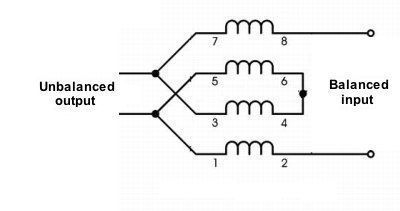
So, I began reading about the other types of baluns. The one that seemed most promising is the Guanella current balun. Unlike the Ruthroff, the input and output are on opposite sides of the core, making it easier to package in a PVC pipe. Sevick also claims that the response is flatter than the Ruthroff balun as well. One disadvantage is that you need almost twice as much wire, as there are four windings, instead of only two. Here’s the schematic:

4to1guanellabalun.jpg

It took me about a half hour to unwind the first balun and rewind it with two bifilar windings instead of just two. I then connected it up to my antenna analyzer, and found that the response did seem to be flatter, the impedance measurement varying between 58 and 60Ω from 1.8 MHz to 18.1 MHz, then dipping to 56&OMega; at 28.0 MHz.

Although I wound my balun on a 2.4-in. core, the Sevick book shows a design wound on a 1.25-in. core. This core should be substantially cheaper than the 2.4-in. core, and the design uses 20-ga. hookup wire, which is certainly easier to get than magnet wire. Sevick notes:

They are conservatively rated at 150W of continuous power and 300W of peak power. They have been exposed to 500W of continuous power (in a matched condition) for a considerable length of time with virtually no rise in temperature.

That’s plenty good for most ham radio applications.

Assuming that these baluns actually play nice with some real RF, I was thinking about possibly even building a bunch and selling them. RadioWorks charges $60 for a 1.5 kW 4:1 current balun. I should be able to sell a lower-power version for half that or less. And not only would it be cheaper, but it’s smaller and lighter, too. Why pay for something you’ll never need?

Links
Here are a couple of links that look useful:

  • Step-By-Step Construction of a 4:1 Current-Type (Guanella) Balun
  • Low Power Balun Manual. This is a design by Charles Greene, W1CG.

Filed Under: Antennas, Building/Homebrew

More Fun With Baluns

January 17, 2007 By Dan KB6NU 1 Comment

I’ve written about building baluns before. I’m still quite proud of myself that I was able to build and deploy a couple of nice 1:1 baluns.

Of course, the next challenge is the 4:1 balun. I even bought a couple of AB240-125 kits to build one. Since my 40m dipole came down in the ice storm we had here over the weekend, I couldn’t really get on the air, so I decided to try it tonight.

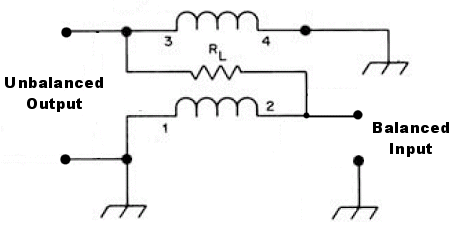
The book Building and Using Baluns and Ununs by Jerry Sevick, W2FMI, has a whole chapter on building 4:1 baluns. After reading through it, I decided to build the Ruthroff design. Here’s the schematic:

4to1balunschematic.gif

The book shows several different designs, but the one that caught my eye was the low-power version on page 24. What I liked about it was that it was built with hookup wire instead of magnet wire. Using some cheap hookup wire, I could play around without possibly ruining the magnet wire.

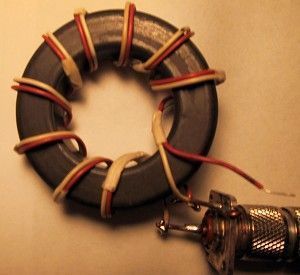
One problem with using hookup wire is that it’s not as ductile as the magnet wire. This means it has a tendency to want to unravel. I did finally manage to get ten turns around the core, though. Here’s what it looks like:

4to1balun011707.jpg

Next, I clipped a 220-ohm resistor across the input and connected the output to my antenna analyzer. Here’s what I measured:

MHZ Z
1.9 57
3.7 58
7.1 59
10.1 58
14.2 56
21.2 53
28.2 53

Amazingly, the thing actually seems to work! Not only that, it’s relatively flat over the HF frequency range. The next step is to package it into a nice enclosure, then put it to work.

I think my next antenna project is going to be the Cobra Antenna. They use a 4:1 balun to get the impedance of the antenna into a range tuneable by a common antenna tuner. K1JEK sells the antenna for $90-100, but you can build the thing for about a quarter of the price. More on that this weekend.

Filed Under: Antennas, Building/Homebrew

This Weekend on the Radio at KB6NU

January 15, 2007 By Dan KB6NU Leave a Comment

I wasn’t all that active this weekend, and in the next week or so, I’ll be even less active, on the air anyway. Let me explain…

Contests and More Contests
Last weekend was the CW portion of the North American QSO Party. I had several things to do on Saturday, including helping to get our latest Tech class underway, so I didn’t get to operate very much. I did, however, manage to make 34 contacts in about an hour.

To be honest, though, there are so many contests that I’m kind of burning out on them. I suppose it would help if I had a more competitive station, but I don’t have the time, or the motivation, to do a whole lot more.

Ice and Ham Radio Don’t Mix
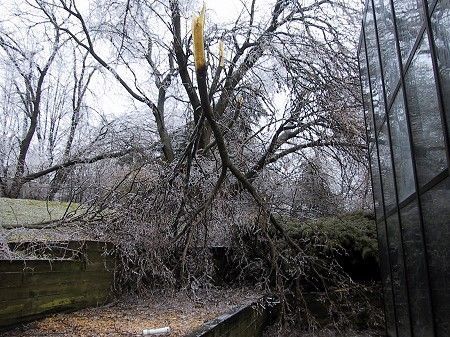
While some of us do enjoy ice in an adult beverage from time to time, in general, ice and ham radio don’t go together very well. Let me show you what I mean:

AntennaDown2007

Sunday evening, we had an ice storm here that coated everything with about a half inch of ice. The trees in my yard lost several branches. This one fell on my 40m/30m dipole, bringing it down. You can see the balun/center insulator in the foreground.

So, I’m off the air for a while. I probably won’t be able to fix it and hoist it back up in the air until this weekend. I guess I’ll use the time to work on some of the construction projects that I have waiting for me on the bench.

Filed Under: Antennas, Contests

Want to Know More About Antennas? Join a Yahoo Group.

December 5, 2006 By Dan KB6NU 1 Comment

A recent post to the HamRadioHelpGroup mailing list noted that the author was forming another Yahoo Group to discuss antennas. This prompted me to search for Yahoo Groups that already discuss antennas, and in particular, amateur radio antennas. Here are some of the more active groups that I found doing a quick search:

  • SkyWires. Formed to discuss horizontal loop antennas, this list welcomes discussion of all types of antennas. 828 members.
  • Live-Wire. This list is for “amateurs who enjoy experimenting with creative simple antennas using “Yankee ingenuity.” 1,157 members.
  • Buddipole. This group is for owners and prospective owners of the Buddipole – both the commercial and homebrew versions. 2,774 members.
  • Tower-pro. This list is for those whose profession or interests center around erecting, installing, or maintaining antennas on communications towers. 2,447 members.

I’d bet there are more. If you belong to any good ones, please add a comment.

Filed Under: Antennas

Yet More Links

October 23, 2006 By Dan KB6NU Leave a Comment

Here are more websites that I’ve come across that could be of interest to amateur radio operators:

  • MIT Open Courseware. Want to get an MIT education without moving to Cambridge or paying high tuition? Take courses online! Of course you won’t get an MIT degree, but I bet you learn a lot. One place you might start is 6.071 Introduction to Electronics.
  • W5LET’s Bare-Essentials Transmitter. 1968 was a simpler time. That’s the year this one-tube transmitter project was published in Electronics Illustrated. It’s articles like these that got me interested in ham radio. Find a 50C5 and build this rig.
  • W5GI’s Mystery Antenna. I found this antenna while looking for a design for an 80m antenna that would fit on my lot. I haven’t built this antenna yet, but it’s on my list of things to do.
  • Amateur Radio Special Events. I like working special events stations, both operating them and contacting them. Here’s a website devoted entirely to special event stations. For example, it lists the following taking place in November:
    • XE2BC – Nov 10 – XE2BC , founded in 1946, will celebrate the founding date on November 10th 2006
    • K6PV – Nov 12 -15 – mini IOTA DXpedition to Santa Catalina Island (NA-066) California
    • ARMAD – Nov 13 – Amateur Radio Golden Corral Military Appreciation Day
    • W6OI – Nov 25- 26 – 10 -10 International Club Station Special Event
  • Ridge Equipment Company. This company sells both new and used test equipment, including dummy loads and attenuators. The prices for the used gear looks pretty good.

Filed Under: Antennas, Building/Homebrew, Classes/Testing/Licensing, Gear/Gadgets, Operating Tagged With: antennas, building/homebrewing, classes, Operating

A Beam by Any Other Name…

October 4, 2006 By Dan KB6NU Leave a Comment

Monday evening, I went to a talk on antenna modelling by Chris, KA8WFC, the former president of the University of Michigan Amateur Radio Club. One of the antennas he modelled was an 18-element, 440 MHz beam that the club plans to mount on its soon-to-be-erected tower.

As an aside, Chris mentioned that although with generally call such an antenna a Yagi antenna, it should perhaps be called a Uda antenna instead. The story goes that while Hidetsugu Yagi is often credited with inventing this antenna, it was really Shintaro Uda who did most of the work. Yagi gets the credit because he is the one who published the first paper in English (in 1928) on this antenna. Researchers now realize this, and in academic circles anyway, the antenna is referred to as the “Yagi-Uda” antenna.

Don’t despair for Uda. Although Yagi got most of the recognition in the English-speaking world, he was always quick to point out Uda’s contribution. For more information on this, see the Wikipedia entry on the Yagi-Uda antenna.

Filed Under: Antennas

How to Pluck a Transmission Line

September 10, 2006 By Dan KB6NU Leave a Comment

Last year, we started devoting one of our monthly meetings to building something. Last year, we built a small keyer kit, and it was an unqualified success. All 20 people who built the kit got it working. This particular kit was a good choice because it offered something for both beginners and old timers (old farts?). It was simple enough for beginners to build, and yielded something that an old time might use.

This year, we’re doing something a bit different. We’re actually doing two kits – one for beginners and one for the more advanced. The reason we’re doing this is that I became enamored with a project in the March/April 2006 QEX, the Pizzicato Pulse Generator.

The Pizzicato generates very low duty cycle waveforms that, as the article points out:

electrically “plucks” a transmission line; by observing the line’s reaction
on an oscilloscope, you can check the line’s length, terminations, and possible defects.

Now you see why this is a project for more advanced users. Although the circuit isn’t a big deal—it consists of an IC, a voltage regulator, and a handful of resistors and capacitors—one needs an oscilloscope to actually use it.

Bruce, KD8APB, and I (mostly KD8APB) have taken the circuit and modified it so that it could be easily built as a kit. For example, instead of using perf board to build the circuit, Bruce laid out a printed circuit board. Instead of a panel-mount rotary switch, we used a PC-mount DIP switch. The cost for the kits will be $15.

I have already built a couple of them, and they go together in less than an hour. We have the parts for 100 units and plan to offer them for sale, in the same way that QRP clubs offer their kits to the general public.

Filed Under: Antennas, Building/Homebrew, Gear/Gadgets

“No Ham Left Behind” Feedback – Restrictive Homeowner’s Agreements

August 23, 2006 By Dan KB6NU 1 Comment

QST finally published my op-ed piece “No Ham Left Behind” in the September issue. I’ve already gotten several e-mail comments. A couple of them have mentioned restrictive homeowner’s agreements as a factor in ham inactivity. While I don’t mean to minimize the problem of restrictive covenants, there are ways to get around them.

First and foremost, don’t move into such a development! I had one guy e-mail me saying, “I know I chose to move here, but….” Well, you can’t have your cake and eat it, too. I do realize that this could be a big impediment for youngsters who don’t have the option of moving, but adults have no excuse.

Second, there are a variety of stealth antennas that amateurs can build and use effectively. We had a great presentation at our club from a member who’d moved into a condo and experimented with a variety of antennas that he could put in his attic. He’s now happily working 80-10 with the results of his experiments.

Third, clubs should work to establish club stations. These could be located at a local community college, community recreation center, Red Cross chapter, or Salvation Army facility. Certainly, in the case of the Red Cross or Salvation Army it’s a win-win situation. The club gets a club station that can be used by the members and the agency gets amateur radio capabilities. Our club right now is working with the local Red Cross to set up an amateur radio station in their new facility.

I’m sure there are other innovative ways to get around this problem. If you know of one, please let me know.

Filed Under: Antennas, Clubs, The Service

  • « Go to Previous Page
  • Page 1
  • Interim pages omitted …
  • Page 31
  • Page 32
  • Page 33
  • Page 34
  • Page 35
  • Page 36
  • Go to Next Page »

Primary Sidebar

No Nonsense Technician Class License Study Guide (for tests given between July 2026 and June 2030)

New No Nonsense Technican Class Study Guide now available!

The 2026 version of my Tech Class study guide is now available, and as always, the PDF version is FREE!. The ePub version costs $11.97, and a Kindle version and paperback version will be available on Amazon shortly.

Click here to get all of my "No Nonsense" study guides.

Also available: The CW Geek's Guide to Having Fun with Morse Code

W5SWL.Com
Retevis Ailunce H1 DMR Radio
DXpander: Cobweb antennas, Laser Cutting

You’ve got mail!

Enter your email address below and get an email every time I publish a new post.

Email


I frequently teach classes to help newcomers get their licenses. The next class will take place on Saturday, October 10, 2026 on the University of Michigan campus. Click here for more information.

If you can't make the class, subscribe to the mailing list to be notified of when the next class will be held.

You can always download my free study guide, and if you have any questions about the classes, or amateur radio in general, please feel free to email me directly.

Support KB6NU.Com

Donate $7.30 and get two of these cool stickers. Measuring 4.25-in. W by 2.75-in. H, it's perfect for your car, your shack, or wherever!

Contact me

If you have a question or comment about one of my blog posts, or a question about any of the material in my study guides, or just a question about ham radio in general, you can email me at [email protected].

Blogs You Should Also Read

  • AE5X: A CW-centric blog from Kingswood, Texas
  • K0LWC Blog
  • LA3ZA Ham Radio Blog
  • Little Radios, Big Fun – WB3GCK
  • Mr. Vacuum Tube's Blog
  • Radio Artisan – K3NG
  • The K0NR Weblog
  • VE3WDM's QRP Ham Radio Blog
  • W2LJ’s Blog

Ham Radio Websites

  • Dashtoons – The Hammin' Comedy by Jeff K1NSS

Podcasts

  • ICQ Podcast
  • Linux in the Ham Schack
  • No Nonsense Amateur Radio Podcast
  • Resonant Frequency Amateur Radio Podcast

Recent Comments

  • Dan KB6NU on 2015 General Class study guide: Section G2E – Digital operating: procedures, procedural signals, and common abbreviations
  • Jimi on 2015 General Class study guide: Section G2E – Digital operating: procedures, procedural signals, and common abbreviations
  • Ali on Some Good Advice on Learning Morse Code
  • mike on Instant Character Recognition is the key to CW speed
  • Matt W1CDN on A completely different picture of Wayne Green, W2NSD (SK)

Meta

  • Log in
  • Entries feed
  • Comments feed
  • WordPress.org

Footer

Copyright © 2026 Daniel M. Romanchik, KB6NU · Log in