• Skip to primary navigation
  • Skip to main content
  • Skip to primary sidebar
  • Skip to footer

KB6NU's Ham Radio Blog

KB6NU's Ham Radio Blog
  • HOME
  • Study Guides
  • Teach a One-Day Tech Class
  • W8SRC Repeater Guide
  • Advertise
  • Hire Me

People

Operating Notes: CQWW, FT-991A quirk, CW YLs

October 23, 2018 By Dan KB6NU Leave a Comment

The CW CQ Worldwide DX Contest takes place this weekend, but you don’t have to jump into fray to take advantage of the contest. Many of the guys working the DX stations are already in place and testing out their stations. I’ve worked a couple already, and have heard a couple more. P40T in Aruba, for example, was quite loud here in Michigan on 40m this evening.

So, don’t wait until Saturday. Get on the air now and work some DX.


In another post, I compared the Yaesu FT-991A I’ve been using for the past couple of weeks to my ICOM IC-7300. There are lots of things that I think the IC-7300 does better than the FT-991A, but here’s one that I really don’t like.

When you set the clarifier (RIT on ICOMs), it changes the frequency that the rig sends over the computer interface. So, if I’m tuned to a station on 7028 kHz, and set the clarifier to -20 Hz, the frequency that my N3FJP logging software thinks that I’m tuned to is 7027.98 kHz, and if I don’t reset the clarifier before I log the contact, then frequency recorded will be 7.02798 MHz.

To me, that’s just wrong. I’m tuned to 7028 kHz, not 7027.98 kHz.


YLs on CW are sometimes as rare as, well, hen’s teeth (pun intended). A week ago, though, I managed to work two of them in a row: Amy, KT4E, in Knoxville, TN and Bonnie, WB4FSF, in Sanford, FL. Both are great ops (both are members of the First Class Operators’ Club) and I enjoyed our contacts.


Speaking of making contacts, the bands have had some decent, if not good, propagation lately. Maybe if we keep beating on the ionosphere, it will yield some better conditions.


Filed Under: Contests, Operating, People, Propagation Tagged With: FT-991A, logging, YLs

This email made my blood boil

June 12, 2018 By Dan KB6NU 8 Comments

I got an email a couple of weeks ago asking for my help with an antenna question. This gentleman, who I discovered is 80 years old and a relative newcomer to amateur radio wrote:

I read your post that mentions counterpoises. I live in a retirement community in Florida with small lots.   The one way I can string an end fed wire for 20 meters is to run the wire over the shingled house roof front to back.  My other option is to run the wire over the aluminum car port roof.  Per HOA rules, the wire can only be 12 feet above the house roof at the highest part of the roof. (There would be more distance between the car port roof and the antenna but the antenna would be at the same height AGL.)
My question is:   Would it be better to place the wire over the shingled house roof or the aluminum car port roof? If over the house roof should I lay wires on the roof below the antenna to act as a counterpoise and should these wires be grounded?   Can the counterpoise wires be laid on the roof or should they be raised above the roof?  The antenna wire will be 12Ft above the roof.  How many counterpoise wires and how close to the antenna wire?
Any help you can offer will be appreciated.
We swapped a few emails about his situation, and I began to wonder why he wanted to put up an end-fed, when he actually had enough space for a 20m dipole, and if he drooped the ends a little, space for a 40m dipole. I also suggested that he might want to consider a 43-ft. non-resonant vertical or a trap vertical like a Hygain 14AVQ.  I gave him my phone number, and we spent an hour on the phone discussing what might be the best antenna for his particular location.
What really made my blood boil, though is this offhand comment that he made in one of his emails:
I hate to bother you.   The two local clubs explained to me that in the past they spent time and effort helping newbies then the newbies dropped out so they no longer help newbies.
I was spitting nickels after I read that. That really has to be the dumbest thing that I’ve ever read. He went on to say that he’d joined their clubs and had gone to some club events, but even so, was unable to get any help from the jerks in those clubs.
Needless to say, my new friend was incredibly disappointed at the lack of help he’d gotten from those jerks down in Florida. He’d always heard that hams helped other hams, and was really heartbroken when he’d gotten the cold shoulder.
Seriously, why would someone refuse to help this guy? My guess is that most of the hams in those clubs are retired, so I rather doubt that time is the problem. My only other guess is that those hams are not all that smart when it comes to antennas, and they felt uncomfortable trying to give advice when they didn’t really understand the situation. Of course, I suppose that it could be that they’re just jerks.
For the sake of argument, though, let’s say that they were hesitant to offer advice because they don’t know all that much about antennas themselves. I can see where someone might offer the weak excuse they did in order to not reveal their lack of knowledge. But, come on. If you don’t know something, own up to it. You’ll earn a lot more respect by saying that you don’t know rather than offering up a lame excuse.
And, even if you don’t know the answer to a question, that doesn’t mean that you are unable to help. I’m certainly no antenna guru, but by taking the time to ask some pertinent questions, I was able to get a better picture of what the guy was up against, and with that information, offer some halfway decent advice.
I haven’t heard back from my new-found friend on how he’s doing antenna-wise, but I was glad to be able to help him. Elmering is good for the soul. You don’t have to be SuperHam to be an Elmer, just a willingness to help. And, who knows? You may even learn something yourself in the process.

Filed Under: Antennas, People Tagged With: Elmering

Ruth, KM4LAO, featured on NPR show

May 3, 2018 By Dan KB6NU Leave a Comment

Ruth, KM4LAO, is getting a lot of publicity these days—and for good reason. She’s a college student at Kettering University who’s trying to revive the amateur radio club there. As part of that, I taught a one-day Tech class at Kettering last Saturday.

Yesterday, she was interviewed by Cynthia Canty, host of the NPR radio show, Stateside. The eight-minute segment covers how and why she got started in amateur radio and how she’s trying to get other students interested in our hobby. It was a pleasure helping her get the Kettering University club up and running again.

Filed Under: People

Keep in touch with the hams in your life and help prevent isolation

December 25, 2017 By Dan KB6NU 2 Comments

A couple of weeks ago, one of the “lions” of our amateur radio club, Clay, W8JNZ, became a silent key. I won’t go into his long list of accomplishments; you can read his obituary for that. What I will say is that he did a lot for our club, and its members, and for amateur radio.

For the last couple of years, he had stopped coming to our club meetings. I think that this was mostly because he stopped driving, but I never asked. Then, I heard that he’d moved to be with his family in VA. We weren’t bosom buddies, but we were friends, and it saddened me when he disappeared.

Fortunately, Clay had family to be with. That’s not always the case, though. The AARP reports that more than 8 million adults age 50 and older are affected by isolation. They define isolation as “feeling detached physically or psychologically, or being disconnected from support groups of family, friends and community.”

The AARP considers this to be such a big problem, they have started a program called Connect2Affect to make people aware of isolation in general and their own isolation in particular. The Connect2Affect website includes resources for learning more about isolation, evaluating how isolated you might be, how to connect with others if you’re feeling isolated, and how to help others be less isolated.

It’s easy to lose touch with people. We all live busy lives these days, and when someone drops off our radar, it’s easy to forget them. But let’s not let that happen to our ham radio brothers and sisters. Here’s a few things that I’d suggest:

  1. Make a list of club members that may not have been to a club meeting or activity recently or who have not checked in to the club’s 2m net.
  2. Reach out to them and ask them if there’s any particular reason that they haven’t been to a club meeting.
  3. Find some way to get them involved again.
    1. Make sure that they know when the next club meeting is scheduled and offer to drive them if they need a ride.
    2. Invite him or her over to your shack to see your latest rig or homebrew project.
    3. Invite him or her out to lunch sometime to talk about ham radio.

Ham radio is supposed to be all about communication. Let’s keep the lines of communications open with the ham radio operators in our lives and prevent them from becoming isolated.

Filed Under: People Tagged With: AARP, Connect2Affect, w8jnz

Amateur radio in the news: Hams help police nab criminals, elementary school club boasts 30 members

December 13, 2017 By Dan KB6NU Leave a Comment

I thought this was an odd story. There was a story not long ago about how the Indian military used hams to help them track rebels….Dan

Ham radio bounces back in new role to track criminals’ location. PUNE: A ham radio club that will help the Pune police spot the location of criminals has been established by Muktangan Science Exploratory Centre on Saturday. Deputy Inspector General of Police (wireless) Abdur Rahman, who inaugurated the club, said the wireless department is taking help from the ham radio clubs in Pune to resolve communication problems and now a mobile locator will help zero in on criminals.


Antietam Elementary School reaches for the stars. Ham-tietam, the school’s ham radio club, currently has 30 students. The Woodbridge Wireless Amateur Radio Club helped establish the club and continues to mentor the students. Ham-tietam has tripled in participation since its inception three years ago. When asked why ham radio is popular with students, Marcia Wieduwilt, principal of Antietam, shared, “It gives students the opportunity to see the world beyond their own community. “ With help from staff, administrators, and the Woodbridge Wireless Amateur Radio Club, Antietam ES students are given real-world application to academic subject matter. The sky’s the limit for Antietam Elementary School.


‘His one true love’: Vietnam veteran’s last wish to broadcast on ham radio fulfilled. For Vietnam veteran John Nugent, who served in the U.S. Army Signal Corps, coming home to Newburgh, N.Y., meant some isolation, according to his son Chris, but his love of ham radio allowed him to reach out to other people throughout the world. “It was tough for him. The radio made him feel comfortable, and helped with his transition,” Chris Nugent said.

Filed Under: Emergency Communications / Public Service, Kids, People

Amateur radio in the news: K9IXO, KA3JHB (SK)

November 15, 2017 By Dan KB6NU Leave a Comment

Yesterday’s Google Alert for “amateur radio” brought the sad news of two SKs. I would have liked to have met both of these gentlemen…Dan

Richard Tavender, K9IXO. JACKSONVILLE (IL) – Richard Edward Tavender, 58, of Jacksonville, died Monday (Nov. 13, 2017) at his home…Richard graduated from Jacksonville High School in 1977. He was currently serving as an activity instructor for Elm City Center in Jacksonville. Richard had previously worked at EMI Christian Music and the Jacksonville Country Club. Richard was a longtime member of Trinity Episcopal Church and served on the church vestry. He also represented the church on the Passavant Area Hospital Board of Governors. Richard had been a member of the Jacksonville Jaycees and the Jacksonville Amateur Radio Club. He enjoyed fishing, operating ham radio, and especially loved spending time with his family.

According to his QRZ.Com page, he was inactive until January 2016. He upgraded to Extra in March 2016 and was working on his CW skills.


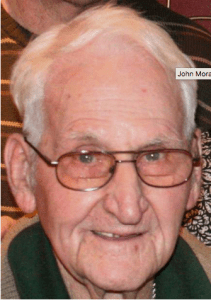
‘Polka John’ of West Newton shared love of music with public. Back in the 1970s and ’80s, viewers of the West Newton cable access channel would have seen John Moran (KA3JHB) once a week as he played polka favorites. The show was called “Polka Janez,” Slovene for Polka John, and featured music from his own collection. John Jacob Moran of West Newton died Monday, Nov. 13, 2017, at his home. He was 97.
…

As a member of the Monessen Amateur Radio Club and the Westmoreland Emergency Amateur Radio Service, he was involved with emergency communications during bad weather and backup communications during the annual air show at Arnold Palmer Regional Airport, his son said. Mr. Moran used his ham radio equipment to talk to people in other parts of the world.

Filed Under: Amateur Radio in the News, People Tagged With: obituaries

Encounters with the dead

November 8, 2017 By Dan KB6NU 7 Comments

Yesterday, I had two somewhat related things happen. This is so weird that I’m not even exactly sure what to call it. I thought writing about it might make some sense, though.

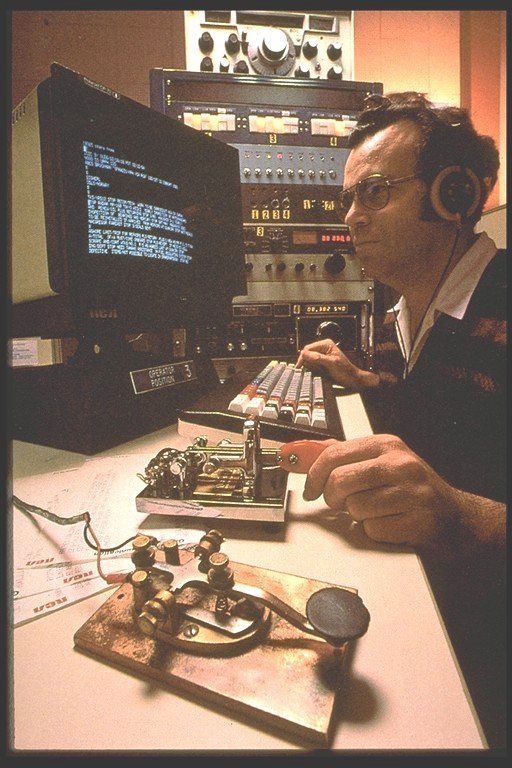
K6GC, sine TR, at the key at KPH.

First of all, in researching the Phillips Code, Google directed me a a web page posted by Warren, K6TG. The page looked like a work in progress, so I sent Warren an email, but it bounced with the error message “Recipient address rejected: User unknown.”

Next, I had some snail mail returned to me that I had sent to Johan, N3RF. I had found Johan last August while paging through an old 73 magazine. In that issue, he ran a classified ad touting his Morse Code course, “Method to learn Morse Code fast and without hangups.” All you had to do was send you if you sent him a dollar and an SASE. I looked him up on QRZ.Com, and found that he was still offering this course. I sent him $2 ($1 adjusted for inflation), but the letter never got to him.

Since I was still interested in finding these gentleman, I sent an email to both the slowspeedwire and CWOps mailing lists. One of the guys on the slowspeedwire list, sent me a  link to an archived copy of the Maritime Radio Historical Society Newsletter #53.

This newsletter not only confirmed that K6GC is a silent key, but it contained a very nice article on Warren. As it turns out, he was very instrumental in keeping KPH, the historic historic ex-RCA coast station on the air.

Finding information on Johan, N3RF has proven to be a little more difficult. His QRZ.Com page has a link to a website for Svanholm Research Labs, a not-for-profit organization that he founded in 1966. On this website, he documents some of the disputes he’s had with state and federal authorities in the early 2000s.

His QRZ.Com page also gives a cell phone number. I tried calling that yesterday, the woman who answered said that it was her daughter’s phone number, and that she’s had that number for six months now. I can only surmise that N3RF is now a silent key as well.

All this has gotten me to thinking about how I’d like my websites to be handled once I become an SK. Should I ask that they be taken down or left online? I’ll be gone, but perhaps some of the content will be useful to someone.  What do you think?

Filed Under: People

Slovak was one of radio’s pioneers

July 5, 2017 By Dan KB6NU Leave a Comment

At some point while teaching my latest one-day Tech class, I happened to mention that I’m Slovak-American. That is to say that my great-grandparents emigrated to the U.S. from the region now known as Slovakia. They came to the U.S. early in the 20th century to work the mines in SE Ohio.

At the lunch break, one of the fellows attending the class came up to me, and with a definite Eastern European accent, introduced himself. Jozef, as it turns out, was born in Slovakia. He was already licensed (KD8SAH), but he was there with his teenage son, who was hoping to get his license. (He did.)

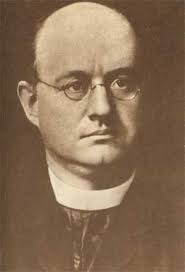
First, Jozef asked if I knew about Ss. Cyril & Methodius Slovak Catholic Church (I did). Then, he asked if I knew about Fr. Jozef Murgas, who, he said, was an inventor in the early days of radio. I had heard the name Murgas, but didn’t really know what he was famous for. Jozef promised to send me some links.

A couple of days later, I received an email from Jozef with a couple of links. Murgas’s story, as it turns out, is quite interesting. His big claim to fame is that he invented (and patented –U.S. Patent 759,826, “Method of Communicating Intelligence by Wireless Telegraphy,” May 10, 1904.), a method for sending multiple tones via spark-gap telegraphy. The theory was that sending multiple tones would be more efficient than conventional telegraphy. One tone would be a dit in conventional telegraphy, while the second tone would be a dah. But, because the second tone needed to last only as long as the dit, more information could be sent in a given time. It was also thought that it would be easier to distinguish between tones of different frequencies than to distinguish between a short tone and a long tone of the same frequency.

He was granted a U.S. patent because, at this point, he was living in the United States. He had emigrated to the U.S. in 1896, and was pastor of the Sacred Heart Slovak Church in Wilkes-Barre, PA. There, he found a couple of investors, and they formed the Universal Aether Telegraph Company. The company built several antenna towers and successfully demonstrated the system, but an unfortunate series of events, including the death of one of the investors, and a storm which destroyed one of the antenna towers, caused the company to fold.

All told, he was granted more than a dozen patents, including one for a unique way to build an antenna – U.S. Patent 860,051, “Constructing Antennas for Wireless Telegraphy,” July 16, 1907. He was also granted a patent for a  fishing rod reel.

Murgas was much more than an inventor. In addition to his work as a priest, he was involved in the Slovak independence movement and collected butterflies. He amassed a collection of more than 9,000 butterflies before he died.

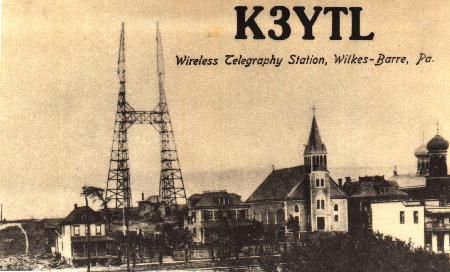
His memory lives on in the guise of the Murgas Amateur Radio Club, of Wilkes-Barre, PA. Their QSL card, shown below, contains a photograph of the towers constructed behind the church to support his radio experiments. (I guess there were no onerous homeowners association agreements back then.) They seem like a very active group.

Before leaving, Jozef invited me to the Slovak festival at Ss. Cyril and Methodius. It takes place on Friday, August 26, from 6 – 11 pm, Saturday, August 26, from 1 pm – 11 pm, and Sunday, August 27, from noon – 9 pm. I’ll also extend that invitation to you. If you go, let me know, and I’ll meet you there. We’ll drink some Slovak beer and eat some klobasa (sausage) and holubky (stuffed cabbage).

Filed Under: History, People Tagged With: Murgas, spark gap

Dayton 2017: Meeting more people, food, and an impulse buy

May 29, 2017 By Dan KB6NU 2 Comments

I got back to the Green County Fairgrounds and Expo Center around 7:30 Saturday morning. I just don’t sleep well in hotels, and I didn’t see any benefit in sitting around the hotel room. Also, I figured that this would give me a chance to check out at least one more food vendor.

Hamvention 2017 food

Let me say this about the food. While some people think that the food was better this year than last, I really didn’t think so. The selection was bigger than at Hara Arena—there were vendors selling pork chop and T-bone steak sandwiches, for example—but I don’t think the quality was any better than at Hara, and in some cases, it was worse. Friday, for example, I had a really bad (and expensive) BBQ sandwich for lunch.

I also feel sorry for the community groups who manned the concessions at Hara. I don’t know how easy it’s going to be for them to replace the funds  they raised at Hara. It’s too bad that they couldn’t have been given the opportunity to serve food at the new venue.

Having said that, I did make a couple of good choices on Saturday. For breakfast, I ordered a breakfast sandwich from RB Foods, which was pretty good. For lunch, I had the cabbage rolls from Jean’s Home Cooking. I really enjoyed this. The cabbage rolls weren’t as good as my grandmother’s holubki (the Slovak word for stuffed cabbage), but it was close.

Another food vendor worth mentioning is Rader’s Ice Cream. They were making it right there on site, using what looked like a one-cylinder John Deer engine to power the ice-cream making machine. I didn’t have any of his ice cream, but it was very popular.

If you ate at any of the other food vendors, or have any other comments about the food, please comment below.

Another turn around the flea market

After eating breakfast, I took another turn around the flea market. It was much muddier than it was Friday morning. I was very careful about where I stepped, though, and luckily my shoes didn’t leak at all.

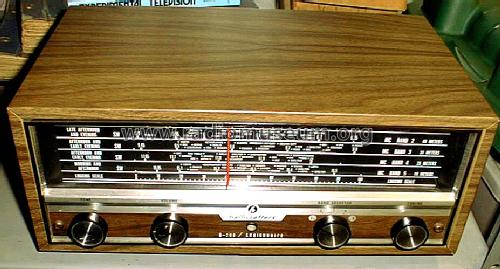
I found a couple of interesting things, although I didn’t buy anything. One radio that tempted me was a Hallicrafters S-200 Legionaire.

I owned one of these as a kid. It covered only the SW broadcast bands. They also made a general coverage version of this receiver, and I’ve seen many of those at hamfests, but this is the first time I’ve seen an S-200 in a long time.

The guy wanted $30 for it, which was probably a reasonable price, but I thought that I’d go back for it later and offer $20, if he still had it. Alas, I never got back to the flea market. It’s just as well, though. I’d probably never use it.

Another guy had a General Radio capacitance bridge. Being the measurement geek that I am, I was drawn to it, of course. It was in great shape, and we had a good time talking about it, as well as other General Radio gear. I didn’t buy it, of course. I would probably never use it, and I just don’t have the room for a big box like that. It was hard to resist, though.

As it turned out, I ended up not making a single flea market purchase, not even a single connector.

Saturday book sales again disappoint

Since Friday had been so disappointing with regard to book sales, I was hoping that Saturday would be a lot better. Unfortunately, while it was a little bit better, it was not even close to what I was hoping for.

I did, however, meet and talk with a lot of great people. I shared a laugh or two with Randy, KB3IFH, who does my QSL cards and my new business cards. He did  some “CW Geek” coasters for me, and I owed him some money.

Entry-level licensing

Cover shot of the 1951 ARRL License Manual. The Novice section is only four pages!

I also spent at least a fascinating 45 minutes with Bruce, K1BG. I’ve worked Bruce many time on 40m CW, and now I come to find out that Bruce is on the ARRL’s entry-level license committee. The committee’s charter is to make recommendations to the ARRL board regarding the entry level license.

This could take any number of different forms. They might recommend changes to the Technician Class license, but they might also recommend the establishment of an additional, but simpler, license with privileges that would give a newcomer a taste of most facets of ham radio from HF to VHF and UHF.

To be honest, I was kind of skeptical about this when I first read about it, but Bruce makes a very compelling case. He notes that the first Novice question pool consisted of only 28 questions, if you go by the number of questions found in the 1951 edition of The Radio Amateur’s License Manual. The Novice section of this manual is only four pages long, and doesn’t even have a question about Ohm’s Law! Over the years, this number grew, but slowly reaching 51 questions in  1968, when incentive licensing was established.

Bruce says that it’s his opinion that the number of teenagers getting amateur radio licenses declined as the test got more difficult. So, if we want to really attract young people into our hobby, we should have a Novice license, akin to what we had back in the day. By comparison, the current Tech test question pool has more than 430 questions! Food for thought there. I plan to keep on top of this topic and blog more about it after I investigate this some more.

Around 3:00 pm, I joined my friend, Mark, W8MP, in the County Hunter’s Forum. Mark and I have an ongoing debate as to what’s crazier: county hunting or my little side hobby of collecting QSL cards from stations whose callsigns spell words. One of the fellows who spoke at the forum, Bob, N4CD, has worked all counties nine times!

What was really fun about attending this meeting was that I actually got to work two people there whose callsigns spell words: W8TAX and W2RAN. Mark ran around and found two handhelds for us to work one another. What a great guy!

Social media meetup

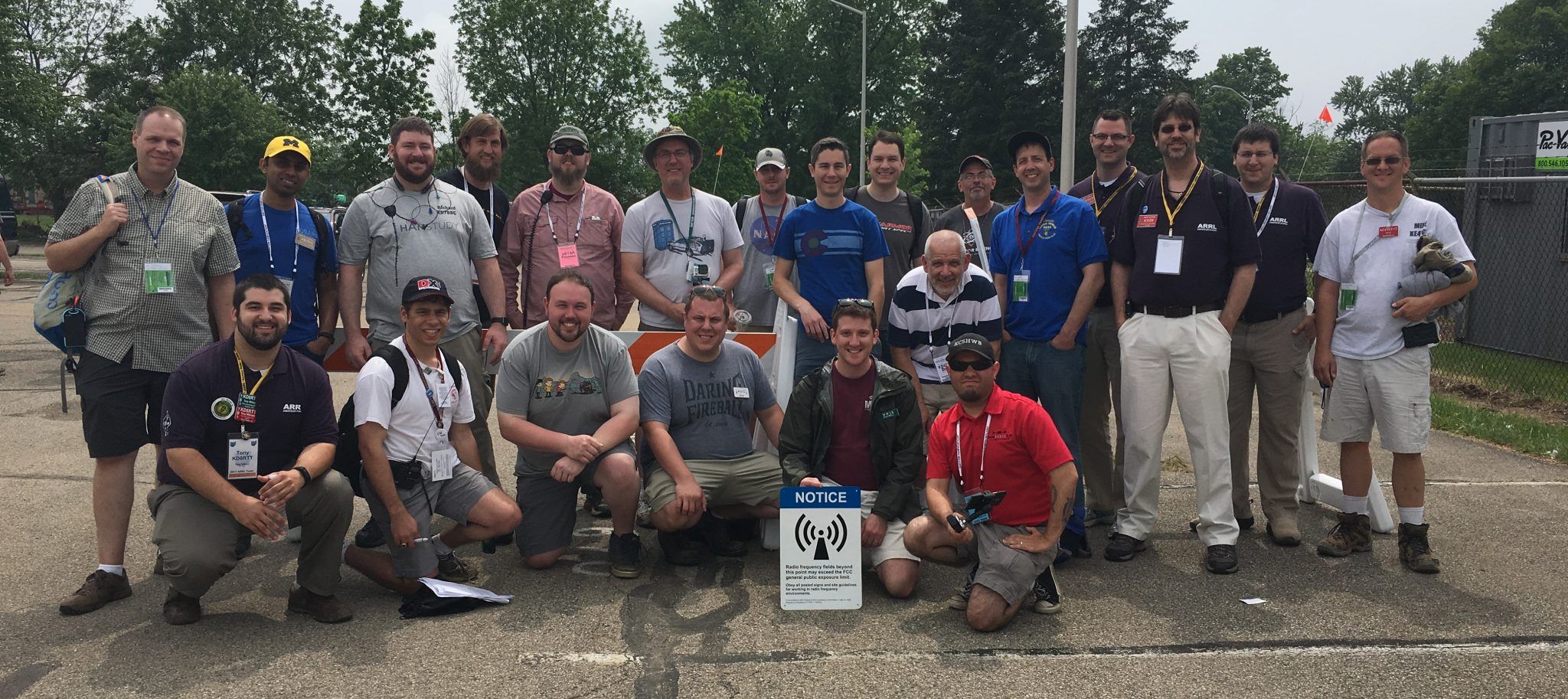
At 3:30 pm, we had the annual social media meetup (see the photo below). By my count, there were 22 of us this year.Who says ham radio operators are all old guys? I’m the oldest one in this photo!

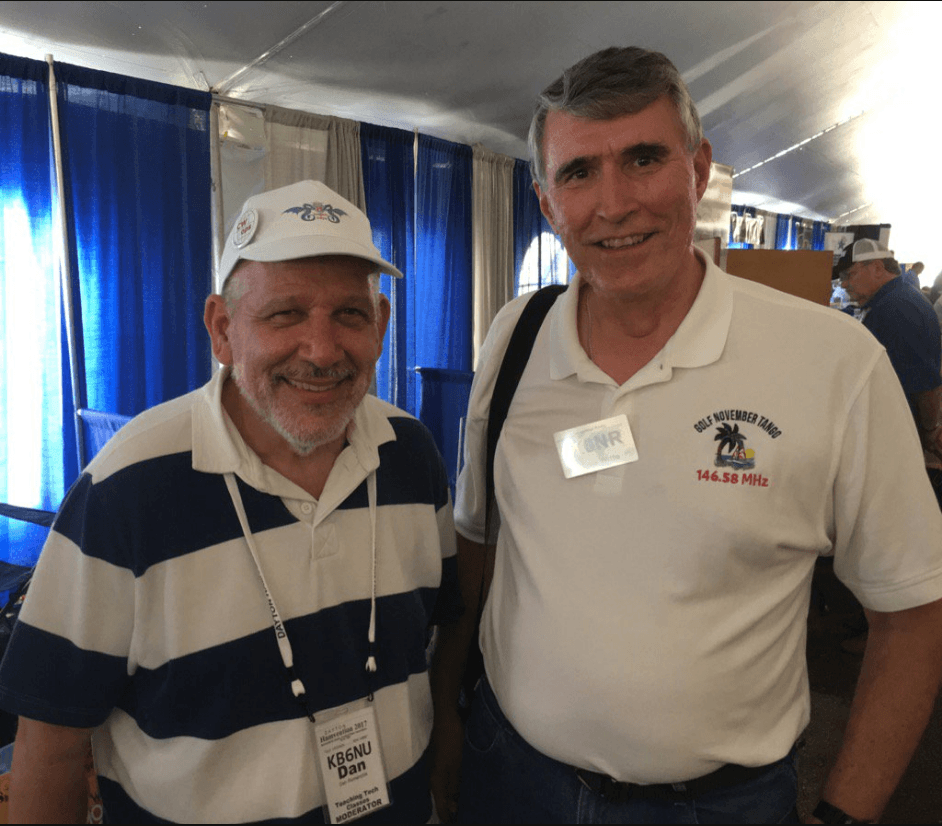
A short time after that, Bob, K0NR, wandered by my booth. I’m glad I got to meet Bob face-to-face. We actually go a long way back, back to the time I wrote for Test&Measurement World magazine. We’ve talked on the phone, and on the Internet, many times, but this is the first time we got to meet in person. Check out his take on Dayton 2017.

That’s Bob on the right and me on the left, sporting my new Begali cap.

A last-minute impulse buy

Earlier in the day, I took a break and wandered quickly around some of the other halls. One of the things that stuck with me was the new RS-HFIQ SDR transceiver by HobbyPCB. I had actually signed up for their Kickstarter back in December, but for some reason cancelled my pledge. I’m not really sure why because if I hadn’t I would have already had one up and running.

At any rate, I mulled over buying the thing until it was just about time to go. By 4 pm, foot traffic by the booth had fallen way off, and by 4:10 pm, I decided to pack up for day. After I got my books all packed up, I hurried over to the HobbyPCB booth, hoping they were still open and that they still had one for me. Fortunately, they did, and I walked away with  an RS-HFIQ and the enclosure kit for the Hamvention price of $270.

It’s not an IC-7300, but with the HardRock 50W amp (which I already own), it’s about half the cost and most of the functionality (aside from the cool LCD screen). More on this in another blog post.

That’s all, folks

Well, that’s about it for my Dayton 2017 experiences. I had a rather uneventful drive home, arriving back in Ann Arbor about 8:30 pm that evening. I’m looking forward to next year, and I’m already thinking about what I can talk about. Perhaps another talk on CW, or perhaps I could organize a panel on licensing issues, including the new entry-level license. What do you think?

Filed Under: Classes/Testing/Licensing, Hamfests, People Tagged With: Dayton, Dayton 2017, K0NR, SDR

Amateur radio in the news: Kids get radios,

April 18, 2017 By Dan KB6NU 3 Comments

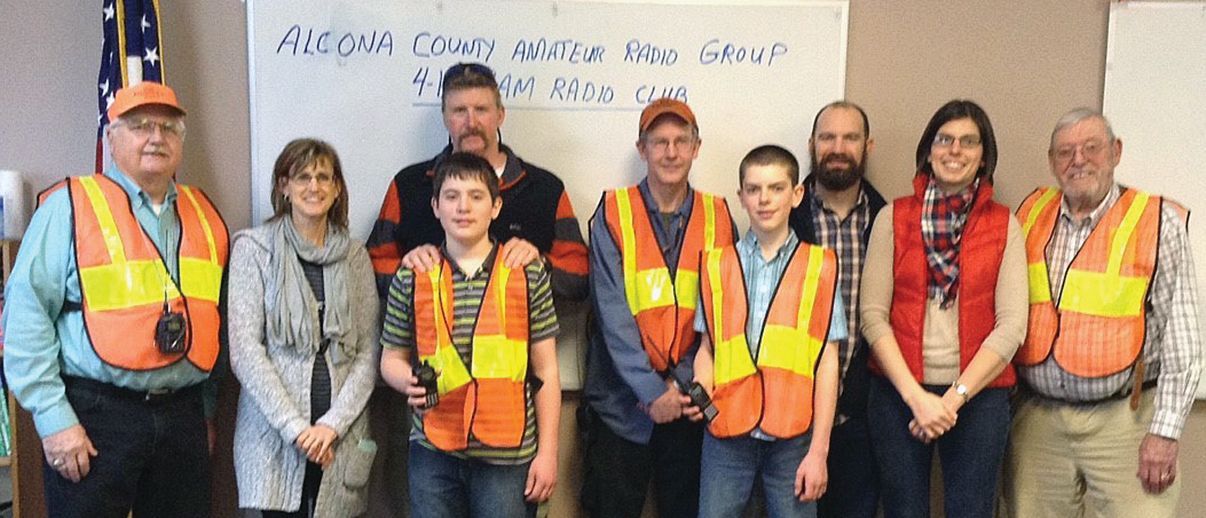
Two youth receive radio equipment. Alcona County Amateur Radio Group and Alcona County 4-H have teamed-up for 14 years to sponsor Amateur Radio FCC license classes for more than 50 youth. Included is a youth equipment program for those who successfully complete the license class. The program provides new radios and is funded primarily by donations and group member “silent key” bequests.

Shown from left are Stan Darmofal, W8SZ, Alcona County emergency coordinator and radio officer; parents Anne and Bob Mills and their son, Robby Mills, KE8GLG; Rick Gull, KD8AQT, instructor; Mark Collins III, KE8GLF, and his parents Mark and Traci Collins II; and Art Laatz, K8AKL, youth program administrator.

Christian vocal legend at Rose Hill Sunday. Larnelle Harris, a legendary voice in Christian music for more than four decades, is coming to Ashland on Sunday night. The singer/songwriter will be part of “Super Sunday” at Rose Hill Missionary Baptist Church.

In amateur radio circles, Larnelle is known as Stu, WD4LZC. I’ve worked him many times, and he’s a great CW operator in addition to being a “vocal legend.”


High-altitude balloons are the average person’s SpaceX. Space travel today is largely ruled by government agencies and billionaire tech magnates. But for the average person, it’s much easier to reach Earth’s outer limits than you might think. All you need is a big weather balloon, some helium, a camera, and a dose of good timing. [And, I might add amateur radio…Dan] High-altitude “ballooning” allows hobbyists, photographers, and students alike to view our planet from as high as 100,000 feet. These balloons can capture the curvature of the Earth and fields of endless clouds from greater heights than drones, and with richer detail than a satellite.

Filed Under: Gear/Gadgets, Kids, People

  • « Go to Previous Page
  • Page 1
  • Page 2
  • Page 3
  • Page 4
  • Page 5
  • Interim pages omitted …
  • Page 10
  • Go to Next Page »

Primary Sidebar

No Nonsense Technician Class License Study Guide (for tests given between July 2026 and June 2030)

New No Nonsense Technican Class Study Guide now available!

The 2026 version of my Tech Class study guide is now available, and as always, the PDF version is FREE!. The ePub version costs $11.97, and a Kindle version and paperback version will be available on Amazon shortly.

Click here to get all of my "No Nonsense" study guides.

Also available: The CW Geek's Guide to Having Fun with Morse Code

W5SWL.Com
Retevis Ailunce H1 DMR Radio
DXpander: Cobweb antennas, Laser Cutting

You’ve got mail!

Enter your email address below and get an email every time I publish a new post.

Email


I frequently teach classes to help newcomers get their licenses. The next class will take place on Saturday, October 10, 2026 on the University of Michigan campus. Click here for more information.

If you can't make the class, subscribe to the mailing list to be notified of when the next class will be held.

You can always download my free study guide, and if you have any questions about the classes, or amateur radio in general, please feel free to email me directly.

Support KB6NU.Com

Donate $7.30 and get two of these cool stickers. Measuring 4.25-in. W by 2.75-in. H, it's perfect for your car, your shack, or wherever!

Contact me

If you have a question or comment about one of my blog posts, or a question about any of the material in my study guides, or just a question about ham radio in general, you can email me at [email protected].

Blogs You Should Also Read

  • AE5X: A CW-centric blog from Kingswood, Texas
  • K0LWC Blog
  • LA3ZA Ham Radio Blog
  • Little Radios, Big Fun – WB3GCK
  • Mr. Vacuum Tube's Blog
  • Radio Artisan – K3NG
  • The K0NR Weblog
  • VE3WDM's QRP Ham Radio Blog
  • W2LJ’s Blog

Ham Radio Websites

  • Dashtoons – The Hammin' Comedy by Jeff K1NSS

Podcasts

  • ICQ Podcast
  • Linux in the Ham Schack
  • No Nonsense Amateur Radio Podcast
  • Resonant Frequency Amateur Radio Podcast

Recent Comments

  • Bulin 47 AI on ICQPodcast Episode 485 – World Cup Special Event Station
  • Jesse Alexander on What do you think of this artwork for the ham radio EMF Explorer
  • CADProps on My first go at 3D printing not quite a success
  • Dan KB6NU on A Media Guide to Amateur Radio
  • Steve Stroh N8GNJ on A Media Guide to Amateur Radio

Meta

  • Log in
  • Entries feed
  • Comments feed
  • WordPress.org

Footer

Copyright © 2026 Daniel M. Romanchik, KB6NU · Log in