
• Skip to primary navigation
  • Skip to main content
  • Skip to primary sidebar
  • Skip to footer

KB6NU's Ham Radio Blog

KB6NU's Ham Radio Blog
  • HOME
  • Study Guides
  • Teach a One-Day Tech Class
  • W8SRC Repeater Guide
  • Advertise
  • Hire Me

American Morse Code Chart

June 24, 2011 By Dan KB6NU 5 Comments

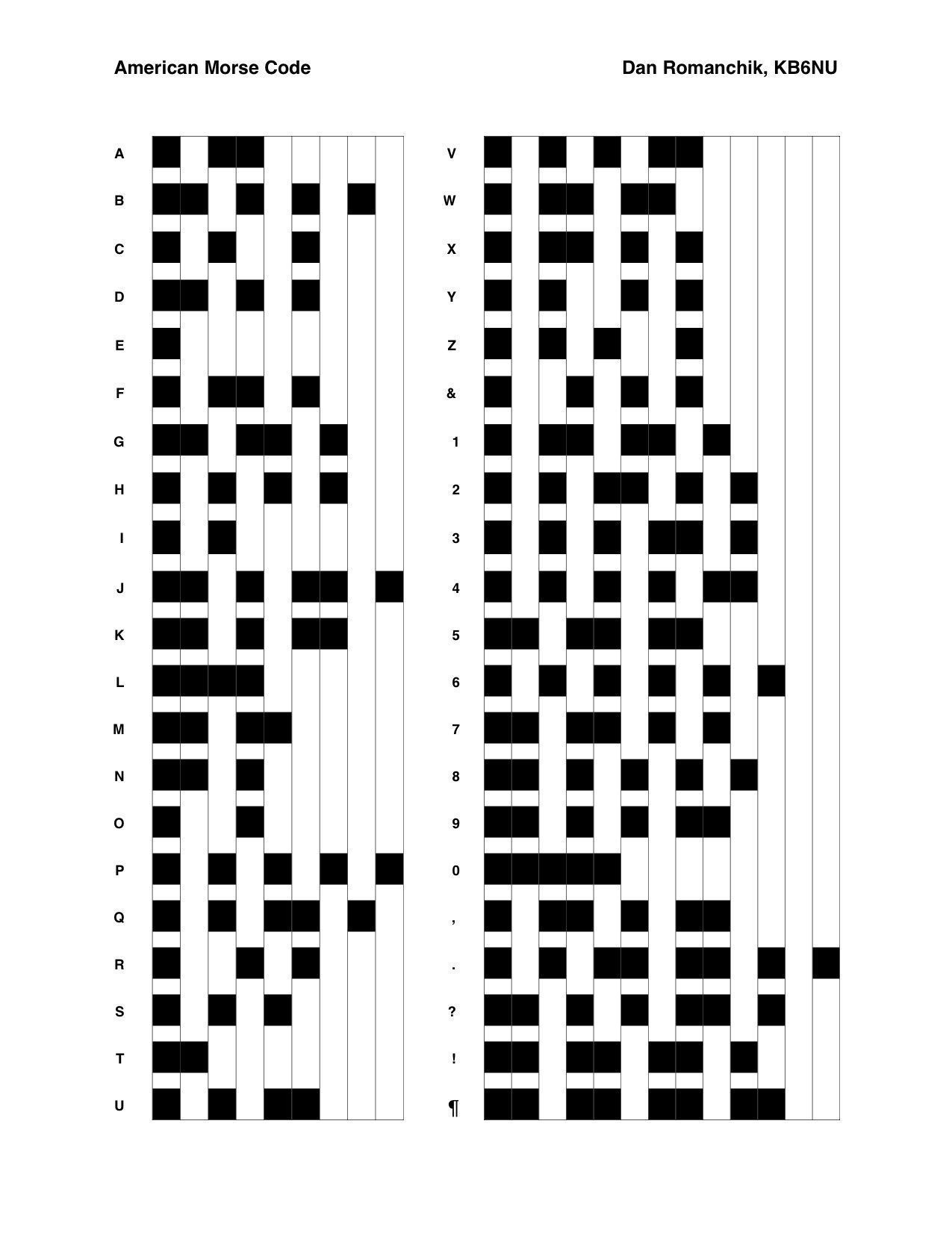
For some strange reason, I’ve decided to learn American Morse. One problem with doing this is that  there seems to be only one chart on the Web that shows the dots and dashes for Amercian Morse. This low-resolution scan is small and hard to read.

Yesterday, I decided to start practicing again, but I couldn’t find the printout I’d made of that chart. Since it was hard to read, I decided to make my own chart instead of just printing another copy of the old one.

At right is my chart. Click on the image and you’ll get the full-sized chart. If you want a PDF version, click here.  If you want to make changes to it, e-mail me, and I’ll send you a Mac Pages or Microsoft Word version of the chart.

Happy Morsing!


Related posts:

  1. From my inbox: Morse Code, WWV, Raspberry Pi
  2. American Morse Lives
  3. American Morse Illegal on the Ham Bands?
  4. More on American Morse on the amateur radio bands

Filed Under: CW

Reader Interactions

Comments

  1. Larry W2LJ says

    June 24, 2011 at 10:25 pm

    Dan,

    I can’t even imagine attempting to learn American Morse without it unraveling all the Continental Morse currently in my brain.

    Good luck with that!

    Larry W2LJ

    Reply
    • Dan KB6NU says

      June 27, 2011 at 10:37 am

      I think I can do this, without my knowledge of International Morse going to pot. I think there are two keys to this:

      1. The sounds are quite different. When I hear tones, I’ll put myself into International Morse mode, and when I hear clicks, I’ll go into American Morse mode.
      2. Practice, practice, practice. It’s like learning code all over again. The practice will not only help me learn the code, but also be able to tell the difference between the two codes.
      Reply
  2. Mike Zydiak W2MJZ says

    June 27, 2011 at 12:49 pm

    Dan:

    Just a bit of clarification please. From your post found above, I suspect that you are utilizing a “telegraph sounder” to receive your American Morse Code (like the type found in some remote railway station office back in the 1800’s), and not audible CW tones such as those we utilize today with standard International Morse.

    It does bring back fifty year old memories when a few of us had buzzers with bell wire strung from back porch to back porch, and we established our very own digital, EMP proof, highly secured, emergency powered, point to point, communications network at the height of the cold war.

    Mike Zydiak W2MJZ

    Reply
  3. Dan KB6NU says

    June 27, 2011 at 4:38 pm

    No, what I’m using is the computer program MorseKOB, which simulates a sounder.

    Using buzzers is more akin to radiotelegraphy than it is to landline telegraphy in that you’re still hearing continuous tones rather than clicks, and it’s the length of the buzz that determines whether an element is a dot or a dash. In landline telegraphy, it’s the length of time between two clicks that determines if an element is a dot or a dash.

    Reply
    • Eric Hagerstrom says

      December 12, 2025 at 4:23 pm

      14 years later. I download the latest MorseKOB software version (4.5) from a link on the morsetelegraphclub.com website and install on my Windows 10 Pc. I search for a printable American Morse Code sheet and yours is the cleanest. From an encounter with club officers years ago manning a table at a Frostfest (hamfest) in Richmond VA: they assured me that learning American Morse won’t mess up your International Morse code proficiency. I joined the club and they helped me select a sounder on eBay (a device from “1903. And a MorseKOB interface device from my sounder/key to my PC via USB. With the software you can still listen to the wire traffic without your own KOB just to hear the clicks and the software decodes it, too, and displays it on the screen.

      Reply

Leave a Reply Cancel reply

Your email address will not be published. Required fields are marked *

This site uses Akismet to reduce spam. Learn how your comment data is processed.

Primary Sidebar

No Nonsense Extra Class License Study Guide: for tests given between July 2024 and June 2028

New No Nonsense Extra Class Study Guide now available!

The 2024 version of my Extra Class study guide is available in PDF, ePub, Kindle, and print versions.

Click here to get all of my "No Nonsense" study guides.

Also available: The CW Geek's Guide to Having Fun with Morse Code

W5SWL.Com
Retevis Ailunce H1 DMR Radio
DXpander: Cobweb antennas, Laser Cutting

You’ve got mail!

Enter your email address below and get an email every time I publish a new post.

Email


I frequently teach classes to help newcomers get their licenses. The next class will take place on Saturday, February 7, 2026 on the University of Michigan campus. Click here for more information.

If you can't make the class, subscribe to the mailing list to be notified of when the next class will be held.

You can always download my free study guide, and if you have any questions about the classes, or amateur radio in general, please feel free to email me directly.

Support KB6NU.Com

Donate $7.30 and get two of these cool stickers. Measuring 4.25-in. W by 2.75-in. H, it's perfect for your car, your shack, or wherever!

Contact me

If you have a question or comment about one of my blog posts, or a question about any of the material in my study guides, or just a question about ham radio in general, you can email me at [email protected].

Blogs You Should Also Read

  • AE5X: A CW-centric blog from Kingswood, Texas
  • K0LWC Blog
  • LA3ZA Ham Radio Blog
  • Little Radios, Big Fun – WB3GCK
  • Mr. Vacuum Tube's Blog
  • Radio Artisan – K3NG
  • The K0NR Weblog
  • VE3WDM's QRP Ham Radio Blog
  • W2LJ’s Blog

Ham Radio Websites

  • Dashtoons – The Hammin' Comedy by Jeff K1NSS

Podcasts

  • ICQ Podcast
  • Linux in the Ham Schack
  • No Nonsense Amateur Radio Podcast
  • Resonant Frequency Amateur Radio Podcast

Recent Comments

  • Ed K8MEJ on Is anyone running for the board this year in the Great Lakes Division?
  • Skip Behnke on 2020 Extra Class study guide: E9F – Transmission lines: characteristics of open and shorted feed lines; coax versus open-wire; velocity factor; electrical length; coaxial cable dielectrics
  • Mike on Map your contest QSOs
  • Phillip Cardwell on J-Poles
  • Dan KB6NU on Dayton Hamvention 2026: Day 1, Wednesday, May 13

Meta

  • Log in
  • Entries feed
  • Comments feed
  • WordPress.org

Footer

Copyright © 2026 Daniel M. Romanchik, KB6NU · Log in