• Skip to primary navigation
  • Skip to main content
  • Skip to primary sidebar
  • Skip to footer

KB6NU's Ham Radio Blog

KB6NU's Ham Radio Blog
  • HOME
  • Study Guides
  • Teach a One-Day Tech Class
  • W8SRC Repeater Guide
  • Advertise
  • Hire Me

DSP

Yaesu FT-710: What’s the big deal?

July 11, 2022 By Dan KB6NU 90 Comments

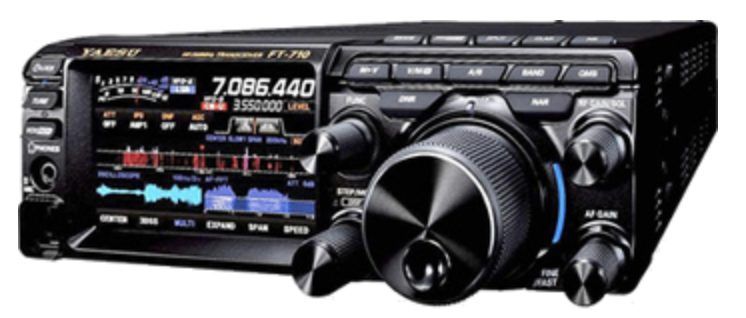
There has been a lot of buzz about the Yaesu FT-710 (above) on Twitter and YouTube over the past week or so. For the life of me, though,  I can’t figure out what the buzz is about. Here are the specs from the Yaesu website:

  • TX Frequency Range: 1.8MHz band – 50MHz band (Amateur bands only). 70MHz – 70.5MHz (UK Amateur bands only)
  • RX Frequency Range: 30KHz – 75MHz (Operating)
    • 1.8MHz – 29.699999MHz (Specified performance, Amateur bands only)
    • 50MHz – 53.999999MHz (Specified performance, Amateur bands only)
    • 70MHz – 70.499999MHz (Specified performance, UK Amateur bands
  • Emission Modes: A1A(CW), A3E(AM), J3E(LSB/USB), F3E(FM)
  • Supply Voltage: DC13.8V ±15%
  • Power Output: 5 – 100W (5 – 25W AM Carrier)
  • Dimensions (W x H x D):    9.4” x 3.1” x 9.7” (239 x 80 x 247mm)
  • Weight (Approx.):  9.92lbs (4.5kg)

OK, so it’s a very small, HF+6m SDR transceiver. According to video hastily produced by John Kruk, N9UPC, the FT-710 is meant to be a desktop base station radio and NOT a competitor of the Icom IC-705.

That being the case, what’s the big deal? What purpose does this radio really serve? If it’s supposed to be a base station, I know that I would prefer to have a Yaesu FTdx-10, which I had the pleasure of  operating on Field Day. The front panel and controls are bigger than the FT-710, and I can’t imagine that the performance of the FT-710 is any better than that of the FTdx-10.

The only reason that I can think of for all the hubbub about the FT-710 is to increase traffic to websites and YouTube channels. And, honestly, that’s the only reason I’m blogging about it. Thanks for reading this, and increasing my readership numbers. <evil grin>

Filed Under: DSP, Gear/Gadgets Tagged With: FT-710, Yaesu

Why aren’t more hams using GNU Radio?

September 21, 2021 By Dan KB6NU 9 Comments

For the past day and a half, I’ve been attending the GNU Radio Conference 2021 in my capacity as Content Manager for ARDC. There’s a lot of stuff that’s flying over my head, but I’m learning a lot as well. One idea that I can’t shake is why more hams aren’t using GNU Radio.

There are a lot of cool things about GNU Radio:

  • It’s open source and free to use.
  • It runs—at least that’s what they tell me—on inexpensive computing platforms, such at the Raspberry Pi 4.
  • There’s a graphical user interface for developing GNU radio applications, which makes programming much easier.

Perhaps one reason is that it’s not that easy to set up and use. Nine months ago, I tried getting started with GNU Radio on a Raspberry Pi 4. My results were a bit disappointing to say the least. I keep threatening to get working on this project again, but I always seem to find an excuse not to do it. I’d guess that other hams are in the same boat.

Another reason perhaps is that while many of us know what digital signal processing (DSP) is, and are aware of the advantages of DSP, making radios with DSP is hard. You do need to know some of the mathematics behind DSP and what techniques to use in particular situations. If you think the math on the Extra Class test is hard, then DSP is going to be a real brain buster.

Perhaps I’m wrong, and there are a bunch of GNU Radio projects out there in the amateur radio world. If so, I’d love to know about them.

Let’s just say for the moment that I’m right. What do we need to make GNU Radio more popular and used in the amateur radio world? The first thing I think we need is more basic DSP training. Again, if there are course out there—perhaps on Coursera or some similar learning platform—please let me know.

Second, I’d say we need a “GNU Radio for Dummies.” This book/online course/set of videos would not only introduce hams to GNU Radio, but use as an example some simple radio, say a 70 cm FM transceiver.

The hardware for this training course could possibly be the ADALM-PLUTO. This devices has a frequency range of 325 MHz to 3.8 GHz, and Analog Devices says, “[The ADALM-PLUTO] helps introduce electrical engineering students to the fundamentals of software-defined radio (SDR), radio frequency (RF), and wireless communications. Designed for students at all levels and from all backgrounds, the module can be used for both instructor-led and self-directed learning to help students develop a foundation in real-world RF and communications that they can build on as they pursue science, technology, or engineering degrees.” What’s more GNU Radio has very good support for the ADALM-PLUTO.

Software-defined radio is the future of radio…including amateur radio. It behooves us to learn about this technology, if only to be able to use it more effectively. I’d also say that we should learn about it so that we can fulfill out purpose of “advancing the state of the radio art.” GNU Radio could be a big part of that.


Filed Under: Building/Homebrew, DSP

In QST 100, 50, and 25 year ago: the mysteries of radio, quad vs. Yagi, DSP: an intuitive approach

February 10, 2021 By Dan KB6NU 1 Comment

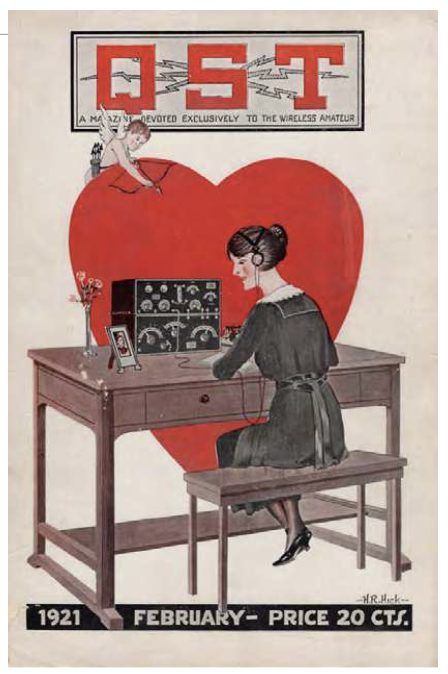
Some interesting articles have appeared in the February issues of QST. Here are three from the 1921, 1971, and 1996 issues…..Dan


Some Whys, and Speculation as to Some Possible Wherefores by M.B. West.

Some interesting speculation about how to improve the transmitters of the day. Remember, this was 100 years ago.


Quad vs Triband Yagi by Col. John Parrott, Jr., W4FRU.

Clarence Moore, the inventor of the cubical quad, probably little realized when he and his associates were huddled of the reference books back in 1942 that the product of their efforts would receive such widespread acclaim and damnation as has been poured out upon the cubical quad antenna.

The conclusion of the article, though, is:

One can expect to achieve the same or better results with a two-element quad of proper dimensions that with a three- or four-element triband Yagi.

A wide-space quad will perform substantially better that a close-spaced quad.

Dollar-for-dollar, the quad appears to be a better investment than a Yagi.

The question then, is, why are there still more Yagis than quads?


DSP—An Intuitive Approach by David Hershberger, W9GR

Digital signal processing (DSP) is, of course, all the rage now. Back in 1996, though, the technology was really just getting off the ground. Prices for DSP chis had dropped from around $200 to “$5 to $20” ($8.50 to $34.00 in 2021 dollars). W9GR writes, “This makes them ideal for low-cost amateur applications. Thanks to low-cost DSP chips, digital approaches….are now more than competitive with analog methods.” What follows is a nice explanation of basic DSP techniques, without a lot of math. Intuitive indeed.

Filed Under: Antennas, DSP, Transmitters

2020 Extra Class study guide: E4E – Noise suppression and interference: system noise; electrical appliance noise; line noise; locating noise sources; DSP noise reduction; noise blankers; grounding for signals; common mode currents

March 25, 2020 By Dan KB6NU Leave a Comment

Noise is often a real problem for radio amateurs. Fortunately, by understanding how noise is generated and how to reduce or eliminate it, noise can be tamed.


Atmospheric noise is naturally-occurring noise that appears across a wide bandwidth. To help you copy signals when there’s a lot of atmospheric noise, or any wide bandwidth noise, you can often use a receiver’s noise blanker. One undesirable effect that can occur when using a receiver’s IF noise blanker is that nearby signals may appear to be excessively wide even if they meet emission standards.

QUESTION: Which of the following signals might a receiver noise blanker be able to remove from desired signals? (E4E03)
ANSWER: Signals that appear across a wide bandwidth

QUESTION: What undesirable effect can occur when using an IF noise blanker? (E4E09)
ANSWER: Nearby signals may appear to be excessively wide even if they meet emission standards

Many modern receivers now use digital signal processing (DSP) filters to eliminate noise. The types of receiver noise that can often be reduced with a DSP noise filter, include broadband white noise, ignition noise, and power line noise.

QUESTION: Which of the following types of noise can often be reduced with a digital signal processing noise filter? (E4E02)
ANSWER: All these choices are correct

    • Broadband white noise
    • Ignition noise
    • Power line noise

Some receivers with DSP filter have an automatic notch filter, or ANF. An automatic notch filter recognizes interfering signals in the passband and attempts to set the notch to filter out that signal. When receiving CW signals, however, the filter may remove the CW signal as well as the interfering carrier.

QUESTION: What problem can occur when using an automatic notch filter (ANF) to remove interfering carriers while receiving CW signals? (E4E01)
ANSWER: Removal of the CW signal as well as the interfering carrier

While filters can be very effective at reducing noise, it is often better to figure out what is generating the noise and take steps to reduce or eliminate the amount of noise generated in the first place. Loud roaring or buzzing AC line interference that comes and goes at intervals could be caused by arcing contacts in a thermostatically controlled device, a defective doorbell or doorbell transformer inside a nearby residence, or a malfunctioning illuminated advertising display. To determine if the AC line noise interference is being generated within your home turn off the AC power line main circuit breaker and listening on a battery operated radio to see if the noise goes away. If by doing this you determine that an electric motor is a problem, noise from an electric motor can be suppressed by installing a bypass capacitor across the motor leads.

QUESTION: What might be the cause of a loud roaring or buzzing AC line interference that comes and goes at intervals? (E4E10)
ANSWER: All these choices are correct

    • Arcing contacts in a thermostatically controlled device
    • A defective doorbell or doorbell transformer inside a nearby residence
    • A malfunctioning illuminated advertising display

QUESTION: How can radio frequency interference from an AC motor be suppressed? (E4E05)
ANSWER: By installing a bypass capacitor in series with the motor leads

Sometimes your own equipment may be the cause of received noise. Cables in an amateur radio station, for example, can radiate or pick up interference. Common mode currents are the culprits. Common mode current is current that flows equally on all conductors of an unshielded multi-conductor cable. Common mode current on the shield and conductors can can also cause shielded cables to radiate or receive interference. To eliminate this interference, make sure to ground the shield at one end of the cable.

QUESTION: Which of the following can cause shielded cables to radiate or receive interference? (E4E07)
ANSWER: Common-mode currents on the shield and conductors

QUESTION: What current flows equally on all conductors of an unshielded multi-conductor cable? (E4E08)
ANSWER: Common-mode current

The main source of noise in an automobile is the alternator. Conducted and radiated noise caused by an automobile alternator can be suppressed by connecting the radio’s power leads directly to the battery and by installing coaxial capacitors in line with the alternator leads. The capacitors help filter out the noise, and short, direct leads to the battery help prevent noise pickup.

QUESTION: How can conducted and radiated noise caused by an automobile alternator be suppressed? (E4E04)
ANSWER: By connecting the radio’s power leads directly to the battery and by installing coaxial capacitors in line with the alternator leads

Personal computers and other digital devices can also generate noise. One type of electrical interference that might be caused by the operation of a nearby personal computer is the appearance of unstable modulated or unmodulated signals at specific frequencies.

QUESTION: What is one type of electrical interference that might be caused by a nearby personal computer? (E4E06)
ANSWER: The appearance of unstable modulated or unmodulated signals at specific frequencies

Noise can even be generated by the most unlikely things. For example, if you are hearing local AM broadcast band signals on one or more of the MF or HF ham bands it’s possible that nearby corroded metal joints are mixing and re-radiating the broadcast signals.

QUESTION: What could cause local AM broadcast band signals to combine to generate spurious signals in the MF or HF bands? (E4E11)
ANSWER: Nearby corroded metal joints are mixing and re-radiating the broadcast signals

Filed Under: DSP Tagged With: grounding, noise blanker

Will digital voice (on HF) ever be a thing?

May 30, 2018 By Dan KB6NU 12 Comments

A couple of days ago, Bruce, K6BP, tweeted:
FreeDV radio digital voice 1.3 released as source, no packages yet. 700D mode reported to consistently outperform SSB, is loud and clear while SSB is inaudible, error-free transatlantic communication reported.
For those not familiar with FreeDV, here’s what the website has to say:

FreeDV is a Digital Voice mode for HF radio. You can run FreeDV using a free GUI application for Windows, Linux and OSX that allows any SSB radio to be used for low bit rate digital voice.  There are several reports of the new FreeDV 700D mode outperforming SSB at low SNRs.   At high SNRs FreeDV 1600 sounds like FM, with no annoying analog HF radio noise.

Alternatively you can buy a SM1000 FreeDV adaptor that allows you to run FreeDV (1600 mode) on any HF radio without a PC or sound card.  If you are a hardware or software developer, you can integrate FreeDV into your project using the LGPL licensed FreeDV API.

Speech is compressed down to 700-1600 bit/s then modulated onto a 1.25 kHz wide signal comprised of 16 QPSK carriers which is sent to the Mic input of a SSB radio. The signal is received by an SSB radio, then demodulated and decoded by FreeDV.

FreeDV was built by an international team of Radio Amateurs working together on coding, design, user interface and testing. FreeDV is open source software, released under the GNU Public License version 2.1. The modems and Codec 2 speech codec used in FreeDV are also open source.

That all sounds good, but FreeDV has been criticized as sounding too robotic. I forwarded the tweet to my friend Rick, KA8BMA, who designed the hardware for the SM1000 FreeDV adaptor. He said, “There are several male and female samples for the new 700D mode. Check it out at rowetel.com.”
I listed to the sample QSO I found there, and I must admit that it did sound better than when I had investigated FreeDV a couple of years ago. Maybe these new improvements will make this a more enjoyable mode to operate. It certainly does have some distinct advantages over plain old single sideband. That being the case, perhaps FreeDV will actually become a thing sooner rather than later.

Filed Under: Digital Communications, Digital Modes, DSP, Gear/Gadgets

Can you do DSP with an Arduino?

May 12, 2017 By Dan KB6NU 7 Comments

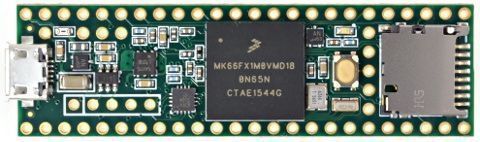
Last fall, I ran across the Kickstarter for the Teensy 3.5 and 3.6. The designer, Paul Stoffregen, bills his Teensies as “powerful microcontrollers for making awesome DIY electronic projects.” The Teensy 3.5 uses a 120 MHz ARM Cortext M-4 processor with a floating-point unit. The Teensy 3.6 has a 180 MHz processor. And, they are Arduino compatible.

The Teensy 3.5 Arduino-compatible microcontroller features a 120 MHz ARM Cortex M-4 processor with a floating point unit. The Teensy 3.6 uses a 180 MHz processor.

“Hmmmm,” I thought to myself, “I bet these processors could do some digital signal processing.” I got really interested when I read about the Teensy Audio Library, which is a toolkit of dozens of audio processing components.

So, I  joined the Kickstarter, and in due course a Teensy 3.5 arrived in my mailbox. Of course, I haven’t yet done anything with it.

Well, yesterday, my friend, Quentin, KD8IPF, sent me an e-mail posted to the 817ND mailing list. It was posted by Gareth, GI1MIC, and includes a couple of links to an open-source project that uses an earlier version of the Teensy to implement an audio DSP add-in for the FT-817. The links include:

  • Code and instructions
  • A video showing the Teensy DSP in action

Gareth notes, “The project is easily modified to run on other rigs or could be fitted inside an amplified speaker.” The latter is what I had in mind.

On the code and instructions page, Gareth links to a tool called TFilter. The web page describes this tool as “a web application that generates linear phase, optimal, equal ripple finite impulse response digital filters. It uses a pure javascript implementation of the Parks–McClellan filter design algorithm.” This tool generates the coefficients used by the Teensy program.

I haven’t really looked at the code yet, but Gareth’s program will switch between a CW filter, a SSB filter, and a third type that I couldn’t make out from the video. In Gareth’s application, the Teensy is embedded into the FT-817, and somehow he is able to use one of the radio’s controls to switch between the different filter types.

Another thing about Gareth’s project is that it uses a Teensy 3.2. The Teensy 3.2 uses a 72 MHz ARM processor, and apparently, that’s quite enough power for audio DSP. The Teensy 3.6 costs $30, while the Teensy 3.2 costs only $20.

I always thought that I’d build mine into a speaker. Not only that, I would like to have a PC application, somewhat like TFilter, that would allow a user to build his own filter on the fly. The program would have to calculate the coefficients on the fly and then download them to the filter.

Filed Under: Building/Homebrew, DSP Tagged With: filters, IIR

Modulation Recognition? How did I miss this?

April 21, 2017 By Dan KB6NU 2 Comments

The other day I found this short item in the ACM Tech News:

DARPA Pop-Up Testbed Takes On Spectrum Management
Government Computer News
George Leopold
April 7, 2017

The U.S. Defense Advanced Research Projects Agency (DARPA) sponsored a recent event to test new modulation recognition strategies for navigating the radio frequency spectrum. The desired objectives included demonstrating new modulation recognition methods for identifying signal origins and types, and finding better techniques for sending and receiving information over the least trafficked spectral bands. “Modulation recognition is that first step towards getting beyond just describing ‘presence’ or ‘absence’ [and] actually describing what is present,” says Paul Tilghman with DARPA’s Microsystems Technology Office. The event employed about 30 modulation schemes, with hand-coded expert systems matched against newer machine-learning platforms. The former did better in identifying signal characteristics, but DARPA program manager Tom Rondeau expects the machine-learning method to catch up. DARPA says modulation recognition is vital for achieving “wireless situational awareness” that could help extract more capacity from congested electromagnetic spectrum, and then predict spectrum use and increase throughput.

After reading this, I said to myself, “How cool is this? what a great new use for artificial intelligence.” When I did a little Googling on the topic, though, I found out that modulation recognition has been around for at least 20 years. Now, I’m saying to myself, “How did I miss this?”

I’m not an AI expert, but it seems to me that whoever can crack this nut will be years ahead of the competition. Instead of setting up your radio for CW, SSB, or one of the digital, just let the radio do it. Instead of you or me extracting the information from a noisy signal, we’ll let the computer do it instead. And you know what, chances are the radio will do a lot better job than we can. The future’s going to look a lot more different than we can imagine.

Filed Under: Communications Theory, Digital Communications, DSP Tagged With: DARPA, modulation recognition

From my Twitter feed: DMM tutorial

February 8, 2017 By Dan KB6NU 1 Comment

HamRadioFeed's avatar
HamRadioFeed @HamRadioFeed
Great multimeter tutorial for aspiring Hams ift.tt/2kgW67c#HamRadio

ud6acw's avatar

UD6ACW @ud6acw


Download this book for free!…Dan
DSP_fact's avatar
Signal Processing @DSP_fact
Think DSP book greenteapress.com/thinkdsp/ by @AllenDowney

Filed Under: DSP, Test Equipment

Technical advances in QST 25 and 50 years ago in QST

September 22, 2016 By Dan KB6NU Leave a Comment

QSTMy last post talked about how QST covered one the technical advances 100 years ago—the move to undamped wave transmitters. The October 1966 and October 1991 issues of QST also had interesting articles on new technologies of the day. The October 1966 issue featured the article, “Field Effect Transistors: What They Are, How They Work.”

Field-effect transistors (FETs) are, of course, now an important part of nearly every amateur radio set. In 1966, however, they were cutting edge technology. I’m not sure when they first became available, but the article notes, “A recently introduced semiconductor device called the field-effect transistor, or FET…”

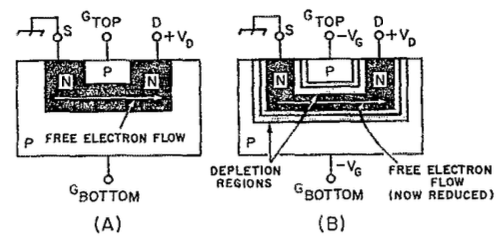
The nice thing about articles from this era of amateur radio is that they were very descriptive. This article starts out by describing how junction diodes work, which leads to a discussion of how junction FETs work (see the diagram below), and finally how insulated-gate FETs work.

jfet-operation

Also included are some typical characteristic curves and some circuit examples. Great stuff if you’re just learning about FETs or want to review what you know about them.

The next breakthrough in 1991: DSP

Dave, K1ZZ, hit the nail on the head in his October 1991 editorial when he wrote, “It’s pretty clear that the next major development to hit our ham shacks will be digital signal processing (DSP).” He couldn’t have gotten it any more right. After more than 25 years of development in DSP, nearly all of our radios use some form of DSP, and some of them are just one big digital signal processor.

Some hams wax nostalgic about the “good, old days” of tubes and analog circuits, but not me. DSP makes amateur radio a lot more fun.

Also worth noting in this issue is the Audio Filter Roundup. In this article, Jim, KR1S reviews the J-Com Magic Notch Filter, the Modular Systems Smart Filter, and the JPS Communications NIR-10. The first two are analog filters, the third a DSP filter. None of these products are still available, nor are the companies  still in business. Perhaps that was an omen of things to come.

Filed Under: DSP, Electronics Theory, Gear/Gadgets Tagged With: audio filter, FET

Learn the math of DSP

February 12, 2016 By Dan KB6NU Leave a Comment

Digital signal processing is, obviously, all about the math. This series is from EE Times, and consists of excerpts from the book Digital Signal Processing: Instant Access.

The math of DSP, part 1: Series, integration, and frequency. Part 1 introduces the basic math needed for DSP. Topics covered include polynomials, transcendentals, series, limits, integration, polar notation, and frequency.

The math of DSP, part 2: Complex numbers. Part 2 explains complex numbers. Topics covered include real and imaginary numbers, periodic signals, digital frequencies, and discrete arithmetic.

The math of DSP, part 3: Filters. Part 3 explains the basics of low-pass and high-pass filters. It also explains the concept of causality.

The math of DSP, part 4: Convolution, Fourier, and Nyquist. Part 4 looks at convolution, the Fourier series, and the Nyquist sampling theorem.

The math of DSP, part 5: Orthogonality. Part 5 explains the concept of orthogonality and introduces quadrature signals.

Filed Under: Books and Magazines, DSP

  • Page 1
  • Page 2
  • Go to Next Page »

Primary Sidebar

No Nonsense Technician Class License Study Guide (for tests given between July 2026 and June 2030)

New No Nonsense Technican Class Study Guide now available!

The 2026 version of my Tech Class study guide is now available, and as always, the PDF version is FREE!. The ePub version costs $11.97, and a Kindle version and paperback version will be available on Amazon shortly.

Click here to get all of my "No Nonsense" study guides.

Also available: The CW Geek's Guide to Having Fun with Morse Code

W5SWL.Com
Retevis Ailunce H1 DMR Radio
DXpander: Cobweb antennas, Laser Cutting

You’ve got mail!

Enter your email address below and get an email every time I publish a new post.

Email


I frequently teach classes to help newcomers get their licenses. The next class will take place on Saturday, October 10, 2026 on the University of Michigan campus. Click here for more information.

If you can't make the class, subscribe to the mailing list to be notified of when the next class will be held.

You can always download my free study guide, and if you have any questions about the classes, or amateur radio in general, please feel free to email me directly.

Support KB6NU.Com

Donate $7.30 and get two of these cool stickers. Measuring 4.25-in. W by 2.75-in. H, it's perfect for your car, your shack, or wherever!

Contact me

If you have a question or comment about one of my blog posts, or a question about any of the material in my study guides, or just a question about ham radio in general, you can email me at [email protected].

Blogs You Should Also Read

  • AE5X: A CW-centric blog from Kingswood, Texas
  • K0LWC Blog
  • LA3ZA Ham Radio Blog
  • Little Radios, Big Fun – WB3GCK
  • Mr. Vacuum Tube's Blog
  • Radio Artisan – K3NG
  • The K0NR Weblog
  • VE3WDM's QRP Ham Radio Blog
  • W2LJ’s Blog

Ham Radio Websites

  • Dashtoons – The Hammin' Comedy by Jeff K1NSS

Podcasts

  • ICQ Podcast
  • Linux in the Ham Schack
  • No Nonsense Amateur Radio Podcast
  • Resonant Frequency Amateur Radio Podcast

Recent Comments

  • Dan KB6NU on The EMF Explorer: A badge for ham radio?
  • Travis Good on The EMF Explorer: A badge for ham radio?
  • MARTIN ROBERT ROTHFIELD on The EMF Explorer: A badge for ham radio?
  • Mike Chen on Operating Notes, January 5, 2026
  • Rob W4ZNG on The EMF Explorer: A badge for ham radio?

Meta

  • Log in
  • Entries feed
  • Comments feed
  • WordPress.org

Footer

Copyright © 2026 Daniel M. Romanchik, KB6NU · Log in