
• Skip to primary navigation
  • Skip to main content
  • Skip to primary sidebar
  • Skip to footer

KB6NU's Ham Radio Blog

KB6NU's Ham Radio Blog
  • HOME
  • Study Guides
  • Teach a One-Day Tech Class
  • W8SRC Repeater Guide
  • Advertise
  • Hire Me

Test Equipment

Multimeter Links to iPhone or iPad

May 18, 2011 By Dan KB6NU Leave a Comment

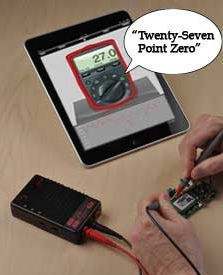
Redfish iDVMHere’s an interesting new product—the iDVM Multimeter—a product the company claims is the first digital phone-enabled multimeter. As you can see, the instrument itself has no display or controls. All display and control is done through an iPhone or iPad app.

The connection to the iPhone or iPad is a Bluetooth link. The app allows users to acquire, visualize, and share electrical measurement data on their Apple devices. Data can also be exported and e-mailed for further analysis.

The kicker is that the instrument won’t ship until June, and it will cost $220! A Fluke 177 multimeter costs only $240, and undoubtedly has much better analog specs. (The “Technical Specs” page on the Redfish website is currently not available.) It does do some things that the Fluke doesn’t do, such as speak the measurements and use a rechargeable battery, but I’m not sure those features are worth the price.

I like the iDVM concept a lot, but I’m afraid that they’re going to have to reduce the cost of this thing by at least 50% to be successful.

Filed Under: Test Equipment

Is Now the Time to Buy a Tek Scope?

May 6, 2011 By Dan KB6NU Leave a Comment

Having your own scope is a real pleasure. I’ve had one myself for the last 20 years or more. When you really need to look at a signal, you just hook up the scope and you can see the waveform. It’s beautiful.

There are many places that you can be a used oscilloscope for a reasonable price. Ham radio operators have been getting by with industry castoffs for years. Now, however, it might be time to think about buying your first, new oscilloscope. Tektronix is holding what they’re calling their 2011 Scope Sales Event. The sale runs through July 1, 2011.

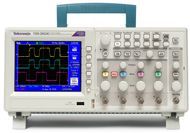
New scopes, like this TDS2000C, are amazingly versatile when compared to scopes that amateurs typically use.

You can save 10% on TDS2000C series scopes (see right), 25% on MSO/DPO2000 Series scopes, and 10% on the MSO/DPO3000 Series scopes. For example, you can get a 200-MHz TDS2022C with two analog inputs for only $1,854. A two-input 100-MHz TD2012C is only $1,308.

Not only are these scopes (relatively) inexpensive, they’re much easier to use and fully-featured than older models. For example, the TDS2000C series uses an LCD display, meaning the scope is more like a small, flat-panel TV, and it takes up a lot less bench space than the older scopes. They also have a whole range of analysis features that the older scopes don’t have.

A scope is one of those things that you never knew you needed until you have one. And, once you have one, you wonder how you ever did without it. Now, with the cost of a new scope about the same price as a mid-level transceiver, perhaps it’s time that you got one of your own.

Filed Under: Gear/Gadgets, Test Equipment

NIST Conducting Time and Frequency Survey

March 25, 2011 By Dan KB6NU Leave a Comment

NISTDo you use NIST radio station WWV or WWVH? Do you have a radio-controlled clock or set your computer clock using NIST? Do you get NIST time via telephone or Internet?

Please take a moment to complete the NIST Time and Frequency Services survey. Your input will be greatly appreciated.

By the way, you might also want to visit the NIST Time and Frequency Division website. It has a bunch of interesting info for time and frequency geeks.

For example, currently there’s a piece on the world’s most precise clock. It says:

NIST scientists have built a second “quantum logic clock,” using quantum information processing techniques on a single ion of aluminum to make a clock that would not gain or lose more than one second in about 3.7 billion years.

Filed Under: Test Equipment Tagged With: frequency, time

From the Trade Mags

December 15, 2010 By Dan KB6NU Leave a Comment

I’m on the distribution list for many different electronics trade magazines. Quite often, there are articles of interest to amateur radio operators. Here are four of them—two from electronic design and two from EE Times—that I hope you’ll find interesting.

Radiated efficiency: A true measure of antenna performance
Many engineers tend to think of antennas in terms of gain, but the author argues that we’d be better off if instead we evaluated antennas in terms of efficiency, that is how well it turns the power supplied to the feedpoint into radiated energy.

And You Thought The 555 Timer Was Dead?
Recently, both Advanced Linear Devices and Semtech have redesigned the 555 timer chip, improving it in many ways and extending its usefulness—most likely—for years to come.

Melville Eastham: Workplace Innovator Crafts Early Electronic Products
Eastham was the founder of General Radio. The article points out that Eastham founded the company in 1915 to “serve the rapidly growing ham radio market.” By the late 1920s, that “boom” had subsided, and the company turned its attention to precision measurement instruments. It was very successful doing this for many, many years.

10 Technologies to Watch in 2011
This article predicts that “wireless connects for health care” will be one of the technologies to watch in 2011. Makers of medical electronics equipment, apparently, are planning to integrate their gear using Bluetooth.

Filed Under: Antennas, Electronic Components, Test Equipment Tagged With: antennas, electronics, Test Equipment

Random Links

September 10, 2010 By Dan KB6NU 5 Comments

Here are a bunch of random links to interesting and useful websites:

  • 1×1 Callsign Search. It’s often difficult to know who’s using a 1×1 special-event callsign. Looking them up on QRZ.Com doesn’t work because they’re only issued for short-term use, and they are re-used over and over. To help you identify that 1×1 callsign, the W5YI VEC has set up this searchable database. Type in a call, and it tells you who’s used the call recently and who will be using it in the near future. Very cool.
  • Arcane Radio Trivia. True to its name, this blog has all sorts of radio trivia. For example, a couple of the latest posts cover a 1920s radio show called Midnight Frolic that ran on WMC in Memphis, TN and the February 1930 issue of Radio News magazine. The latter is available as a PDF for download.
  • This item is from the 9/1/10 ARRL Contest Update: Why is 10.7 used to determine the solar flux index? Spaceweather published this interesting article that explains why.
  • Radio Sky Publishing: Resources for Amateur Radio Astronomers, Students, and Teachers. If you have any interest at all in radio astronomy, check out this website. It’s been very slow for me, though, so be prepared to wait. I’m waiting right now for the “Beginner Tips” page to load.

Filed Under: Online Resources, Special Events, Test Equipment

You Get What You Pay For

June 9, 2010 By Dan KB6NU 9 Comments

At the Maker Faire on Saturday, I pulled out my $2 Harbor Freight DMM to check the continuity of the light bulb in my “visualize RF” demo. Bad news. The “low battery” indicator was on, and apparently it couldn’t supply enough current to make the measurement. On top of that, as I was fooling around with it, the wire came off one of the probes.

Well, yesterday, I tried to fix things. I re-soldered the probe wire and replaced the 9 V battery, but the meter’s still non-functional. The display comes on, but I’m not able to make any measurements.

I guess the moral of the story is that you get what you pay for. I now have another cheap $2 Harbor Freight DMM in my tool chest. We’ll see how long this one lasts.

Filed Under: Test Equipment Tagged With: Test Equipment

Fall Frequency Measuring Test This Week

November 9, 2009 By Dan KB6NU Leave a Comment

The W1AW Frequency Measuring Test (FMT) has taken several different formats over the past few years. This year, the ARRL returns to the “classic” FMT — measuring the frequency of an unmodulated carrier. Accurate frequency measurement is required of all hams for both regulatory compliance — “stay in the band!” — and operating convenience, particularly on the new digital modes. The W1AW FMT will run on November 12, 2009 at 0245 UTC (this is Wednesday evening, November 11, 2009 at 9:45 PM EST). It will replace any W1AW bulletin normally scheduled for that time. It is recommended that participants listen to W1AW’s transmissions prior to the event to get an idea of conditions to see which band (or bands) will be best for measurement purposes. Read more here.

Filed Under: ARRL, Test Equipment Tagged With: ARRL, Test Equipment

Don’t Be a Dummy and Spend Too Much for Oil

July 27, 2009 By Dan KB6NU 1 Comment

Tim, N9PUZ writes to the HamRadioHelpGroup mailing list:

With new HF rigs being 100% solid state these days, the need for a dummy load in some shacks has gone away. However, if you have an amplifier they are very useful as you can do most of your tuning off-air and avoid causing QRM.

Recently, I bought a used Heathkit Cantenna. It is a dummy load similar to the MFJ-250 1kW “wet” dummy load. It did not come filled with oil due to shipping difficulties.

In many places, such as where I live, genuine transformer oil to fill the load is unobtainium. You can buy a gallon from MFJ but it costs $30 plus shipping.

According to the Heathkit documentation, a good substitute is mineral oil. I checked at the local pharmacy and they wanted $4.25 per PINT still making this an expensive proposition. I wouldn’t classify myself as cheap but I am frugal so I kept searching.

An Internet search led to my discovery that mineral oil is often used as a laxative for horses and other farm animals. A quick trip to our local farm store “Farm and Home” got me a gallon jug for just $15. I imagine any store of this type or even the local Vet would have some.

The amplifier tunes up into the Cantenna very nicely now. Life is good.

Tim, N9PUZ

This is a great tip, but I disagree that “the need for a dummy load in some shacks has gone away.” Every shack should have a dummy load. They are immensely useful, especially in situations where you’re not whether your antenna or your transmitter is what’s causing you not to transmit properly.

Filed Under: Test Equipment Tagged With: Test Equipment

Cheap Sig Gen Kits

July 23, 2009 By Dan KB6NU 1 Comment

On the qrp-l.org mailing list, someone asked about signal generator/function generator kits. Ken, N9VV, came up with the following list:

  • Sine, square, and triangle wave signal generator electronic kit MK105, $5.69
  • Elenco FG-600K, $45
  • Elenco FG-500, $41
  • DEV-09002 Function Generator Kit, $35

As always, there was a lot of back and forth on the topic. One guy noted that none of these were really “good” function generators. My comment was that for such low prices, they might be fun to play with.

A third commented that by looking around at hamfests one could probably purchase something much better for just a little more. He’s right about that. A couple of years ago, I scored a 2 MHz B+K generator for about $120. It even does amplitude modulation.

Of course, another approach is to use your PC’s sound card as a signal generator. This works fine if all you need is audio signals. You could even get fancy and do modulation or other types of arbitrary waveforms. Two software packages that will allow you to do this are Marchand Function Generator Lite (free) and NCH Tone Generator ($20).

Finally, someone suggested using an iPod for audio test waveforms. Using a computer’s sound card, you can generate all kinds of test waveforms, record them on the iPod, then just select the tracks you want when you want them. That’s a neat idea. Someone should prerecord a bunch of commonly used waveforms and make them available on a website somewhere.

Filed Under: Kits, Test Equipment Tagged With: kits, Test Equipment

NIST Time and Frequency Metrology Seminar to be held June 2-5

March 10, 2009 By Dan KB6NU Leave a Comment

Call me a “time geek,” but I think this would be very interesting to attend……Dan

The National Institute of Standards and Technology (NIST) will host the 34th annual Time and Frequency Metrology Seminar on June 2-5, 2009, in Boulder, Colo.

The four-day seminar provides the most comprehensive course in understanding the characteristics of clocks and oscillators, making precise time and frequency measurements and synchronizing and applying precision time in an array of systems. The seminar is designed for all who are responsible for measurements, analysis, documentation, publications, proposals, calibrations and/or certifications of timing systems. Registrants of all levels of experience are welcome, including scientists, engineers, laboratory technicians, educators, managers, mathematicians and computer programmers.

Notable speakers will include: John (Jan) Hall, who shared the 2005 Nobel Prize in Physics for “contributions to the development of laser-based precision spectroscopy, including the optical frequency comb technique”; David Allan, who has authored more than 100 papers in the field of precise time and frequency, and who led development of the Allan Variance, the recommended statistic for comparing and evaluating clocks and oscillators; and John Vig, current president of IEEE, who holds 55 patents related to quartz crystal resonators and oscillators for high-stability frequency sources, clocks and sensors.

The seminar includes laboratory demonstrations at NIST. For registration information and the full agenda, visit http://tf.nist.gov/timefreq/seminars/T&Foverview.html.

Filed Under: Electronics Theory, Test Equipment

  • « Go to Previous Page
  • Page 1
  • Interim pages omitted …
  • Page 12
  • Page 13
  • Page 14
  • Page 15
  • Go to Next Page »

Primary Sidebar

No Nonsense Technician Class License Study Guide (for tests given between July 2026 and June 2030)

New No Nonsense Technican Class Study Guide now available!

The 2026 version of my Tech Class study guide is now available, and as always, the PDF version is FREE!. The ePub version costs $11.97, and a Kindle version and paperback version will be available on Amazon shortly.

Click here to get all of my "No Nonsense" study guides.

Also available: The CW Geek's Guide to Having Fun with Morse Code

W5SWL.Com
Retevis Ailunce H1 DMR Radio
DXpander: Cobweb antennas, Laser Cutting

You’ve got mail!

Enter your email address below and get an email every time I publish a new post.

Email


I frequently teach classes to help newcomers get their licenses. The next class will take place on Saturday, February 7, 2026 on the University of Michigan campus. Click here for more information.

If you can't make the class, subscribe to the mailing list to be notified of when the next class will be held.

You can always download my free study guide, and if you have any questions about the classes, or amateur radio in general, please feel free to email me directly.

Support KB6NU.Com

Donate $7.30 and get two of these cool stickers. Measuring 4.25-in. W by 2.75-in. H, it's perfect for your car, your shack, or wherever!

Contact me

If you have a question or comment about one of my blog posts, or a question about any of the material in my study guides, or just a question about ham radio in general, you can email me at [email protected].

Blogs You Should Also Read

  • AE5X: A CW-centric blog from Kingswood, Texas
  • K0LWC Blog
  • LA3ZA Ham Radio Blog
  • Little Radios, Big Fun – WB3GCK
  • Mr. Vacuum Tube's Blog
  • Radio Artisan – K3NG
  • The K0NR Weblog
  • VE3WDM's QRP Ham Radio Blog
  • W2LJ’s Blog

Ham Radio Websites

  • Dashtoons – The Hammin' Comedy by Jeff K1NSS

Podcasts

  • ICQ Podcast
  • Linux in the Ham Schack
  • No Nonsense Amateur Radio Podcast
  • Resonant Frequency Amateur Radio Podcast

Recent Comments

  • Michael Burkhardt on One lump or two (or three)?
  • Eric on POTA notes, 7/27/26
  • Steve KB3JC on How to “ragchew” on CW
  • Dan KB6NU on Yaesu FT-710: What’s the big deal?
  • Andrei on Yaesu FT-710: What’s the big deal?

Meta

  • Log in
  • Entries feed
  • Comments feed
  • WordPress.org

Footer

Copyright © 2026 Daniel M. Romanchik, KB6NU · Log in