• Skip to primary navigation
  • Skip to main content
  • Skip to primary sidebar
  • Skip to footer

KB6NU's Ham Radio Blog

KB6NU's Ham Radio Blog
  • HOME
  • Study Guides
  • Teach a One-Day Tech Class
  • W8SRC Repeater Guide
  • Advertise
  • Hire Me

ISS

ISS SSTV transmissions to commemorate 20 years of ham radio aboard ISS

December 18, 2020 By Dan KB6NU Leave a Comment

From ARRL News…

Amateur Radio on the International Space Station (ARISS) will continue its year-long 20th anniversary celebration of continuous ham radio operation from the ISS this month, with a slow-scan television (SSTV) event over the holidays. The first ARISS school contact took place in December 2000, not long after the first ISS crew arrived on station a month earlier and had made test contacts. The commemorative late-December SSTV event will be held December 24 through December 31, although dates are subject to change. The frequency will be 145.800 MHz, using SSTV PD-120 mode. Over its 20 years, ARISS has supported nearly 1,400 scheduled ham radio contacts with schools, student groups, and other education organizations.

Image from a previous ISS SSTV transmission.

This is a fun thing to do. I did this a couple of years ago with mixed results. I now have an Arrow hand-held Yagi, so I should have a better shot at it.

Filed Under: VHF/FM/Repeaters Tagged With: ISS, SSTV

ARISS: Celebrating 20 years of continuous operations on the International Space Station

November 15, 2020 By Dan KB6NU 1 Comment

November 13, 2020—Twenty years ago today, the Expedition-1 crew turned on the ARISS Ericsson radio for the first time and completed several contacts with ARISS ground stations around the world to validate the radio communications system. These inaugural contacts launched an incredible two-decade operations journey on ISS, enabling ARISS to inspire, engage and educate our next generation of explorers and provide the ham radio community a platform for lifelong learning and experimentation.

In celebration of the ISS 20th anniversary, ARISS was part of an ISS Research and Development Conference Panel session entitled “20 years of STEM Experiments on the ISS.” The video below, developed for this panel session, describes our program, celebrates our 20th anniversary, conveys some key lessons learned over the past 20 years and describes the ARISS team’s vision for the future. Enjoy watching!

20 years of continuous operations is a phenomenal accomplishment. But what makes it even more extraordinary is that ARISS has achieved this through hundreds of volunteers that are passionate in “paying it forward” to our youth and ham radio community. On behalf of the ARISS International team, I would like to express our heartfelt thanks to every volunteer that has made ARISS such an amazing success over the past 20 years. Your passion, drive, creativity and spirit made it happen!!

Congratulations ARISS team!!!

Frank H. Bauer, KA3HDO
ARISS International Chair

Filed Under: Satellites Tagged With: ARISS, ISS

Amateur radio in the news: Santa on the air, Sea Road students to talk to ISS, Villager built ISS ham power supply

November 13, 2020 By Dan KB6NU Leave a Comment

Longmont (CO) club puts Santa on the airwaves with hope of transmitting interest in amateur radio

The coronavirus has altered the way that communities are celebrating this year’s holidays, meaning Santa Claus may not be able to make his Christmas list through in-person visits. One Longmont club, though, is giving Kris Kringle some air time so that he can still hear from Boulder County’s children in a safe-distanced way.

FIRESTONE, CO – NOVEMBER 12:Chuck Poch, call sign K0ITP, poses for a portrait in his “ham shack” at his home in Firestone on Nov. 12, 2020. Longmont Amateur Radio Club operators will be giving kids the opportunity to Santa from Dec. 1 to 5. (Matthew Jonas/Staff Photographer)

The Longmont Amateur Radio Club will host On Air with Santa from 6 to 7 p.m. Dec. 1 to Dec. 5. The club is encouraging licensed ham radio operators to give their children and grandchildren a chance to connect with Santa in a safe, distanced way.

Firestone’s Chuck Poch, president of the radio club, said this is the first time that the Longmont Amateur Radio Club has hosted the event. While the Longmont Amateur Radio Club wants to give children a chance to connect with Santa, members also hope to transmit an interest in the next generation of ham radio operators.

Sea Road students to radio orbiting astronauts

KENNEBUNK (ME) – The students at Kennebunk’s Sea Road School are getting ready to talk with astronauts aboard the orbiting International Space Station (ISS). The Sea Road School serves over 300 third, fourth, and fifth-grade students. NASA indicates the direct radio contact will likely take place this coming January.

The New England Radio Discussion Society, a Maine radio club comprised of federally-licensed radio amateurs, known as ham radio operators, is actively helping plan the contact.

Significantly, NASA is celebrating its 20th anniversary of Amateur Radio operations on the ISS. The new crew includes Commander Bill Shepherd, with American ham radio call sign KD5GSL, Soyuz Commander Yuri Gidzenko, and Flight Engineer Sergei Krikalev, with Russian ham radio call sign U5MIR.

Just a few days after the new ISS crew arrived, they set up the Amateur Radio equipment. ISS crews will now use the new gear to talk to schools as they orbit the Earth.

Villager built power supply for space station

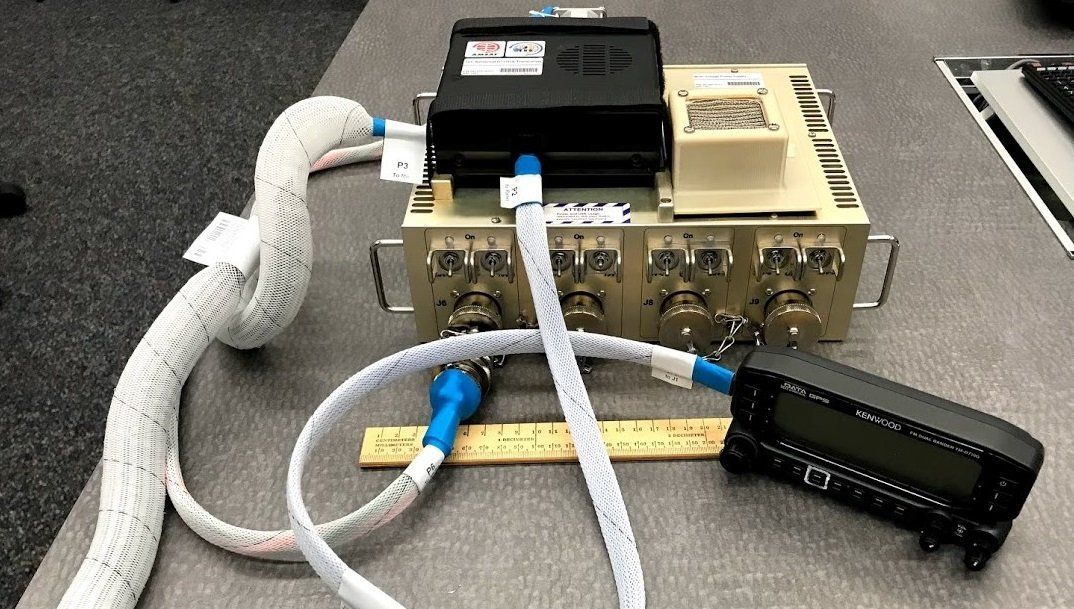
If you can communicate with an astronaut using an amateur radio, you can thank Ed Krome for it. Krome, K9EK, a self-described experimenter and builder, was involved in creating what’s known as a Multi-Voltage Power Supply, which is used to power a next-generation amateur radio system on the International Space Station. The first of four power supplies for this system launched March 6 as part of a SpaceX commercial supply mission to the space station.

When he watched that rocket launch, Krome, of the Village of Amelia, thought it was awesome to have something he worked on go into space. “Going to the launch, it happened to be the clearest night ever over at (Cape) Canaveral, we could see the end of the fueling, the takeoff,” he said.

Filed Under: Clubs, Satellites Tagged With: ISS

Made my first satellite contact!

October 16, 2020 By Dan KB6NU 2 Comments

I’ve been threatening to get on the satellites for years now. It’s just been one of those things that never percolated up to the top of my list. I finally bit the bullet, though, and actually made my first satellite contact Tuesday!

Several things finally motivated me to do this. One, I’ve been feeling like I’ve been in a rut. Not just with ham radio, but with life in general. I’m sure that I’m not the only one feeling this way. I felt like I needed to do something different to shake things up a bit.

Two, among my followers, and those who I follow on Twitter, there are many satellite operators, including KI4ASK, KM4LAO, 2M0SQL, KX9X, and many others. Hearing about their exploits certainly gave me a push in the right direction.

This recently-installed ham gear on the ISS includes a V/U crossband repeater.

Third, was the news about the International Space Station’s new crossband repeater. It sounded pretty cool to me to be able to bounce a signal off the ISS. After reading this news, I programmed my HT to the receive frequency, 437.800 MHz, and wouldn’t you know it, the ISS was passing nearly overhead at that exact time, and I copied a few callsigns on just the HT antenna. I took that as an omen.

Next, I had to decide on what kind of antenna to buy or build. I initially considered building my own antenna. There are lots of web pages and YouTube videos that show you how to build a satellite antenna. One of the many that caught my eye was Satellite Log Periodic Antenna Project Pt. 1.

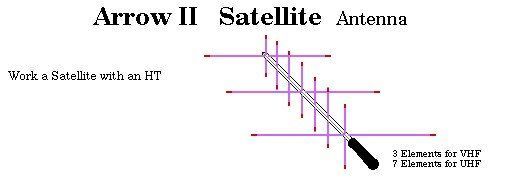
In the end, though, I decided that if I tried building one I might get bogged down in the construction process instead of making contacts. I did some research on commercial antennas, and the choice seemed to be an antenna from Arrow Antennas and the Elk Antennas. Both Martin, M1MRB and Edmund, M0MNG, my co-hosts on the ICQPodcast, have Elk antennas, but when I asked on Twitter, the nearly unanimous choice was the Arrow antenna. Jeff, KE9V, settled that dispute when he noted that if I bought an Arrow antenna through AMSAT, that AMSAT would make a few bucks from the sale. So, I got the Arrow. I re-joined AMSAT, too.

It took me a few days to put the antenna together, and then discovered that I didn’t have the right adapters to connect it to the radio. After consulting with the Twitter gods, I purchased some from Amazon (BNC-SMA, BNC-reverse SMA). In the meantime, I programmed my radio for the new ISS cross-band repeater. For help in doing so, I found this great blog post. I thought that this might be the most logical one to try first, but I didn’t take into account how busy it would be. Since it’s the newest satellite station on the air, everyone wants to work it.

Next, I had to figure out when when the ISS was going to be overhead. I went back to the Twitter gods for recommendations for a satellite-tracking program, and among them was N2YO.Com. I like N2YO.Com. Using it, I was able to determine that the ISS would be passing nearly over head a little after 0030Z that evening.

I thought that tracking the ISS was going to be easy. At 0000Z, the sky was clear, and on a 2m net, I was assured by a local ham, who happens to be a professor emeritus of astronomy at the University of Michigan, that the ISS would be the brightest object in the sky. Unfortunately, by 0030Z, the sky had clouded over, and I never actually saw the satellite. I didn’t make a contact, either. I did hear the ISS repeater, but no one heard me.

After that, I refined my approach. I expanded the number of satellites I now have programmed into my radio and upped the transmit power to 5W. The satellites that I have now programmed into my radio include:

  • ISS
  • DIWATA-2B (PO-101)
  • FOX-1B
  • FOX-1CLIFF
  • SAUDISAT-1C (SO-50)
  • FOX-1D

My strategy finally paid off. Just before lunch last Tuesday, I stood on my back porch and had a QSO with ND0C via PO-101! That was quite exciting. I can see where this might get addicting.

This has been a real learning experience, and isn’t that what ham radio is all about? I’ve been thinking about a number of ways to learn more and enhance my satellite operating experience:

  • Build a satellite antenna. Like I said earlier, I’m a big believer in building, rather than buy antennas, and, if I build a log-periodic, I can compare the performance of the log periodic to the Arrow Yagi antenna.
  • Build a SatNOGS ground station. I’ve always thought that this project was very cool. The SatNOGS website is a wealth of information on how to do this.
  • Move to higher ground. I’m kind of in a hollow here, so I don’t hear the satellites until they get fairly high in the sky, and eventhen, the pass is fairly short, unless they are going right overhead. There’s a park up at the top of the hill, which is just about the highest point in Ann Arbor, and I think trying from there will give me clear shot at many satellites.
  • Try the linear satellites. One bit of advice I got from Twitter is to try the linear satellites instead of the FM satellites. They’re less busy than the FM satellites, and you can work them with SSB and CW. I think that would be pretty cool. I may be wrong, but it looks to me like the IC-705 would be the perfect radio to do this. I think that if I sell my KX-3 and some other stuff I’m really not using, I could afford to buy one.

One thing’s for sure. This has gotten me out of my ham radio rut. And, in times like these, that’s a good thing.

Filed Under: Operating, Satellites Tagged With: AMSAT, ARROW Antennas, Elk Antennas, ISS, N2YO.COM, SatNOGS

First attempt at satellite QSO not so successful

October 5, 2020 By Dan KB6NU 5 Comments

I’ve been working CW for a long time. So long, that I don’t really remember how difficult or easy it was to learn the code. My recent experience with operating satellites—or trying to, anyway—may be giving me some perspective, however. I feel like I’m making some progress, but I have yet to actually make a satellite contact.

Let me describe what I’ve done so far:

  1. After consultation with the Twitter gods of satellite operation, I decided to purchase an Arrow II 146/437-10WBP Handheld Yagi w/ Duplexer antenna. I purchased it from the AMSAT website, because AMSAT gets a little cut of the sale. It was delivered about a week ago.
  2. I didn’t get around to playing with it for a couple days, and when I did, I realized that I didn’t have the right adapters to connect the antennas to my HTs.
  3. Purchased the adapters from Amazon (BNC-SMA, BNC-reverse SMA). I received these on Saturday.
  4. Yesterday, I assembled the antenna (very simple) and programmed my radio for the new ISS cross-band repeater. For help in doing so, I found this great blog post.
  5. Next, I had to figure out when the ISS was going to be overhead. I got a bunch of recommendations from the Twitter gods, and Mike suggested N2YO.Com. I like N2YO.Com. Using it, I was able to determine that the ISS would be passing nearly over head a little after 0030Z last night.
  6. I thought that tracking the ISS was going to be easy. At 0000Z, the sky was clear, and I was assured by a local ham, who happens to be a professor emeritus of astronomy at the University of Michigan, that the ISS would be the brightest object in the sky. Unfortunately, by 0030Z, the sky had clouded over, and I never actually saw the satellite.
  7. I did actually hear several stations using the ISS repeater, though. I called a few times, but I don’t think that anyone heard me.
  8. Today, I tried again during the 1715Z pass, but this was a much lower and shorter pass, and again, wasn’t successful.
  9. I also monitored an earlier pass of AO-91. The signals were quite good on this pass, but I didn’t have my radio programmed to transmit, so I didn’t have any chance of making a contact.

During the passes, it was kind of like working a pileup. People were just throwing their callsigns out, but only rarely did two stations connect. If there’s some method to this madness, I’d love to have someone explain it to me.

Another thing that I’m thinking is possibly the reason no one can hear me is that I have my radio programmed to low power, which is only about a watt and a half. I’m thinking that I’ll try high power (5W) and see how that goes.

Anyway, I’m just getting started here. It would have been cool to make a contact on my first go, but I realize that’s not usually how it works. I keep telling CW newcomers to stick with it and “practice, practice, practice,” and that’s what I intend to do here.

Filed Under: Satellites Tagged With: ISS

Amateur radio in the news: More ISS SSTV, AMSAT-DL Satellite Symposium video now online, Seattle club’s testing triumph

September 27, 2020 By Dan KB6NU Leave a Comment

An SSTV image sent by the ISS in August 2020.

More SSTV from the ISS

Southgate reports that slow-scan TV (SSTV) transmissions will probably occur from the International Space Station (ISS) next week:

  • Wed 2020-09-30 13:05 UTC to 18:45 UTC
  • Thu 2020-10-01 12:30 UTC to 17:40 UTC

Images will be downlinked at 145.8 MHz and the expected SSTV mode of operation is PD 120. If you receive the transmissions, you can post and view images on the ARISS SSTV Gallery at https://www.spaceflightsoftware.com/ARISS_SSTV/ .

I just got my ARROW antenna yesterday, so I’m hoping to try it out and get better images than I did last time.


AMSAT-DL Satellite Symposium video now online

More space news….

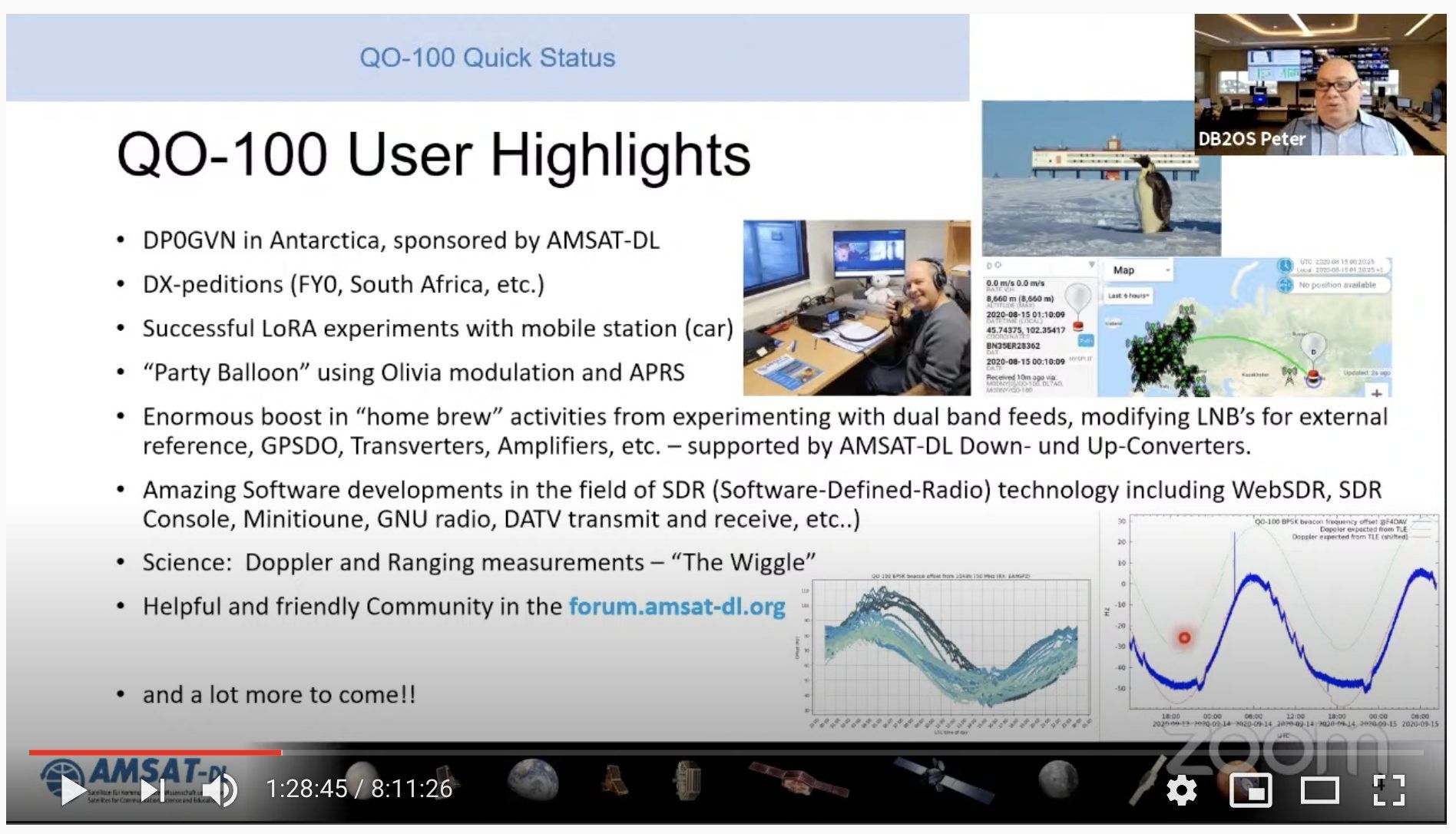
The video of the AMSAT-DL Online Satellite Symposium 2020 held on Saturday, Sept 16, can now be watched on YouTube. Most of the talks are in English to cater for an international audience. See the schedule of talks at
https://amsat-dl.org/en/amsat-dl-online-satelliten-symposium/, and the 8-hour video is at
https://www.youtube.com/watch?v=QNRahMn2dYE.

The schedule is heavy on QO-100 talks, but even though that satellite is not accessible here in the U.S., you should find something of interest.


Seattle club’s testing triumph

The West Seattle Amateur Radio Club recently provided a round of testing with unique challenges posed by the pandemic and more. Five people took the test. Three passed the Technician exam, one ham moved up from Technician to General, and one ham moved up from General to Extra.

The exam session was held under adverse conditions. Not only is the Northwest is the COVID-19 pandemic still active there, there are high levels of smoke from wildfires. The test was planned for outdoors but was moved indoors to avoid the smoke hazard and was held with safe distancing and COVID-19 precautions. As each participant signed in, their temperatures were taken with a forehead infra-red thermometer to verify they had normal temperatures. Masks were worn by everyone. Hand sanitizer and wipes were plentiful.

….read more

Filed Under: Amateur Radio in the News, Classes/Testing/Licensing, Satellites Tagged With: ISS, SSTV

ICQ Podcast Episode 333 – Hams Celebrate Healthcare Heroes

September 13, 2020 By Dan KB6NU Leave a Comment

In episode #333 of the ICQ Podcast, Martin M1MRB, Leslie Butterfield G0CIB, Edmund Spicer M0MNG, and yours truly discuss the latest amateur radio news. Colin M6BOY rounds up the news in brief and this episode’s feature is Hams Celebrate Healthcare Heroes.

This episode included some really good discussions on the following topics:

  • ARRL Board elects new CEO
  • Trans-Atlantic Opening on 144 MHz between the Canary Islands and the Caribbean
  • FCC Proposes Charging Amateur Radio License Fees
  • ISS 437.800 MHz Cross Band Repeater Activated
  • Brazil Proposes End of All Amateur Radio Exams

Other news includes:

  • Six Metre Group AGM Goes Online
  • Battle of Britain 80th Anniversary
  • EURAO Party – Summer 2020: working on 80m and 40m bands

Filed Under: ARRL, Classes/Testing/Licensing, Podcasts Tagged With: ARISS, Brazil, fees, ISS

Amateur radio videos: Copying SSTV from the ISS, IC-705 un-boxing, Morse Code and leadership

September 6, 2020 By Dan KB6NU Leave a Comment

Published by the European Space Agency (ESA), this video shows you step by step how to receive SSTV sent by the astronauts on the International Space Station at home using your computer?

The long-awaited IC-705 is shipping. This guy got his hands on one and did a quick un-boxing video.

I did a little googling on the speaker in this TED Talk, Lital Marom, who bills herself as a “keynote speaker and corporate innovator.” She seems to be one of those people who are now more known now for speaking about innovation rather than actually innovating. According to her talk, she got her start in “hacking,” or innovating, as a kid by learning Morse Code and getting an amateur radio license.

Filed Under: CW, Gear/Gadgets, Satellites Tagged With: ic-705, ISS

Space Station SSTV activity planned for August 4-5

July 29, 2020 By Dan KB6NU 1 Comment

This is is from Southgate News this morning. I’ve copied the ISS SSTV before, and it’s a fun thing to do. Last time I did this, I used MMSSTV. As the ARRL has reported, there’s a new version of MMSSTV (now apparently called YONIQ), so you may want to update the program, if you have the older version installed…..Dan


It is planned Russian cosmonauts will transmit amateur radio Slow Scan Television (SSTV) images from the International Space Station (ISS) during August 4-5 on 145.800 MHz FM (likely using PD-120). It should be receivable across the British Isles and Europe

On July 9, ESA Education had tweeted:

We are expecting the ISS to transmit pictures in the next weeks for the 45th anniversary of the Apollo-Soyuz test project. This is a perfect opportunity to try this activity for yourself!

An announcement on the ARISS SSTV Blog says:

The final crew schedule for the week of Aug 3-9 was released recently and it showed a MAI-75 activity scheduled for Aug 4 and 5. This is soon after the Space X Demo-2 undock so changes to that event could impact the schedule.

The current dates and times of the planned activity are as follows:

  • Aug 4 (12:25-18:10 UTC) is setup and day 1 operations.
  • Aug 5 (11:15-18:45 UTC) is day 2 operations and close out.

This is the Moscow Aviation Institute SSTV experiment that is active for orbital passes over Moscow, Russia. It has traditional been PD-180 or PD-120 and transmitting on 145.800 MHz.

The ISS puts out a strong signal on 145.800 MHz FM and a 2m handheld with a 1/4 wave antenna will be enough to receive it. Many FM mobile and base station rigs can be switched been wide and narrow deviation FM filters. For best results you should select the filter for wider deviation FM (25 kHz channel spacing). Handhelds all seem to have a single wide filter fitted as standard.

The space agency ESA has released a video How to get pictures from the International Space Station via Amateur Radio along with a collection of Tutorial videos explaining how to receive ISS Slow Scan TV (SSTV) pictures for different computers and mobile devices.

More links

  • Pictures from space via ham radio
  • ISS SSTV info and links

Filed Under: Satellites, SSTV Tagged With: ISS

First shot at copying ISS SSTV a moderate success

February 16, 2019 By Dan KB6NU 2 Comments

Last weekend, I read several Tweets and several reddit posts of guys boasting that they were able to copy the slow-scan TV transmissions from the International Space Station. Since many of these guys were using handhelds and cellphones, this didn’t sound like rocket science (pun intended).

So, when Jay, WB8TKL, posted the ARRL bulletin that the Space Station was going to do a “do over” of last week’s transmissions (due to some equipment problems), and Dave, N8SBE, posted that there would be several passes on Saturday morning, I thought I’d give it a go. I downloaded MMSSTV, brought my USB microphone down to the shack, and tuned my IC-207 to 145.800 MHz. I was hoping that my j-pole antenna, mounted to a trellis on my back deck, would be sufficient to receive the ISS signals.

On the first pass, just after 9:30 am, I only heard a few bursts of SSTV. You really couldn’t see anything. After exchanging a few Tweets with my followers, it occurred to me that I probably wanted to turn off the squelch (D’oh!). On the second pass, I was a little more successful.

It’s nowhere near some of the images that other guys received, but it’s not a total failure, and you can make out some of the text, including the call sign RS0ISS. Despite the less than stellar (pun intended again) results, it was a lot of fun. I guess that I need to improve the antenna. Any other suggestions would be appreciated.

Filed Under: Satellites, SSTV Tagged With: ARISS, ISS, SSTV

  • « Go to Previous Page
  • Page 1
  • Page 2
  • Page 3
  • Go to Next Page »

Primary Sidebar

No Nonsense Technician Class License Study Guide (for tests given between July 2026 and June 2030)

New No Nonsense Technican Class Study Guide now available!

The 2026 version of my Tech Class study guide is now available, and as always, the PDF version is FREE!. The ePub version costs $11.97, and a Kindle version and paperback version will be available on Amazon shortly.

Click here to get all of my "No Nonsense" study guides.

Also available: The CW Geek's Guide to Having Fun with Morse Code

W5SWL.Com
Retevis Ailunce H1 DMR Radio
DXpander: Cobweb antennas, Laser Cutting

You’ve got mail!

Enter your email address below and get an email every time I publish a new post.

Email


I frequently teach classes to help newcomers get their licenses. The next class will take place on Saturday, October 10, 2026 on the University of Michigan campus. Click here for more information.

If you can't make the class, subscribe to the mailing list to be notified of when the next class will be held.

You can always download my free study guide, and if you have any questions about the classes, or amateur radio in general, please feel free to email me directly.

Support KB6NU.Com

Donate $7.30 and get two of these cool stickers. Measuring 4.25-in. W by 2.75-in. H, it's perfect for your car, your shack, or wherever!

Contact me

If you have a question or comment about one of my blog posts, or a question about any of the material in my study guides, or just a question about ham radio in general, you can email me at [email protected].

Blogs You Should Also Read

  • AE5X: A CW-centric blog from Kingswood, Texas
  • K0LWC Blog
  • LA3ZA Ham Radio Blog
  • Little Radios, Big Fun – WB3GCK
  • Mr. Vacuum Tube's Blog
  • Radio Artisan – K3NG
  • The K0NR Weblog
  • VE3WDM's QRP Ham Radio Blog
  • W2LJ’s Blog

Ham Radio Websites

  • Dashtoons – The Hammin' Comedy by Jeff K1NSS

Podcasts

  • ICQ Podcast
  • Linux in the Ham Schack
  • No Nonsense Amateur Radio Podcast
  • Resonant Frequency Amateur Radio Podcast

Recent Comments

  • Mir Labs on Ten Steps to Mastering Morse Code
  • Skip K4EAK on Is the ARRL finally feeling the heat?
  • Victor on 468: Ham Radio’s Magic Number
  • Goody K3NG on Not1MM now working on my Linux box!
  • Mir Labs on JA1NUT: Two Issues in Morse Code Learning

Meta

  • Log in
  • Entries feed
  • Comments feed
  • WordPress.org

Footer

Copyright © 2026 Daniel M. Romanchik, KB6NU · Log in