Build a TX for the 1929 QSO Party

This from VE7SL via the qrp-l mailing list:

If any of you were thinking about putting something together for the Antique Wireless Association’s 1929-style QSO party, there is still time to throw together a little Hartley or TNT!

The 1929 QSO party runs Dec 05/06 and Dec 10/11 (2300z-2300z). This is the contest where entrants are required to use a tube and tx circuit design that was only available in 1929 or earlier (210, 245, 27….there’s a bunch of them, mostly triodes). No xtals are allowed …..self-excited oscillators only! Your transmitter doesn’t have to look pretty either! Most of the activity is on 80m (3550-3580) but there are always a handfull of brave soles venturing way up to 40m (7040-7060) as well.

There has been a significant rule change this year that allows the ’29 member stations to work non-’29ers for points (previously these QSO’s could not be scored) so even if you don’t put a transmitter together, please join in the fun and listen to the chirps and buzzes of what the bands once sounded like….and then call them!

For inspiration, I have posted a gallery of eligible transmitters. The AWA has a ‘quick-build’ plan on their website, and a page on replica vintage transmitters.

Hope to hear you in the contest.

73 / Steve

An Interesting Find

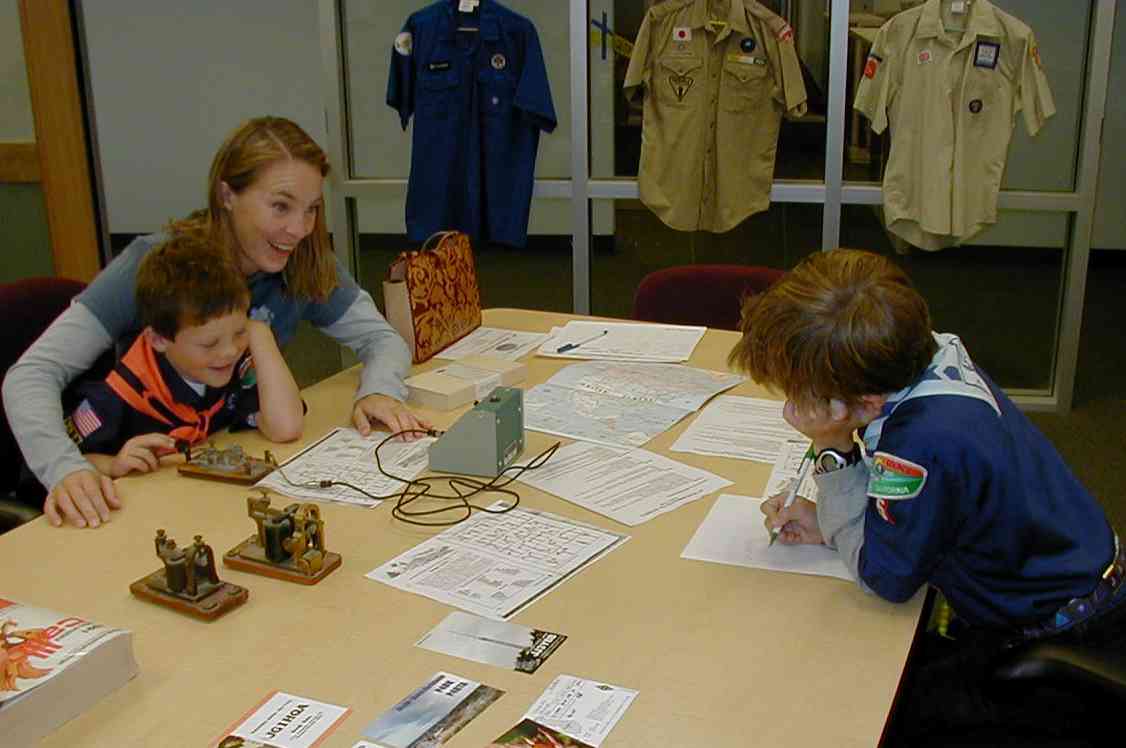
Recently, someone donated an entire TS-820 station to our Ham Radio at the Hands-On Museum project. The equipment included a fully decked-out TS-820, plus a lot of other stuff from that era (the late 1970s), including a Heathkit code practice oscillator, a Handbook, and other assorted books and materials.

I’d looked through this stuff before, but somehow I’d overlooked the Heathkit Amateur Radio Log. Here are a couple of scans I made:


heathkitlogp1
heathkitlogp2
heathkitlogp3

Kinda cool, isn’t it? I’d never seen one of these before.

Hams Aren’t the Only Nuts Who Restore Old Electronics


IEEE Spectrum is running a short article on a group of “vintage” engineers who are restoring a vintage IBM 1401 computer. The computer had been in storage, but there was extensive water damage, damage that took 10,000 man-hours to repair! Think about that next time you get your hands on an old Hallicrafters.

Make sure to check out the slide show at the end of the article.

WD8DAS Searches for Heathkit

While his family went to the beach, WD8DAS visited the sites of the old and new Heathkit plants in St. Joseph, Michigan.

A Tale of Two Tubes

A couple of weeks ago, I worked N4QR on 40m CW. I could tell by the tone of his signal that he was operating a homebrew transmitter. There wasn’t any 60 Hz on his signal, and it didn’t chirp exactly, but I could tell it wasn’t the pure tone you get out of today’s radios.

I asked him about his rig, and he told me that it was a one-tube transmitter made with a 6L6. I forgot to ask him where he got the schematic, but a quick Internet search turned up the following:

  • The May 2005 issue of the K9YA Telegraph has an article written by N4QR titled, “The Wonderful One-Tuber,” that contains the schematic for the transmitter. The K9YA folks don’t make issues of The Telegraph available on their website, but I was able to get a copy of the issue by e-mailing them.
  • A 6L6 Classic (shown below)
  • WB2MIC 6L6 Transmitter Project


This one-tube transmitter is made with a 6L6 pentode.

The 6L6 is a pentode that, according to Wikipedia, was introduced by the Radio Corporation of America (RCA) in July 1936. Apparently, it was used quite a bit in public address systems.

After the tube became successful, tube manufacturers introduced a number of variations, including the venerable 807. The original 6L6 was capable of delivering 19 W; the latest variation, the 6L6GC is rated for 30 W. The 6L6GC is still used in guitar amps, and is still manufactured in Russia, China, and by Groove Tubes in the U.S. They sell a number of different 6L6 variants; the cheapest is $16, the most expensive $180!!

Tube #2
One of the reasons I was interested in the 6L6 is because about a year ago I came across a schematic for a transmitter using 6A6 dual triode. I had just come into possession of a couple hundred tubes, and while I didn’t have a 6A6 (at least I haven’t found one yet), I do have a couple of 6J6 dual triodes. They’re not quite as high power as the 6A6, but I’m still thinking about building a little transmitter with one.

As you might expect, there’s a bunch of information on the Internet about this tube:

One interesting fact about the 6J6 is that IBM used it in the 604 computer. Unfortunately, they found it to be not as reliable as they wanted it to be, but at first none of the tube manufacturers were interested in making a more robust version. This led IBM to set up a tube-making laboratory where they could experiment with designs. They developed a more reliable version of the 6J6 and finally convinced RCA to manufacture the tube. According to the author of the history of the 604, part of the concern is that IBM would decide to get into the tube business.

So, the next time you hear a signal that doesn’t sound so perfect, remember that there just might be a story behind it. Ask the op about his transmitter, and listen to what he or she has to say.

The Wesco BN-1

The latest buzz on the Glowbugs mailing list is about the sale of a Weskit BN-1. This rig, apparently sold by Western Radio of Kearney, NE is a one- or two-tube “Novice transmitter/receiver.” It originally sold in kit form for $14.95, assembled and test $19.95.

bn1

Sheldon, KC0CW, actually has a very nice writeup, which includes a schematic, about this radio. In part, he writes:

The Weskit transmitter-receiver was made by Western Radio (a.k.a. Western Electronics) of Kearney, Nebraska, around the 1956/1957 time period. It is an extremely simple rig, using only a single 7 pin miniature type 3A5 tube. This dual triode tube, which typically serves as a push-pull audio output tube in battery powered portable receivers, performs the transmit function with one triode, and the receive functions with the other. The front panel as shown above, is made of thin sheet metal, with a rather attractive gray paint job with red screen printed markings. The sides, top, and bottom of the box are made of a plastic impregnated cardboard, while the back of the unit remains open.

The transmitter is a modified Pierce crystal controlled oscillator on the 80 or 40 meter amateur bands. The L-C tuned plate tank circuit is link coupled to the antenna, and a type 1843 incandescent lamp in the antenna circuit is used as a tuning indicator. After tuning, the lamp is to be replaced with a type 41 lamp to reduce resistive losses. Power input can be as much as 5 watts with 180 volt supply, however the instructions suggest plate supply voltages as low as 45 volts, with “nominal” operation at 90 volts, with about 1 to 1.5 watts input. Snap on clips are provided for connection to dry cell batteries for high voltage, and a single D-cell battery holder is provided for the filament supply. Switching from transmit to receive applies filament power to only the half of the tube which is in operation.

The receiver is a regenerative type. Regeneration is controlled by a potentiometer across the feedback winding of the tuning coil. Frequency coverage is claimed to be 3400 kc to 8000 kc in the manual, however dial calibration does not go below 3500 kc. Audio output is intended to be fed to high impedance headphones. An optional stage of audio amplification using a type 3V4 tube can be added for operation of a small speaker. A pre-punched hole in the chassis can be utilized for the purpose of mounting the additional tube.

As you can imagine, comments were mixed.

One guy commented, “What a cutsy-kewl rig; and it’s DC powered to boot!”

Another replied, “I remember seeing an ad for the bn-1 when I was a novice and taking offense at the word ‘novice’ emblazoned on the face of the poorest excuse for a lunchbox with knobs I had ever envisioned. I still think that abomination was designed and marketed as a joke. I just cannot imagine any sane ham buying, building, or even wanting something that crude. The folk that brought that thing to market were confusing the words amateur and fool.”

A third said, “The thing with such gizmos, like the one-transistor radios and such that were advertised in the same era magazines, is not to expect miracles for your money. That the ad was the size of a postage stamp should be a clue to any reasonable reader that you were not dealing with the National, Hammarlund, or Hallicrafter class. The thing does work, whether you like it or not. What’s not to work?

“A 1-watt transmitter and a 1 or 2 tube receiver. Granted, the
tuning rate is atrocious, but it was intended to just tune to the frequency of the crystal.

“I prefer to consider such gizmotron products as kind of a friendly joke. The buyer understands, somewhere in his head, not to expect miracles, but you can still hope for them. The company provides a not-expensive learning experience (and I don’t mean learning about being ripped off!! ) and makes a little money as well.”

It does kind of amaze me that someone would actually buy one of these things, but as the last guy says, you could get them to work, and if they weren’t stellar performers, they were cheap, so it was an inexpensive education.

Three Random Links

Three random links from my pile of “links to post one of these days.”

  • HP Archive. This site is run by Glenn Robb, an Electrical Engineer and HP aficionado. It’s goal is to help others collect, preserve and enjoy vintage HP equipment and literature. By making hard-to-find documentation easily available to all, it is hoped that others will begin collecting HP, and help preserve the shrinking supply of vintage materials. This site will serve to organize a community of collectors, experts and gather volunteers to work together towards a common goal of preservation.
  • Simple CPO. Build this simple code practice oscillator (CPO) in an Altoids tin. The straight key is mounted on the lid.
  • Surface-Mount Kits. Nightfire Electronics offers a number of different kits and prototyping boards for surface mount circuits.

Straight Key Night

As I’ve written, I’m not a big fan of using straight keys. Even so, Straight Key Night—every New Year’s Eve—is fun. Everyone drags out their straight keys and vintage gear. Here’s a great video by Steve, N0TU, showcasing a wide variety of keys and gear:

WA6UBE has also made a Straight Key night video that’s interesting.

Tubescence and the “All-American Five”

Donald Christensen has written an homage to the vacuum tube. He notes that many young engineers aren’t aware of the rich history of the vacuum tube. He writes, “Some [young engineers] may even believe that aside from a few special-purpose tubes (magnetrons, klystrons, photomultipliers, and CRTs for example), tubes are no longer manufactured and are found only in museums.”

He should have also included some links to information on the “All-American Five” radio he refers to, but they are easy to come by on the Net. Here are a few links:

Tubs of Tubes

Yesterday, I got a call from a guy whose website I’m working on. He says he’s calling from the Ann Arbor Reuse Center and that they have two tubs full of vacuum tubes there. He asked, “Do you know anyone who might want them”?

“How much are they asking for them”? I reply.

“Ten cents a piece.”

“How many are thereâ”?

“I’d guess about two hundred.”

“Well, tell them I’ll give him 20 bucks for all of them.”

He tells them that I’ll give them $20 for the lot. I hear some mumbling. He comes back on the line and says they’re negotiating. After a minute or two, he says, “OK. You got them. How do I get to your house”?

I gave him directions, and in about 15 minutes, he pulls up to my house, gets out, opens the hatch, and pulls out two plastic tubs and a cardboard box with vacuum tubes in them. I can tell he was way off in his estimate. There must be at least 400 tubes in all.

Tub of Tubes

There’s nothing really exotic–most of them seem to have been taken out of old TV sets–but I did find a couple of 6J6s. These are the tubes used for the single-tube transmitter I have been thinking about building. In one of the tubs, there was even a socket for the 6J6.

There are also a bunch of 6KS7s. According to the RCA tube manual, these tubes were often used as RF or IF amplifiers. That sounds like the beginning of a receiver project, doesn’t it? In fact, 6SK7s were used in the receiver section of the ParaSet, a “spy radio” used during WWII.

And, of course, there are a bunch of rectifiers to make a power supply. Now, all I have to find some cheap transformers. Anyone know a good source for them?