• Skip to primary navigation
  • Skip to main content
  • Skip to primary sidebar
  • Skip to footer

KB6NU's Ham Radio Blog

KB6NU's Ham Radio Blog
  • HOME
  • Study Guides
  • Teach a One-Day Tech Class
  • W8SRC Repeater Guide
  • Advertise
  • Hire Me

Electronics Theory

Things I learned on Twitter this morning: QRM Guru, how MOSFETs work, Analog Devices is awesome

May 19, 2020 By Dan KB6NU 1 Comment

One of the reasons I love being on Twitter is that I learn so much from the #hamradio folks that I follow. Here’s what I learned about this morning.

QRM Guru

This morning, Jason Milldrum, @NT7S, tweeted:

I’ve mostly got the new shack set up and operating again, but now I need to tackle this nasty QRM. It’s across the entire tuning range of the Airspy HF+. Space approx. 30 kHz. Not sure if coming from our home or exterior. Any ideas?
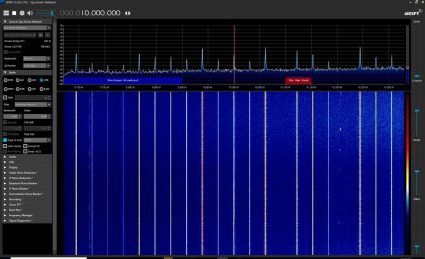
To which, Onno Benschop, @owh, replied:

Use QRM Guru to figure it out: https://qrm.guru./blockquote>

This looks like a really great resource for finding and eliminating RFI.

Phil, @kb6nzv, also gave some great advice. He wrote, “Try plonking a large steel pot over suspect devices, while those sit on a sheet of aluminum foil. Instant Faraday cage.”


How MOSFETs work

Digikey posted a link to this video explaining how MOSFETs do what they do.


Analog Devices is awesome

Analog Devices makes a lot of great ICs used in communications. SnapEDA, @Snap_EDA tweeted:

AD6655BCPZ-80 is a mixed-signal intermediate frequency (IF) diversity receiver that features a multistage, pipelined architecture. This is designed to support communications where low cost, small size, and versatility are desired. https://bit.ly/2AaHQr3

Image

Filed Under: Electronic Components, Electronics Theory, EMI/RFI

From ACM Tech News: Spray on a user interface, AI improves battery life, easier 3D electronics

May 13, 2020 By Dan KB6NU Leave a Comment

Here are some items of interest from the Association of Computing Machinery’s ACM Tech News…


Sprayable User Interfaces
MIT News
April 8, 2020

Researchers at the Massachusetts Institute of Technology’s Computer Science and Artificial Intelligence Laboratory (CSAIL) have developed a technique for spraying on user interfaces. The SprayableTech system automatically generates cardboard stencils of artwork users create in a three-dimensional editor, which can be used to apply the art to surfaces by airbrushing on functional inks. The user can add sensors and displays that control various appliances, and a microcontroller is attached to link the interface to the board that runs the code. The researchers tested SprayableTech on multiple items, including a musical interface on a concrete pillar, an interactive sofa connected to a TV, and a wall display for controlling lighting levels. CSAIL’s Michael Wessely said, “We view this as a tool that will allow humans to interact with and use their environment in newfound ways.”

read more….


AI Techniques Used to Improve Battery Health, Safety
University of Cambridge (UK)
April 6, 2020

A machine learning method developed by researchers at the University of Cambridge and Newcastle University in the U.K. can predict battery health with 10 times greater accuracy than the current industry standard. The new method could help develop safer, more reliable batteries for electric vehicles and consumer electronics. An add-on compatible with any existing battery system, the method monitors batteries by sending electrical pulses into them, measuring the results, and processing those measurements with a machine learning algorithm to predict the battery’s health and useful lifespan. The researchers trained the model by performing more than 20,000 experimental measurements. Said Cambridge’s Alpha Lee, “By improving the software that monitors charging and discharging, and using data-driven software to control the charging process, I believe we can power a big improvement in battery performance.”

read more….


UCLA Engineers Develop Simpler, Faster Way to Build Complex, Better-Performing 3D Electronics
UCLA Samueli Newsroom
April 20, 2020

Engineers at the University of California, Los Angeles (UCLA) Samueli School of Engineering have developed a faster, simpler method for three-dimensionally (3D)-printing electronics, shortening fabrication times from hours to minutes. The researchers patterned 3D shapes with pre-programmed electrostatic charges in an optical 3D printer, then dipped printed components into a solution with a dissolved material, like copper; the material cohered into desired configurations within seconds. UCLA’s Xiaoyu Zheng said the new method “can open the door to integrating new classes of 3D electronics, such as lighter, more compact antennas for the next generation of smart phones and 5G communications, or new classes of sensors and smart materials for wearables.”

read more….

Filed Under: Electronics Theory Tagged With: AI, user interfaces

From the trade magazines: On-off keying gets the job done, what you should know about RMS and communications electronic

March 10, 2020 By Dan KB6NU Leave a Comment

Here’s a smattering of links to articles in the engineering trade magazines that I thought you might find interesting….Dan


On/off keying gets the communications job done.

Written by Bob, K0NR, this is a brief review of some of the keying techniques used in communications, including Morse Code, Baudot, ASCII, and more.


Five things you should know about RMS.

TL;DR:

  1. RMS is a specific property of a defined segment of signal
  2. Filtering is not the same thing as averaging
  3. RMS is not always about power
  4. RMS is better than Mean in a sampled system
  5. You can’t filter successive RMS results to improve accuracy


How Much Do You Really Know About Communications Electronics?

As communications wends its way into virtually every electronic product, having a solid understanding of the technology becomes essential. Here are steps you can take to achieve that goal. [HINT: Getting an amateur radio license is one of them.]

Filed Under: Books and Magazines, Electronics Theory

From redditt: waterproofing coax, K7UGA

January 13, 2020 By Dan KB6NU 3 Comments

Here are three recent items of note on /r/amateurradio, the sub-reddit for radio amateurs:

  • Just passed my Advanced (Extra) Exam so…
    That’s pretty hardcore, if you ask me. There are comments from others with electronics-related tats.
  • Waterproofing Coax question
    Lots of good answers, but the one I liked best was a link to a DX Engineering Tech Tip, Weatherproofing Coaxial Cable Connections.
  • K7UGA Will Get the Ham Vote (1964). This post contains a link to a 1964 New York Times report on Barry Goldwater, the 1964 Republican candidate for president. Spoiler: Despite support from hams, he didn’t win.


Filed Under: Antennas, Electronics Theory, Just for Fun

Videos: How PCBs Work, electromagnetic waves explained without (too much) math, antennas and propagation

December 3, 2019 By Dan KB6NU Leave a Comment

Here are a couple of YouTube videos I found while looking for information on electromagnetic waves. This first one does a pretty good job of explaining how electromagnetic waves get generated with a minimum of mathematics (at least for the first 30 or 40 minutes).

This second one is one is an oldie, but goodie from the Canadian Royal Air Force on how antennas create radio waves.

And, finally, here’s one on how PCBs work. Thanks to Davey Jones of EEVblog for posting this link to his Twitter feed.

Filed Under: Antennas, Electronics Theory Tagged With: electromagnetic waves, printed circuit boards

From my inbox: Nuts and Volts, Morse Code clock

August 15, 2019 By Dan KB6NU 1 Comment

I get a lot of interesting things via email. Here are a few things that I think you might find interesting, too…..Dan


Every year at Dayton, I pick up a copy of Nuts and Volts magazine. I feel kind of guilty about it, too. I always intend to subscribe, but I never seem to get around to it.

I do subscribe to their free email newsletter. It usually has something interesting. For example, the last one had a link to a free article that describes how to Build an RF Frequency Counter Buffer for HF. Another recent article that some of you might find interesting and useful is the Know Your Basics series.

Check it out.


About a week ago, I got an email from Pat, W5WTH. He writes:

I wrote up a short blog post, “Ham Radio: My thoughts after 365 Days.” I link to your site in #10.  Any problem with that?

It’s an interesting post, and not because he links to my blog. :) So, of course, I gave him permission. Most of his takes are spot on. One that I might take exception with is, “The hobby is as cheap (or as expensive) as you want it to be.” There’s a certain minimum amount of money that you need to spend to really have fun with amateur radio. If you go too cheap, then you’re missing out.

While I was on his site, I surfed around a bit and found the Internet Time Morse Code Clock. This clock uses an ESP8266 with on board WiFi.  At power up, the rig connects to WiFi and fetches the time from the internet.  After booting up, it outputs the time of day in Morse Code to a speaker and an LED tower. The speed is adjustable by a variable in the source code.
I’m thinking about building one of these myself.


What’s the Difference between PNP and NPN? In this Electronic Design article, Maria Guerra explains the differences between PNP and NPN transistors. It’s kind of basic, but hey, you gotta know the basics.

Filed Under: Electronic Components, Electronics Theory

2019 No Nonsense General Class Study Guide: Circuit Components

February 6, 2019 By Dan KB6NU 3 Comments

Here’s chapter 2 of the updated General Class study guide. I was surprised by some of the questions that they eliminated. For example, they deleted question, “What is a microprocessor?”…….Dan


Resistors; capacitors; inductors; rectifiers; solid state diodes and transistors; vacuum tubes; batteries

There are a number of practical considerations you must make when using electronic components in circuits. Wire-wound resistors, for example, are great in DC circuits because they offer high precision, but because the wire in a wire-wound resistor is actually a coil of wire, they may not be a good choice for RF circuits.

QUESTION: Which of the following is a reason not to use wire-wound resistors in an RF circuit? (G6A06)

ANSWER: The resistor’s inductance could make circuit performance unpredictable

Cost is often also a consideration. Low cost is one reason ceramic capacitors are often used in electronic circuits.

QUESTION: Which of the following is an advantage of ceramic capacitors as compared to other types of capacitors? (G6A14)

ANSWER: Comparatively low cost

One disadvantage of ceramic capacitors is that they cannot be used where a high capacitance is needed, such as in the filter of an AC power supply. For this application, we generally use electrolytic capacitors. Electrolytic capacitors are polarized, meaning that they have both positive and negative leads. That being the case, you must be careful not to connect them so that the voltage on the positive lead is negative with respect to the voltage on the negative lead.

QUESTION: Which of the following is an advantage of an electrolytic capacitor? (G6A04)

ANSWER: High capacitance for a given volume

QUESTION: Why is the polarity of applied voltages important for polarized capacitors? (G6A13)

ANSWER: All of these choices are correct
• Incorrect polarity can cause the capacitor to short-circuit
• Reverse voltages can destroy the dielectric layer of an electrolytic capacitor
• The capacitor could overheat and explode

Both capacitors and inductors are used in RF circuits. A popular choice for inductors is the ferrite core inductor. It consists of a coil of wire wound around a ferrite core.

QUESTION: What is an advantage of using a ferrite core toroidal inductor? (G6A08)

ANSWER: All of these choices are correct
• Large values of inductance may be obtained
• The magnetic properties of the core may be optimized for a specific range of frequencies
• Most of the magnetic field is contained in the core

There are different types of ferrite materials, and how the ferrite material in a ferrite core is made will affect how it performs in an RF circuit.

QUESTION: What determines the performance of a ferrite core at different frequencies? (G6B01)

ANSWER: The composition, or “mix,” of materials used

One application for a ferrite bead or ferrite core is to provide the inductance needed to reduce or eliminate RF currents that may cause RF feedback, which can cause equipment to malfunction.

QUESTION: How does a ferrite bead or core reduce common-mode RF current on the shield of a coaxial cable? (G6B10)

ANSWER: By creating an impedance in the current’s path

Like other components, inductors are not perfect. In addition to the inductance, inductors have a parasitic capacitance that must be taken into account. The frequency at which the parasitic capacitance of the inductor resonates with the ideal inductance of the inductor is called the self-resonant frequency.

QUESTION: What happens when an inductor is operated above its self-resonant frequency? (G6A11)

ANSWER: It becomes capacitive


The diode is one of the most versatile components. They are used to rectify AC voltages, regulate DC voltages, switch RF voltages, and demodulate radio signals. One of the most important diode specifications is the junction threshold voltage. This voltage will be different for different types of diodes. Silicon diodes, which are the most widely-used type of diode, have a higher junction threshold voltage than germanium diodes.

QUESTION: What is the approximate junction threshold voltage of a conventional silicon diode? (G6A05)

ANSWER: 0.7 volts

QUESTION: What is the approximate junction threshold voltage of a germanium diode? (G6A03)

ANSWER: 0.3 volts


Transistors are the real workhorses in modern electronic equipment. They are available in single-transistor packages or in integrated circuits, which may consist of millions of transistors. There are two main types of transistors, bipolar transistors and field effect transistors (FETs).One type of FET is the Metal Oxide Semiconductor FET, or MOSFET. Metal oxide layers in a MOSFET insulate the semiconductor layers from one another.

QUESTION: Which of the following describes the construction of a MOSFET? (G6A09)

ANSWER: The gate is separated from the channel with a thin insulating layer

Transistors are often used in amateur radio circuits as amplifiers and switches. When used as a switch, a small base current controls a larger current flowing through the transistor. This current is either on or off. When off, the transistor is said to be operating in its cutoff region. When on, the transistor is operating in its saturation region.

QUESTION: What are the stable operating points for a bipolar transistor used as a switch in a logic circuit? (G6A07)

ANSWER: Its saturation and cutoff regions

Some amateur radio equipment, most notably linear amplifiers, still use vacuum tubes. The simplest vacuum tube is the triode, which has three elements: the cathode, the control grid, and the plate. The control grid, as the name implies, controls the flow of electrons from the cathode to the plate.

QUESTION: Which element of a triode vacuum tube is used to regulate the flow of electrons between cathode and plate? (G6A10)

ANSWER: Control grid

One disadvantage of a triode is parasitic capacitance between the control grid and the plate. To reduce this capacitances, a tube called a pentode, because it has five total elements, has an element called the screen grid.

QUESTION: What is the primary purpose of a screen grid in a vacuum tube? (G6A12)

ANSWER: To reduce grid-to-plate capacitance

Batteries are often used to power amateur radio equipment, so it’s important to know their characteristics and how to use them. Some batteries can be used only once, while others are rechargeable. Nickel-cadmium batteries, sometimes called “Ni-Cads,” are one type of rechargeable battery. Because they have a low internal resistance, they can supply a high current.

QUESTION: What is an advantage of the low internal resistance of nickel-cadmium batteries? (G6A02)

ANSWER: High discharge current

For applications that require long battery life, 12 volt lead-acid batteries, often car batteries or deep cycle marine batteries, are used. When using these batteries, it’s important to not discharge them all the way.

QUESTION: What is the minimum allowable discharge voltage for maximum life of a standard 12 volt lead-acid battery? (G6A01)

ANSWER: 10.5 volts


Analog and digital integrated circuits (ICs); memory; I/O devices; microwave ICs (MMICs); display devices; connectors

Most amateur radio devices today contain integrated circuits (ICs). On a single piece of silicon, manufacturers can put thousands of transistors, implementing very complex circuit functions. ICs may include analog circuits, digital circuits, or a combination of both. A simple example of an analog integrated circuit is the operational amplifier, or op amp.

QUESTION: What kind of device is an integrated circuit operational amplifier? (G6B06)

ANSWER: Analog

A more sophisticated analog IC is the MMIC, which can operate at frequencies in the microwave range.

QUESTION: What is meant by the term MMIC? (G6B02)

ANSWER: Monolithic Microwave Integrated Circuit


Digital ICs are often described by the technology used to create the transistors. One type, or “family,” of digital IC uses complementary, metal-oxide semiconductor, or CMOS, transistors. CMOS has several advantages over other IC technologies, such as transistor-transistor logic (TTL).

QUESTION: Which of the following is an advantage of CMOS integrated circuits compared to TTL integrated circuits? (G6B03)

ANSWER: Low power consumption

Memories are an important type of digital IC. One type of memory is the read-only memory, or ROM, which is often used to store programs or data that never changes.

QUESTION: What is meant by the term ROM? (G6B04)

ANSWER: Read Only Memory

QUESTION: What is meant when memory is characterized as non-volatile? (G6B05)

ANSWER: The stored information is maintained even if power is removed


Modern transceivers use light-emitting diodes (LEDs) or liquid crystal displays (LCDs) to display operating status, such as frequency. LEDs actually emit light when current flows through them. LCDs on the other hand, do not emit light, but instead become opaque when a voltage is applied across them. Because of that, they may need some sort of light to make them readable.

QUESTION: How is an LED biased when emitting light? (G6B08)

ANSWER: Forward biased

QUESTION: Which of the following is a characteristic of a liquid crystal display? (G6B09)

ANSWER: It utilizes ambient or back lighting


To connect all of the devices we typically have in an amateur radio station, we use many different types of connectors. For audio signals, we typically use phone or RCA phone jacks and plugs.

QUESTION: Which of these connector types is commonly used for audio signals in Amateur Radio stations? (G6B11)

ANSWER: RCA Phono

There are many different types of connectors designed specifically to connect RF signals. These include PL-259s, N connectors, and SMA connectors.

QUESTION: Which of these connector types is commonly used for RF connections at frequencies up to 150 MHz? (G6B12)

ANSWER: PL-259

QUESTION: Which of the following describes a type N connector? (G6B07)

ANSWER: A moisture-resistant RF connector useful to 10 GHz

QUESTION: What is a type SMA connector? (G6B11)

ANSWER: A small threaded connector suitable for signals up to several GHz

Filed Under: Connectors, Electronics Theory

From the trade magazines: Bandwidth explained, Silicon Valley flea market, twisted-pair characteristic impedance

February 1, 2019 By Dan KB6NU 3 Comments

What’s that signal’s bandwith?

Engineers will ask the question “how much bandwidth do I need for that signal?” Typically, the question relates to making sure that the signal can propagate through a component or system and come out the other end without any degradation…….Read more


What’s all this e-flea stuff, anyway?

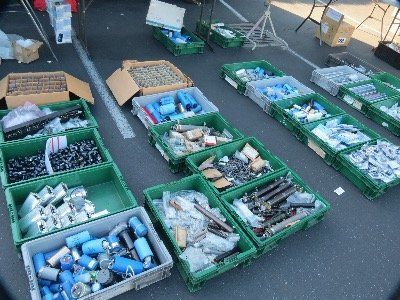
Several ham radio clubs put on an electronics flea market in Silicon Valley during the summer months. They shut down from October to February, since Californians think 60°F is unbearably cold. My buddy Dave Ruigh calls it the eFlea, and that name has stuck with our pals. Last year, the eFlea was held on the second Saturday of the month at the Fry’s Electronics parking lot in Sunnyvale……Read more

Makes me wish that I still lived in Sunnyvale.

Characteristic impedance, or not

Nixon didn’t like something he was being told so he got rid of the messengers. Something like that happened to me at a would-be client.

I was asked to certify that a particular twisted-pair cable would exhibit a particular characteristic impedance. There were two wires inside of a braided shield and in examining the cable, I could feel the two wires through the braid. The wires were not dimensionally consistent along the cable’s length. Instead they were kinky, gnarled, and whatever other adjectives you might care to apply………Read more

Filed Under: Electronics Theory, Hamfests

From the trade magazines: Rotor teardown, SDR course, power transfer

January 5, 2019 By Dan KB6NU Leave a Comment

Here are three more trade magazine articles that amateur radio operators should find interesting and useful…..Dan

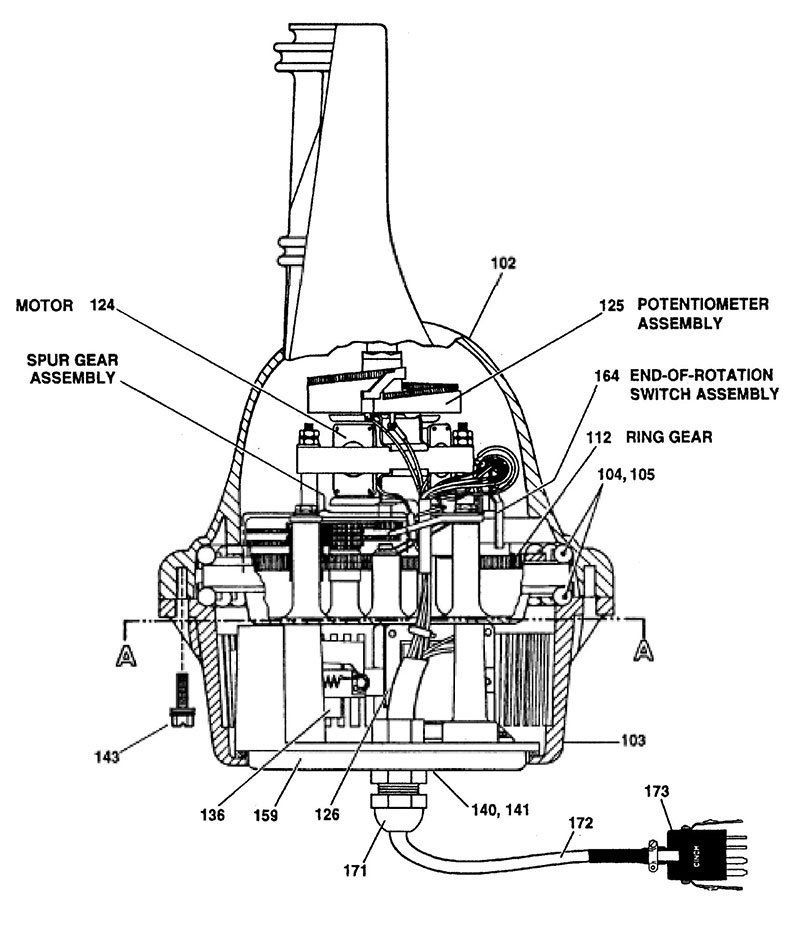
Ham Antenna Rotator: The Teardown

The Hy-Gain rotor is a very sturdy design that has passed the test of time. Paul Rako takes a look inside to see what makes it endure.

The What, Why, How, and When of Software Defined Radio

Software defined radio (SDR) has typically been confined to military or aerospace applications, but Moore’s Law and advanced RF conversion and signal-processing hardware have combined to move SDR downstream to private networks, commercial drones, industrial IoT, and first responders [and even ham radio!].

This 3-part course, from 3 of the world’s leading experts, will provide an introduction to the fundamentals of SDR, some of the latest enabling technologies, some practical design examples to show the state of the art of SDR design and implementation. It will finish with a moderated open panel to address attendee questions and the future of SDR.


Power transfer and phase basics

Our own Bob Witte, K0NR, explains why you need to match a load to a source to get the maximum power transfer. I never knew it was called Jacobi’s Law!

Filed Under: Antennas, Electronics Theory, Software-Defined Radio (SDR) Tagged With: K0NR, rotor

From my Twitter feed: Build a DF loop, calculus made easy, maker podcast

December 4, 2018 By Dan KB6NU 6 Comments

Here are some items I found in my Twitter feed yesterday. The first two are courtesy of Bill Barnes, @ataribill.

Build a direction-finding loop antenna

This is a simple antenna that you can make from a piece of scrap coax.


Calculus Made Easy

This book, written in 1910, and brought to us via Project Gutenberg (which offers more than 57,000 free e-books), purports to make calculus more understandable. I’ve only just started wading into the book, but I think that it does make it easier, if not easy. Being the teacher that I am, I’m thinking about using this book to develop a course with a working title something like “Calculus for Makers.” That just might be doable.


This Should Work Podcast

Speaking of makers, here’s a new podcast for makers and those who run makerspaces. Episode #10 – Otherworldly Sounds, Amateur Radio, and the Ur of Maker Culture with Brian Davis pays homage to amateur radio and the place it occupies in the makersphere. Other episodes of interest to amateurs include #13 – Which 3D Printer Should You Buy? and #12 – Drew Fustini, the Open Hardware Summit Badge, and Why Make?

Filed Under: Electronics Theory, EMI/RFI, Makers/Making, Podcasts Tagged With: calculus

  • « Go to Previous Page
  • Page 1
  • Page 2
  • Page 3
  • Page 4
  • Page 5
  • Interim pages omitted …
  • Page 13
  • Go to Next Page »

Primary Sidebar

No Nonsense Technician Class License Study Guide (for tests given between July 2026 and June 2030)

New No Nonsense Technican Class Study Guide now available!

The 2026 version of my Tech Class study guide is now available, and as always, the PDF version is FREE!. The ePub version costs $11.97, and a Kindle version and paperback version will be available on Amazon shortly.

Click here to get all of my "No Nonsense" study guides.

Also available: The CW Geek's Guide to Having Fun with Morse Code

W5SWL.Com
Retevis Ailunce H1 DMR Radio
DXpander: Cobweb antennas, Laser Cutting

You’ve got mail!

Enter your email address below and get an email every time I publish a new post.

Email


I frequently teach classes to help newcomers get their licenses. The next class will take place on Saturday, October 10, 2026 on the University of Michigan campus. Click here for more information.

If you can't make the class, subscribe to the mailing list to be notified of when the next class will be held.

You can always download my free study guide, and if you have any questions about the classes, or amateur radio in general, please feel free to email me directly.

Support KB6NU.Com

Donate $7.30 and get two of these cool stickers. Measuring 4.25-in. W by 2.75-in. H, it's perfect for your car, your shack, or wherever!

Contact me

If you have a question or comment about one of my blog posts, or a question about any of the material in my study guides, or just a question about ham radio in general, you can email me at [email protected].

Blogs You Should Also Read

  • AE5X: A CW-centric blog from Kingswood, Texas
  • K0LWC Blog
  • LA3ZA Ham Radio Blog
  • Little Radios, Big Fun – WB3GCK
  • Mr. Vacuum Tube's Blog
  • Radio Artisan – K3NG
  • The K0NR Weblog
  • VE3WDM's QRP Ham Radio Blog
  • W2LJ’s Blog

Ham Radio Websites

  • Dashtoons – The Hammin' Comedy by Jeff K1NSS

Podcasts

  • ICQ Podcast
  • Linux in the Ham Schack
  • No Nonsense Amateur Radio Podcast
  • Resonant Frequency Amateur Radio Podcast

Recent Comments

  • mike on Instant Character Recognition is the key to CW speed
  • Matt W1CDN on A completely different picture of Wayne Green, W2NSD (SK)
  • Chana Walsh on Rethinking ham radio education
  • Rob WfourZNG on Videos: What’s next for POTA, ham radio helps rescue man trapped in cave
  • Dan KB6NU on The EMF Explorer: A badge for ham radio?

Meta

  • Log in
  • Entries feed
  • Comments feed
  • WordPress.org

Footer

Copyright © 2026 Daniel M. Romanchik, KB6NU · Log in