• Skip to primary navigation
  • Skip to main content
  • Skip to primary sidebar
  • Skip to footer

KB6NU's Ham Radio Blog

KB6NU's Ham Radio Blog
  • HOME
  • Study Guides
  • Teach a One-Day Tech Class
  • W8SRC Repeater Guide
  • Advertise
  • Hire Me

Electronics Theory

Trade magazine articles: Op amps, microcontroller measures frequency and period, antenna basics

January 22, 2022 By Dan KB6NU Leave a Comment

All three articles in this post are from Electronic Design….Dan

Op Amps for Linear Designs: Back to the Basics

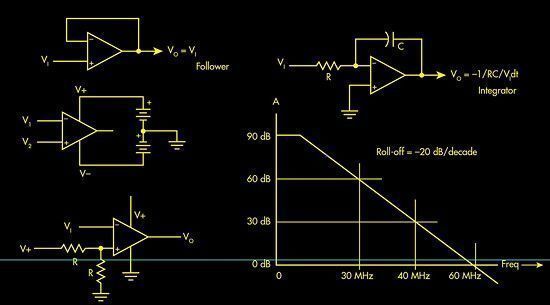
Op amps are the basic building blocks for much of linear circuit design. You probably learned about them in college and even designed some products containing an op amp.  As an electronic engineer, you will at some point in your career probably need to design a linear circuit.

If you’re not an advanced linear or analog circuit designer, perhaps the best way to fulfill your linear design needs is to use an op amp. These ICs are widely available, inexpensive, and can be configured in hundreds if not thousands of ways to satisfy most linear requirements. Here’s a summary and update on these versatile devices…..more


Microcontroller Efficiently Measures Frequency and Period

When you need to take accurate timing measurements in hardware without overloading a microcontroller, the signal measurement timer module (SMT) in the Microchip16F1619 PIC microcontrolleris perfectly suitable for this application. The SMT module captures features of a signal such as Period and Frequency, among others. This design measures input frequency signals within the range of 8 Hz to 10 MHz, and Period signals within the range of 0.1 µs to 125 ms…..more


Welcome To Antennas 101

Antennas are much more than simple devices connected to every radio. They’re the transducers that convert the voltage from a transmitter into a radio signal. And they pick radio signals out of the air and convert them into a voltage for recovery in a receiver.

Typically taken for granted and left for the last minute in a design, antennas are nonetheless critical for establishing and maintaining a reliable radio connection. They may look complex and enigmatic to most engineers, especially EEs working with wireless applications for the first time—not to mention that they come in a seemingly infinite variety of sizes and shapes. However, a brief review of the essentials can help allay any design worries….more

Filed Under: Antennas, Building/Homebrew, Electronic Components, Electronics Theory, Microcontrollers Tagged With: op amps, PIC

Amateur radio videos: S-parameters, crystals go to war, why Fluke meters cost so much

December 22, 2021 By Dan KB6NU Leave a Comment

An intro to S-parameters

With the advent of the nanoVNA, S- parameter measurement is now within reach of most hams. What are S-parameters? Watch this video and find out. Most hams probably don’t need to know this stuff, but it’s pretty cool when you do know it.

Crystals go to war

They don’t make films like this anymore. I’m guessing that they don’t make crystals like this anymore, either.

Why are Fluke meters so expensive?

Fluke meters are arguably the Cadillacs of the test and measurement world. In this video, Dave explains why this is so. Although he gives eight reasons why Flukes cost more than other meters, I think that the most important is measurement confidence. You just feel more confident about the measurement when you’re using a Fluke.

Filed Under: crystals, Electronics Theory, Test Equipment Tagged With: Fluke, s parameters

Amateur radio videos: Mountain Dew, ARRL Foundation, how does electricity really work?, how Begalis are made

December 12, 2021 By Dan KB6NU 1 Comment

Do hams drink Dew?

N3JT posted this to the CWops mailing list, and I thought it was just hilarious.

How electricity really works

This video has been making the rounds lately. It presents a very interesting explanation of how electrical energy flows.

A peek into the Begali factory

I am an unabashed Begali fanboy. Here’s a peek inside the Begali factory.


Filed Under: Amateur radio business, CW, Electronics Theory Tagged With: Begali, Mountain Dew

From the trade magazines: Impedance matching, AM flutter, DIY AI

November 21, 2021 By Dan KB6NU 4 Comments

Back to Basics: Impedance Matching By Lou Frenzel, W5LEF

The term “impedance matching” is rather straightforward. It’s simply defined as the process of making one impedance look like another. Frequently, it becomes necessary to match a load impedance to the source or internal impedance of a driving source. A wide variety of components and circuits can be used for impedance matching. This series summarizes the most common impedance-matching techniques.

  • Impedance Matching: Essential Design Knowledge
  • Back to Basics: Impedance Matching – Part 1
  • Back to Basics: Impedance Matching – Part 2
  • Back to Basics: Impedance Matching – Part 3
  • Automatic Impedance Matching in RF Design
  • Impedance Matching Basics: Smith Charts

The entire series is available as a downloadable ebook.


While I’m not sure, I’d guess that something similar happens on 160 meters or even the HF bands….Dan

AM Radio ‘Flutter’

Sometimes I like to listen to a couple of AM radio stations that transmit from southern New Jersey, which is rather far from here on Long Island. Their signals are pretty strong during the daytime but now and then there is a rapid in-and-out fading effect, which sounds very much like a flutter.

I’ve sometimes heard that same effect when listening to shortwave radio and I initially assumed it was an ionosphericphenomenon but now I don’t think so. There seems to be an alternative explanation.

…read the complete article


I haven’t tried these yet, but they look like fun….Dan

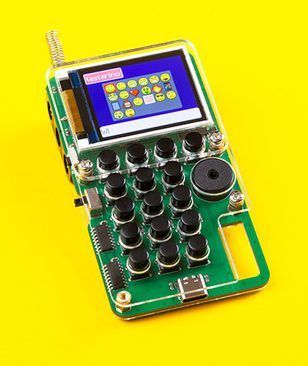
Google’s AIY kits offer do-it-yourself artificial intelligence

There’s plenty of low-cost hardware out there feasible for implementing deep learning training and (especially, along with being your likely implementation focus) inference, as well as plenty of open source (translation: free) and low-priced software, some tied to specific silicon and other more generic. Tying the two (hardware and software) together in a glitch-free and otherwise robust manner is the trick; select unwisely and you’ll waste an inordinate amount of time and effort wading through arcane settings and incomplete (and worse: incorrect) documentation, trying to figure out why puzzle pieces that shouldfit together perfectly aren’t.

That’s where Google’s AIY (which stands for “Artificial-Intelligence-Yourself,” a play on DIY, i.e., “Do-It-Yourself) Project Kits come in. They’re targeted at hobbyists and professionals alike: in Google’s own words, “With our maker kits, build intelligent systems that see, speak, and understand.

…read complete article

Filed Under: Building/Homebrew, Electronics Theory, Kits, Propagation Tagged With: AI, flutter, impedance matching

Amateur radio videos: How does a pi network work?, world-wide microchip shortage, VOA on operating /P

July 11, 2021 By Dan KB6NU 1 Comment

How does a pi network work?

Why do tube transmitters and amplifiers use pi networks? And, how do they work? This is not only a nice explanation of how the pi network works but also resonant circuits.

Worldwide microchip shortage

Steve, KO4KGS, explains why some ICs are in short supply these days, and as a result, why some radios are also in short supply. Steve notes that there’s no easy fix. In fact, the only solution is to build more chip factories, and notes that China is really positioning themselves to take control of this market.

VOA reports on operating portable

A Voice of America report on operating portable, featuring Raisa, R1BIG. Unfortunately, the audio of the interviewed operators doesn’t seem to be working.

Filed Under: Electronic components, Electronics Theory, Mobile/Portable, Operating, Transmitters

From the trade magazines: Automatic impedance matching, AC grounding, rechargeable batteries

June 2, 2021 By Dan KB6NU 2 Comments

Automatic impedance matching in RF design

Impedance (Z) matching is an essential part of most RF circuit design. Regardless of what you’re designing, getting as much power to a load is a top target. Impedances must be matched to transfer the maximum amount of signal power between stages. And in power amplifiers (PAs), impedance matching is critical to getting the maximum power to the final load and maintaining PA linearity. Impedance matching to an antenna in a receiver or transmitter is an essential process.

Some loads are constant; thus, a single fixed Z-matching circuit can be used. But in other applications, that final load may change, or the frequency of operation will change, meaning that a fixed Z-match circuit will not produce the desired results. For these applications, a variable matching network that you can adjust is needed. Better still is a variable and automatic Z-match circuit that adjusts itself to the immediate load or frequency conditions.

Auto Z matching is more common than you think. If you own a recent smartphone, you’re probably using an auto Z-match antenna tuner. However, there are other applications. Here’s a primer on this topic for your elucidation and cogitation.

…read more


AC grounding: essential, dangerous, or both?

Most electrical engineers learn early-on about the importance of what are referred to as circuit grounds. In many cases, whatever your problem, adding a ground or improving the one you have (meaning lower impedance) is a good thing that can’t hurt. That’s what circuit EEs have drilled into them as they work and debug bench circuits prototypes, and more, and learn to connect the analog ground to the digital ground at one point only to minimize unwanted ground-current flow and associated noise.

In most cases, such grounding does improve circuit performance, but as every experienced engineer knows, every rule has legitimate exceptions, and grounding is one of them. A large part of the confusion comes from the ambiguous and this sloppy terminology associated with that innocent-sounding seven-letter word.

…read more


Rechargeable batteries enable greener electronics

While batteries provide untethered power, enabling convenience, dependability, and mobility, environmental responsibility suggests that rechargeable batteries have the same benefits, but can save money while reducing the amount of waste. This article examines the benefits offered by rechargeable battery technology, enabling us to make life better.

…read more

Filed Under: Antennas, Batteries, Electronics Theory Tagged With: grounding

Bob Pease analog design collection online

May 15, 2021 By Dan KB6NU 3 Comments

Bob Pease was one of the premiere analog designers in the late 1900s  and early 2000s. He designed analog ICs for National Semiconductor when, arguably, they were the premiere analog IC company in the world. He also wrote a series for columns for Electronic Design magazine on a variety of analog topics. They’ve started collecting his columns and publishing them as free e-books.

The first collection is now available. (You do have to give them your name and email address, but you can opt out of any further emails.) The columns in this collection cover:

  • Analog Engineering
  • Technical Reading
  • Transimpedance Amplifiers
  • Frequency-to-Voltage Converters
  • Capacitor Leakage
  • Noise Gain
  • Current Limiters
  • Output Impedance

I didn’t always understand these columns back in the day, but I could always appreciate the deep knowledge that Pease had of analog electronics. And, it’s that knowledge that allows you to design circuits and systems that not only work, but work reliably and can be manufactured in volume.

Filed Under: Electronic Components, Electronics Theory

Wishful thinking never hertz

July 5, 2020 By Dan KB6NU 4 Comments

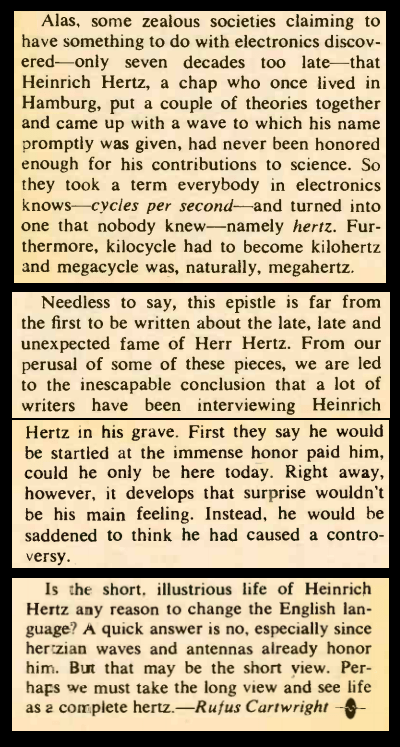
On the amateur radio subreddit, someone posted this little bit of commentary from a 1967 issue of Electronics Illustrated:


The question is, is this argument rational or irrational? I’m just old enough to remember when we talked about frequencies in “kay-cees” and radio dials (yes, they had dials back then, too) were marked in “kc,” or more correctly, “kc/s.” My take on this is that referring frequencies in cycles per second is a lot more rational, at least a lot more self-explanatory, than referring to them as Hertz.

Most of my readers will blow this off as the ranting of an old ham, that is to say me. But, listen for a second. I teach a lot of newcomers. Part of that is teaching them the terminology, including the concept of frequency. It would be a lot easier if we could leave it as “cycles per second” instead of saying that we call one cycle per second a  hertz, and then explain why we do so.

One fellow replied, “Obviously written by a luddite refusing to accept the SI system of units.” my reply to that is, “Mr. Cartwright doesn’t have a problem with the SI system at all, just the name of one of the units. And, if you ask me (I know you didn’t ask, but let’s just say that you did for the sake of this argument), he has a point. “Cycles per second” is a literal description of the unit and its meaning is more obvious than hertz, which has to be explained.”

So, while the horse is long out of the barn, and there’s no way to get it back, I do sometimes wish we hadn’t made the change from c/s to Hz.

Filed Under: Electronics Theory Tagged With: Hertz, SI

Will AI design our signals in the future?

June 17, 2020 By Dan KB6NU 4 Comments

In their experiments, the author of the article claim that they were able to improve the bit error rate of communications via the TDRSS by 42%.

In the May 2020 issue of IEEE Spectrum, there’s an intriguing article by four engineers who claim, “The era of communications systems designed solely by humans is coming to an end.” In the article, “In the Future, AIs—Not Humans—Will Design Our Wireless Signals,” they say, “The reason is simple: rapidly escalating complexity.” Of course, three of the four are associated with a company, DeepSig, that sell the AI tools to do this development, but I found this to be an interesting concept.

In the article, they describe their design approach and how they applied it to the signals sent via NASA’s Tracking Data Relay Satellite System (TDRSS). They claim that using their AI-designed signals, they were able to improve the bit error rate by 42% from 5% to just under 3%. They do admit, however, that in both tests, they ran the system without any error correction, which would have reduced the bit error rate of the system.

My question would be is the effort (and the cost of the software) worth it? The article doesn’t really give much detail, so it’s hard to say. Also, the authors note that this work was just a proof of concept, meaning that they do intend on making improvement in the future.

So, is AI going to take over ham radio, and if so, when? I’ll probably still be pounding brass myself in 20 years, but I certainly think AI is going to play a bigger part in amateur radio in the future. At least I hope so.

You gotta admit it’s interesting to consider the ramifications.. For example, will an AI get the Ham of the Year award at Dayton in 2040? And, when will hear hear the FT8 guys complain about AI being the death of ham radio?

Filed Under: Electronics Theory Tagged With: artificial intelligence

Things I learned on Twitter this morning: QRM Guru, how MOSFETs work, Analog Devices is awesome

May 19, 2020 By Dan KB6NU 1 Comment

One of the reasons I love being on Twitter is that I learn so much from the #hamradio folks that I follow. Here’s what I learned about this morning.

QRM Guru

This morning, Jason Milldrum, @NT7S, tweeted:

I’ve mostly got the new shack set up and operating again, but now I need to tackle this nasty QRM. It’s across the entire tuning range of the Airspy HF+. Space approx. 30 kHz. Not sure if coming from our home or exterior. Any ideas?

To which, Onno Benschop, @owh, replied:

Use QRM Guru to figure it out: https://qrm.guru./blockquote>

This looks like a really great resource for finding and eliminating RFI.

Phil, @kb6nzv, also gave some great advice. He wrote, “Try plonking a large steel pot over suspect devices, while those sit on a sheet of aluminum foil. Instant Faraday cage.”


How MOSFETs work

Digikey posted a link to this video explaining how MOSFETs do what they do.


Analog Devices is awesome

Analog Devices makes a lot of great ICs used in communications. SnapEDA, @Snap_EDA tweeted:

AD6655BCPZ-80 is a mixed-signal intermediate frequency (IF) diversity receiver that features a multistage, pipelined architecture. This is designed to support communications where low cost, small size, and versatility are desired. https://bit.ly/2AaHQr3

Image

Filed Under: Electronic Components, Electronics Theory, EMI/RFI

  • « Go to Previous Page
  • Page 1
  • Page 2
  • Page 3
  • Page 4
  • Interim pages omitted …
  • Page 13
  • Go to Next Page »

Primary Sidebar

No Nonsense Technician Class License Study Guide (for tests given between July 2026 and June 2030)

New No Nonsense Technican Class Study Guide now available!

The 2026 version of my Tech Class study guide is now available, and as always, the PDF version is FREE!. The ePub version costs $11.97, and a Kindle version and paperback version will be available on Amazon shortly.

Click here to get all of my "No Nonsense" study guides.

Also available: The CW Geek's Guide to Having Fun with Morse Code

W5SWL.Com
Retevis Ailunce H1 DMR Radio
DXpander: Cobweb antennas, Laser Cutting

You’ve got mail!

Enter your email address below and get an email every time I publish a new post.

Email


I frequently teach classes to help newcomers get their licenses. The next class will take place on Saturday, February 7, 2026 on the University of Michigan campus. Click here for more information.

If you can't make the class, subscribe to the mailing list to be notified of when the next class will be held.

You can always download my free study guide, and if you have any questions about the classes, or amateur radio in general, please feel free to email me directly.

Support KB6NU.Com

Donate $7.30 and get two of these cool stickers. Measuring 4.25-in. W by 2.75-in. H, it's perfect for your car, your shack, or wherever!

Contact me

If you have a question or comment about one of my blog posts, or a question about any of the material in my study guides, or just a question about ham radio in general, you can email me at [email protected].

Blogs You Should Also Read

  • AE5X: A CW-centric blog from Kingswood, Texas
  • K0LWC Blog
  • LA3ZA Ham Radio Blog
  • Little Radios, Big Fun – WB3GCK
  • Mr. Vacuum Tube's Blog
  • Radio Artisan – K3NG
  • The K0NR Weblog
  • VE3WDM's QRP Ham Radio Blog
  • W2LJ’s Blog

Ham Radio Websites

  • Dashtoons – The Hammin' Comedy by Jeff K1NSS

Podcasts

  • ICQ Podcast
  • Linux in the Ham Schack
  • No Nonsense Amateur Radio Podcast
  • Resonant Frequency Amateur Radio Podcast

Recent Comments

  • Michael Burkhardt on One lump or two (or three)?
  • Eric on POTA notes, 7/27/26
  • Steve KB3JC on How to “ragchew” on CW
  • Dan KB6NU on Yaesu FT-710: What’s the big deal?
  • Andrei on Yaesu FT-710: What’s the big deal?

Meta

  • Log in
  • Entries feed
  • Comments feed
  • WordPress.org

Footer

Copyright © 2026 Daniel M. Romanchik, KB6NU · Log in