• Skip to primary navigation
  • Skip to main content
  • Skip to primary sidebar
  • Skip to footer

KB6NU's Ham Radio Blog

KB6NU's Ham Radio Blog
  • HOME
  • Study Guides
  • Teach a One-Day Tech Class
  • W8SRC Repeater Guide
  • Advertise
  • Hire Me

Electronics Theory

Interesting stuff from the trade magazines: circuit simulation, linearity, circulators and isolators

August 25, 2017 By Dan KB6NU Leave a Comment

EETimes10 Circuit Design Simulation Apps for Pros & DIYers. Whether you’re a professional printed circuit board designer or do-it-yourselfer, you know that testing your circuit board design is a must. Testing can save you money and time avoiding faulty PCB fabrication because it gives you a chance to fix what doesn’t work before the board is made.

It’s best to test your design out virtually. In other words, make a digital (virtual) prototype of your board and simulate (model) how it will behave in the real world. Here are some popular tools to do virtual testing. These software packages cost money but can save you costly mistakes.


Underlining the Meaning of Linearity. Linearity in an RF/microwave component or system is fairly easy to understand in concept: It refers to the ability of a component or system to provide an output signal that is directly proportional to an input signal. As a result, the relationship of the signal input to the signal output as a function of frequency is a straight line.

Achieving good linearity, on the other hand, is not quite so simple, even though it is crucial to preserving key pulse characteristics in a radar and modulation quality in a communications system. Whether it is a frequency mixer, an amplifier, or a complete system, many barriers to linearity must be overcome, often at the expense of some other performance parameter.


A Primer on Circulators and Isolators. Circulators and isolators are three-port passive electronic devices that help direct the flow of microwave signals in RF equipment and systems [including repeaters…Dan]. A port is defined as a connection point for either an input signal, output signal, or termination.

Filed Under: Building/Homebrew, Circuit Simulation, Electronics Theory, Everything Else, VHF/FM/Repeaters

Learn FPGA basics, 5G and RFI, the Ohm in Ohm’s Law

October 14, 2016 By Dan KB6NU Leave a Comment

Here are some more interesting articles from the electronics engineering trade magazines:

electronic-designThe principles of FGPAs. Field-programmable gate arrays (FPGAs) were introduced more than three decades ago, and since then they have evolved, giving way to new generations of FPGAs with better logic density and performance that can be used in a broader range of applications.

ieee-spectrumWhat 5G engineers can learn from radio interference’s troubled past. The last—and only—radio innovator having no reason to think about interference was Heinrich Hertz, when he fired up the world’s first radio transmitter in 1886. Once he turned on a second one, he created the potential for interference. It’s been a problem ever since.

planet-analogThe Munich discovery without which Silicon Valley may never have been born: A resistance story. Georg Simon Ohm, a mathematician and physicist, was born in Bavaria on 18th March 1789. He became fascinated by electricity shortly after electromagnetism was discovered in 1820. At the time, current was measured by measuring the magnetic flux around a wire conductor.

Filed Under: Electronics Theory, EMI/RFI

One-Day Tech Class Videos: Semiconductors, Schematics

October 6, 2016 By Dan KB6NU Leave a Comment

Here are two more videos from the One-Day Tech Class that I held on January 30, 2016:

Filed Under: Classes/Testing/Licensing, Electronic Components, Electronics Theory Tagged With: diodes, Figure T-1, schematics, semiconductors, transistors, videos

One-Day Tech Class Videos: Scientific notation, decibels, electronic components

October 4, 2016 By Dan KB6NU Leave a Comment

Here are three more video clips from my one-day Tech class of January 30, 2016:


Filed Under: Classes/Testing/Licensing, Electronics Theory Tagged With: decibels, scientific notation

From my Twitter feed: Humanitarian Award, Improved AM detector, basic circuits for kids

October 4, 2016 By Dan KB6NU Leave a Comment

arrl's avatar
ARRL @arrl
ARRL Invites Nominations for 2016 International Humanitarian Award: Nominations are open for the 2016 ARRL In… bit.ly/2dpQIep

EDNcom's avatar

EDN.com @EDNcom
This #DesignIdea describes a simple way to overcome traditional diode RF detector limitations: ubm.io/2dtEsad#circuit#AMdetector

DIYGirls's avatar

DIY Girls @DIYGirls
Download our free lesson plan that introduces kids to basic circuits buff.ly/2d9GZGF#edchat

Filed Under: ARRL, Electronics Theory, Receivers

From the trade magazines: home prototyping, piezoelectric principles, the Fast Fourier Transform

September 26, 2016 By Dan KB6NU 1 Comment

electronic-designBuilding home or very small small office electronic-circuit prototypes, part 1. The author writes, “This is hopefully the first installment of several related to setting up a small and inexpensive hobbyist/limited-technology-prototype build-and-test capability.” Unfortunately, I don’t think that there’s a part two, even though this was written a year ago. Even so, it’s an interesting story of how this engineer set up a small surface mount reflow oven.

What is the piezoelectric effect? A short, basic introduction to piezoelectricity: who discovered it, how it works, and what piezoelectric devices are still used in electronics devices today.

ednFFT: equations and history. The FFT (Fast Fourier Transform) is rightfully regarded as the most important numerical algorithm of our lifetime. Whether it’s used to monitor signals coming from the depths of the earth or search for heavenly life forms, the algorithm is widely used in all scientific and engineering fields. But,what exactly is an FFT? How is it used in software-defined radios?

Filed Under: Building/Homebrew, Electronic Components, Electronics Theory, Surface-Mount Devices Tagged With: FFT, piezoelectric, reflow soldering, SMD

Technical advances in QST 25 and 50 years ago in QST

September 22, 2016 By Dan KB6NU Leave a Comment

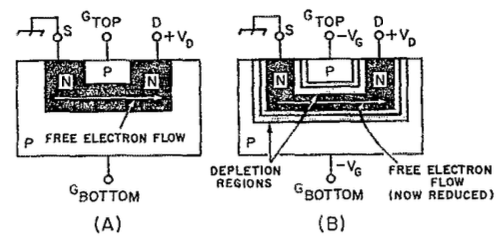
QSTMy last post talked about how QST covered one the technical advances 100 years ago—the move to undamped wave transmitters. The October 1966 and October 1991 issues of QST also had interesting articles on new technologies of the day. The October 1966 issue featured the article, “Field Effect Transistors: What They Are, How They Work.”

Field-effect transistors (FETs) are, of course, now an important part of nearly every amateur radio set. In 1966, however, they were cutting edge technology. I’m not sure when they first became available, but the article notes, “A recently introduced semiconductor device called the field-effect transistor, or FET…”

The nice thing about articles from this era of amateur radio is that they were very descriptive. This article starts out by describing how junction diodes work, which leads to a discussion of how junction FETs work (see the diagram below), and finally how insulated-gate FETs work.

jfet-operation

Also included are some typical characteristic curves and some circuit examples. Great stuff if you’re just learning about FETs or want to review what you know about them.

The next breakthrough in 1991: DSP

Dave, K1ZZ, hit the nail on the head in his October 1991 editorial when he wrote, “It’s pretty clear that the next major development to hit our ham shacks will be digital signal processing (DSP).” He couldn’t have gotten it any more right. After more than 25 years of development in DSP, nearly all of our radios use some form of DSP, and some of them are just one big digital signal processor.

Some hams wax nostalgic about the “good, old days” of tubes and analog circuits, but not me. DSP makes amateur radio a lot more fun.

Also worth noting in this issue is the Audio Filter Roundup. In this article, Jim, KR1S reviews the J-Com Magic Notch Filter, the Modular Systems Smart Filter, and the JPS Communications NIR-10. The first two are analog filters, the third a DSP filter. None of these products are still available, nor are the companies  still in business. Perhaps that was an omen of things to come.

Filed Under: DSP, Electronics Theory, Gear/Gadgets Tagged With: audio filter, FET

From my Twitter feed: NPR edition

September 6, 2016 By Dan KB6NU Leave a Comment

UlisK3LU's avatar

Ulis K3LU @UlisK3LU

Before Apple And Facebook, There Was Something More Revolutionary n.pr/2bmPlwK Via @NPR


npralltech's avatar

All Tech Considered @npralltech

An algorithm called the Kalman filter helped Buzz and Neil land on the moon. technologyreview.com/s/602287/how-a…


MicrowavesRF's avatar
Microwaves & RF @MicrowavesRF

Microwaves and RF Library Focus On Mixers e-Book Compendium bit.ly/2aUVHzZ pic.twitter.com/HuJqyhxyn2

Filed Under: Electronic Components, Electronics Theory Tagged With: Kalman filter, Marconi, mixers

From ACM Tech News: Stretchy circuits, top ten technologies, more durable electronics

July 12, 2016 By Dan KB6NU Leave a Comment

acm-tech-newsFast, Stretchy Circuits Could Yield New Wave of Wearable Electronics
UW-Madison News (05/27/16) Renee Meiller
University of Wisconsin-Madison researchers led by professor Zhenqiang Ma say they have created the fastest stretchable, wearable integrated circuits in the world, which could further the Internet of Things and a more connected, high-speed wireless world. “We’ve found a way to integrate high-frequency active transistors into a useful circuit that can be wireless,” Ma says. “This is a platform. This opens the door to lots of new capabilities.” The circuits’ design was inspired by twisted-pair telephone cables, which contain two extremely small and intertwining power transmission lines in repeating S-curves. The configuration is built in two layers with segmented metal blocks, enabling the lines to stretch without inhibiting performance while also protecting them from interference. Current loss also is substantially mitigated by confinement of the electromagnetic waves flowing through the lines. The circuits currently operate at radio frequency levels up to 40 GHz, with a thickness of 25 micrometers. The researchers say their extremely small size makes them very effective in epidermal electronic systems, which could enable medical staff to monitor patients wirelessly and remotely. View Full Article

The Top 10 Emerging Technologies of 2016

KurzweilAI.net (06/23/16)
The World Economic Forum (WEF) last week published its annual list of 2016’s breakthrough technologies, with a specific focus on closing the gaps in investment and regulation. “Horizon scanning for emerging technologies is crucial to staying abreast of developments that can radically transform our world, enabling timely expert analysis in preparation for these disruptors,” says WEF Meta-Council on Emerging Technologies chair Bernard Meyerson. “The global community needs to come together and agree on common principles if our society is to reap the benefits and hedge the risks of these technologies.” The 10 leading technologies on the 2016 WEF list include nanosensors and the Internet of Nanothings, which involve tiny sensors that can be circulated in the human body or embedded in construction materials. Also making the list is blockchain cryptocurrency, with its potential to transform how markets and governments function. Other cited technologies include self-driving vehicles, miniature organ models, and next-generation sodium-, aluminum,- and zinc-based batteries that could support clean and reliable mini-grids. The list also included perovskite solar cells, which offer near-ubiquitous deployment, easier fabrication, and more efficient power production than silicon solar cells. WEF’s list also includes an open artificial intelligence ecosystem driven by innovations in natural-language processing, social-awareness algorithms, and data availability, enabling versatile smart digital assistants. View Full Article

Stanford Research May Lead to More Durable Electronic Devices Such as Cellphones

Stanford News (06/27/16) Andrew Myers
Stanford University researchers have found the glassy materials in transistors respond very differently to compression than they do to the tension of bending and stretching. The glassy materials “are actually stiffer when compressed than when stretched, and we can use this knowledge to design more durable chips and devices,” says Stanford professor Reinhold Dauskardt. When active, electronic devices heat up and the components expand; when not in use, the components cool down and contract. The materials’ response to this expansion and contraction is inherently related to the interaction within the network of atoms or groups of atoms that do not fully bond during production. In compression, these atoms strongly repel each other to make the network stiffer. In tension, their failure to bond causes the same atoms to interact less, making the materials less stiff and, consequently, more expansive than expected when they heat up. “If you could get rid of all of the unbonded terminal groups and create an absolutely flawless material, you would not see these asymmetries, but we can’t, so we have to understand and accommodate this knowledge in design,” Dauskardt says. Thanks to the Stanford research, materials scientists will have to integrate the results into their mathematical algorithms, which currently assume the stiffness is symmetrical. View Full Article

Filed Under: Electronic components, Electronics Theory

Amateur radio video: RSGB promo, electronics crash course, WWII

May 9, 2016 By Dan KB6NU Leave a Comment

This is the new amateur radio promo from the RSGB, Great Britain’s version of the ARRL.


This is the first of a series of videos produced by Make: magazine on electronics fundamentals.


bbc-wwii-history

The unassuming Buckinghamshire village of Whaddon was the center of radio communications for the British in WW II. This BBC video celebrates the role that Whaddon played in helping the Allies win the war.

Filed Under: Electronic Components, Electronics Theory, People, Promotion & PR Tagged With: BBC, make:, rsgb, WWII

  • « Go to Previous Page
  • Page 1
  • Interim pages omitted …
  • Page 3
  • Page 4
  • Page 5
  • Page 6
  • Page 7
  • Interim pages omitted …
  • Page 13
  • Go to Next Page »

Primary Sidebar

No Nonsense Technician Class License Study Guide (for tests given between July 2026 and June 2030)

New No Nonsense Technican Class Study Guide now available!

The 2026 version of my Tech Class study guide is now available, and as always, the PDF version is FREE!. The ePub version costs $11.97, and a Kindle version and paperback version will be available on Amazon shortly.

Click here to get all of my "No Nonsense" study guides.

Also available: The CW Geek's Guide to Having Fun with Morse Code

W5SWL.Com
Retevis Ailunce H1 DMR Radio
DXpander: Cobweb antennas, Laser Cutting

You’ve got mail!

Enter your email address below and get an email every time I publish a new post.

Email


I frequently teach classes to help newcomers get their licenses. The next class will take place on Saturday, February 7, 2026 on the University of Michigan campus. Click here for more information.

If you can't make the class, subscribe to the mailing list to be notified of when the next class will be held.

You can always download my free study guide, and if you have any questions about the classes, or amateur radio in general, please feel free to email me directly.

Support KB6NU.Com

Donate $7.30 and get two of these cool stickers. Measuring 4.25-in. W by 2.75-in. H, it's perfect for your car, your shack, or wherever!

Contact me

If you have a question or comment about one of my blog posts, or a question about any of the material in my study guides, or just a question about ham radio in general, you can email me at [email protected].

Blogs You Should Also Read

  • AE5X: A CW-centric blog from Kingswood, Texas
  • K0LWC Blog
  • LA3ZA Ham Radio Blog
  • Little Radios, Big Fun – WB3GCK
  • Mr. Vacuum Tube's Blog
  • Radio Artisan – K3NG
  • The K0NR Weblog
  • VE3WDM's QRP Ham Radio Blog
  • W2LJ’s Blog

Ham Radio Websites

  • Dashtoons – The Hammin' Comedy by Jeff K1NSS

Podcasts

  • ICQ Podcast
  • Linux in the Ham Schack
  • No Nonsense Amateur Radio Podcast
  • Resonant Frequency Amateur Radio Podcast

Recent Comments

  • Michael Burkhardt on One lump or two (or three)?
  • Eric on POTA notes, 7/27/26
  • Steve KB3JC on How to “ragchew” on CW
  • Dan KB6NU on Yaesu FT-710: What’s the big deal?
  • Andrei on Yaesu FT-710: What’s the big deal?

Meta

  • Log in
  • Entries feed
  • Comments feed
  • WordPress.org

Footer

Copyright © 2026 Daniel M. Romanchik, KB6NU · Log in