• Skip to primary navigation
  • Skip to main content
  • Skip to primary sidebar
  • Skip to footer

KB6NU's Ham Radio Blog

KB6NU's Ham Radio Blog
  • HOME
  • Study Guides
  • Teach a One-Day Tech Class
  • W8SRC Repeater Guide
  • Advertise
  • Hire Me

Test Equipment

2015 General Class study guide: Section G4B – Test and monitoring equipment, two-tone test

February 7, 2015 By Dan KB6NU Leave a Comment

In this section, question G4B07 was eliminated and question G4B16 was renumbered G4B07, for a net loss of one question.

When you set up your amateur radio station, sometimes called your “shack,” you’ll not only want to acquire radios, but also some test equipment. The most basic piece of test equipment is the voltmeter.

Voltmeters may be either analog or digital, but most amateurs now choose digital meters because they are cheaper and more accurate than analog meters. An advantage of a digital voltmeter as compared to an analog voltmeter is that it has better precision for most uses. (G4B06) Another advantage is high input impedance. High input impedance is desirable for a voltmeter because it decreases the loading on circuits being measured. (G4B05)

The use of an analog meter might, however, be preferred over a digital meter in some applications. When adjusting tuned circuits, the use of an instrument with analog readout may be preferred over an instrument with a numerical digital readout. (G4B14) The reason for this is that with an analog meter you can more easily see how a circuit’s output changes as you tune it.

An oscilloscope is another handy piece of test equipment to have in your shack. With an oscilloscope, you can view signal waveforms. One advantage of an oscilloscope versus a digital voltmeter is that complex waveforms can be measured. (G4B02) An oscilloscope is an item of test equipment that contains horizontal and vertical channel amplifiers. (G4B01)

An oscilloscope is the best instrument to use when checking the keying waveform of a CW transmitter. (G4B03) The attenuated RF output of the transmitter is the signal source that is connected to the vertical input of an oscilloscope when checking the RF envelope pattern of a transmitted signal. (G4B04)

Antenna analyzers are instruments that can measure a number of different parameters associated with antennas, such as SWR. The antenna and feed line must be connected to an antenna analyzer when it is being used for SWR measurements. (G4B11) A use for an antenna analyzer, other than measuring the SWR of an antenna system, is determining the impedance of an unknown or unmarked coaxial cable. (G4B13)

Strong signals from nearby transmitters can affect the accuracy of measurements when making measurements on an antenna system with an antenna analyzer. (G4B12) This is because the antenna being analyzed will pick up RF energy from the nearby transmitters, and this energy will be read as excessive reflected power.

Standing wave ratio can also be determined with a directional wattmeter. (G4B10) To measure the SWR with a direction wattmeter, you first measure the power in one direction, then in the opposite direction, and finally calculate the SWR.

Another instrument often used for making antenna measurements is the field strength meter. The radiation pattern of an antenna can be determined with a field strength meter. (G4B09) A field-strength meter may also be used to monitor relative RF output when making antenna and transmitter adjustments. (G4B08)

One test that is often run on a SSB transmitter is the two-tone test. A two-tone test analyzes the linearity of a transmitter. (G4B15) Two non-harmonically related audio signals are used to conduct a two-tone test. (G4B07)

Filed Under: Classes/Testing/Licensing, Test Equipment Tagged With: antenna tuner, field strength meter, multimeter, oscilloscope, two-tone test

NIST says portable radios may fail at high temperatures (D’oh!)

December 17, 2014 By Dan KB6NU 3 Comments

Don’t try this with your $35 Baofeng. :) The news here is that NIST has not only tested units at high temperatures, but has developed a methodology and a chamber for testing radios at high temperatures. This should help radio manufacturers develop more reliable radios for firefighters. This item is from the December 16, 2014 issue of NIST Tech Beat…Dan

New test results* from the National Institute of Standards and Technology (NIST) confirm that portable radios used by firefighters can fail to operate properly within 15 minutes when exposed to temperatures that may be encountered during firefighting activities.

firefighting radio testing
A portable firefighter radio is instrumented for testing in a NIST-designed apparatus that consistently creates thermal conditions representative of typical fire environments. Data and performance measurements recorded with the equipment are furnished to the National Fire Protection Association, which is developing a performance standard for portable radios used by emergency personnel.
Credit: NIST
View hi-resolution image

Firefighters rely on the radios to report their location and to communicate with other first responders as well as the incident command post or communications center. Performance problems with portable radios have been identified by the National Institute for Occupational Safety and Health as contributing factors in some firefighter fatalities.

All seven of the firefighter portable radios tested by NIST failed to perform properly within 15 minutes when exposed to temperature levels encountered in “fully involved” fires, as when all the contents in a room or structure are burning. Four of the handheld radios stopped transmitting, and three experienced significant “signal drift,” rendering the radios unreliable for communication.

The failures occurred while the radios were subjected to a temperature of 160 degrees Celsius (320 degrees Fahrenheit), termed Thermal Class II conditions.** The temperature is representative of a fully involved fire or conditions outside a room when its contents burst into flames simultaneously, a phenomenon known as flashover.

During the post-test cool-down period, three of the radios did not recover normal function.

Funded by the U.S. Department of Homeland Security, the NIST tests further ongoing work to develop performance standards for firefighter portable radio equipment, which includes radios, wearable combinations of speakers and microphones, and related items. The existing standard provides only general guidance—that portable radios “be manufactured for the environment in which they are to be used.”

NIST researchers are furnishing their test data and performance measurements to the National Fire Protection Association, which is developing a performance standard for portable radios used by emergency personnel.

As important, the NIST team designed a prototype apparatus to electronically control testing equipment intended to consistently create thermal conditions representative of typical fire environments.

All radios tested by NIST performed reliably when exposed to a temperature of 100 degrees Celsius (212 degrees Fahrenheit) for 25 minutes, or Thermal Class I conditions, akin to a small fire in a room or fighting a fire from a distance.

No tests were conducted under more extreme fire conditions (Thermal Classes III and IV).

“Realistic and reliable performance tests provide clear design targets for portable radio manufacturers,” explains NIST fire protection engineer Michelle Donnelly. “Standards incorporating these tests provide firefighters with the assurance that their equipment will perform as expected under specified thermal conditions.”

*M.K. Donnelly, W.F. Young, and D. Camell, Performance of Portable Radios Exposed to Elevated Temperatures (NIST Technical Note 1850); September 2014.
**See NIST Technical Note 1474 at http://fire.nist.gov/bfrlpubs/fire06/PDF/f06001.pdf.


Filed Under: Gear/Gadgets, Test Equipment

Free books from W4JBM

November 26, 2014 By Dan KB6NU 1 Comment

Jim, W4JBM, posted this to the radiokits mailing list:

I have made all four of my radio-related e-books available for free over
the Thanksgiving holidays. They are from Amazon and only available in
Kindle format. There are links for all four on my author’s page at http://www.amazon.com/James-McClanahan/e/B00IA4XOWY/

The four books are:

  • Getting Started With Test Equipment
  • Mysteries Of The Ether: The puzzling and unusual side of shortwave radio!​
  • Radio and Electronics Brain Benders​
  • The Radio and Electronics Project Notebook​

I had hoped to have at least one and maybe two more books ready for
Christmas, but I haven’t had any time for writing lately. I have the
outline for a book that has a pretty exhaustive list of hints I’ve
picked up over the last forty years and I also have a DX-150A that I
want to document the restoration of blow-by-blow.

They are only available through Amazon, but you can get a version of the
Kindle reader for your tablet or PC if you are interest. It is a long
story, but Amazon give you some pretty significant incentives to have
your book only with them.

Reviews and comments are welcome and appreciated–especially positive
ones. :-)

I hope everyone enjoys the long weekend and maybe gets a bit of time to
surf the shortwaves!

73,
Jim W4JBM
http://www.hamuniverse.com/w4jbm/

Filed Under: Books and Magazines, Test Equipment

NIST quantum probe enhances electric field measurements

November 4, 2014 By Dan KB6NU 2 Comments

From NIST Tech Beat, 10/07/2014

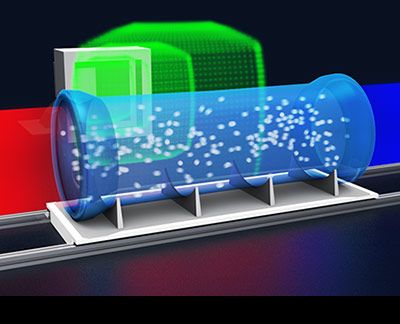
NIST's new method for measuring electric field strength is based on the quantum properties of atoms. The technique works for abroad range of frequencies, 1-500 gigahertz, and directly links measurements to the International System of Units. The method could improve the sensitivity, precision and ease of tests and calibrations of antennas, sensors, and other systems. Credit: Sean Kelley/NIST
NIST’s new method for measuring electric field strength is based on the quantum properties of atoms. The technique works for abroad range of frequencies, 1-500 gigahertz, and directly links measurements to the International System of Units. The method could improve the sensitivity, precision and ease of tests and calibrations of antennas, sensors, and other systems.
Credit: Sean Kelley/NIST

Researchers at the National Institute of Standards and Technology (NIST) and the University of Michigan have demonstrated a technique based on the quantum properties of atoms that directly links measurements of electric field strength to the International System of Units (SI).

The new method could improve the sensitivity, precision and ease of tests and calibrations of antennas, sensors, and biomedical and nano-electronic systems and facilitate the design of novel devices.

Conventional electric field probes have limited frequency range and sensitivity, often disturb the field being measured, and require laboratory calibrations that are inherently imprecise (because the reference field depends on the geometry of the source). Furthermore, linking these measurements to SI units, the highest level of calibration, is a complex process.

NIST’s new electric-field probe spans enormous ranges. It can measure the strength of fields from 1 to 500 gigahertz, including the radio, microwave, millimeter-wave and sub-terahertz bands. It can measure fields up to 100 times weaker than conventional methods can (as weak as 0.8millivolts per meter, the SI unit of measure). Researchers used the new method to measure field strengths for a wide range of frequencies, and the results agreed with both numerical simulations and calculations.

Importantly, the new method can calibrate itself, as well as other instruments, because it is based on predictable quantum properties: vibrations in atoms as they switch between energy levels. This self-calibration feature improves measurement precision and may make traceable calibrations possible in the millimeter and sub-terahertz bands of the spectrum for the first time.

Read more and watch video …

Filed Under: Electronics Theory, Test Equipment Tagged With: electric fields

From my inbox: satellite hacking, hacking hair dryers, bandwidth

October 14, 2014 By Dan KB6NU 1 Comment

Here’s a sampling of some of the interesting stuff that has passed through my inbox lately:

Civilians in abandoned McDonald’s seize control of wandering space satellite. For the first time in history, an independent crew is taking control of a NASA satellite and running a crowdfunded mission. They’re doing it all from a makeshift mission control center in an abandoned McDonald’s in Mountain View, California, using old radio parts from eBay and a salvaged flat screen TV.

Hacker fries hair dryer plug with radio waves. As Maggie Jauregui was getting ready for a date last November, she was simultaneously blow drying her hair and chatting with her boyfriend over a walkie talkie — the sort of electronic gadget that the hacker couple enjoy messing around with. Suddenly, the hair dryer’s plug began to violently vibrate against the wall socket, then spark and release a curl of black smoke. “My jaw just dropped,” Jauregui says. “I had no idea what had just happened.”

Back to Basics: Bandwidth. Among the most important basic specifications of a digital oscilloscope is its bandwidth. Knowing a bit about bandwidth and the influences on the specification can be very helpful in selecting the right oscilloscope for your application. This post will cover some fundamental aspects of oscilloscope bandwidth.

Filed Under: Building/Homebrew, EMI/RFI, Satellites, Test Equipment

From my Twitter feed: diode ring mixers, TAPR news, SDR SA

August 28, 2014 By Dan KB6NU Leave a Comment

Stefano_NVR's avatarDr. NVR @Stefano_NVR
How a Diode Ring Mixer works | Mixer operation theory and measurement: youtu.be/junuEwmQVQ8


ke9v's avatarJeff Davis
Summer 2014 TAPR PSR Journal Available –> tapr.org/psr/psr126.pdf #hamradio


EDNcom's avatarEDN.com @EDNcom
RT @measurementblue: Michael Dunn tries The $11 spectrum analyzer & SDR ubm.io/1q5JI5W @EDNcom @EDNMichael ow.ly/i/645Dp


rtlsdrblog's avatarrtl-sdr.com @rtlsdrblog
BeagleBone Black Image File with RTL-SDR + GNU Radio + More rtl-sdr.com/beaglebone-bla…

Filed Under: Digital Communications, DSP, Electronics Theory, Microcontrollers, Test Equipment Tagged With: Beagle Bone, mixers, spectrum analyzer, TAPR

2215 problem found

June 11, 2014 By Dan KB6NU 2 Comments

A couple of days ago I reported that I’d let the magic smoke out of my Tek 2215 oscilloscope. I was playing around with it last Friday evening, heard some arcing, and then saw a puff of smoke exit the back of the instrument. Oddly enough, the scope still seemed to work, though.

To get some help, I joined the TekScopes Yahoo Group and described my problem. Almost immediately, I got a couple of responses. One guy suggested:

I would take a look at surge suppressor VR901 and line to neutral capacitor C901 at the AC input before the preregulator. Either could have failed without significantly affecting operation of the oscilloscope.

Another said:

I’ll wager that your Tek 2215 has a failing AC-inlet filter. Visit the following site: http://www.vintage-radio.net/forum/showthread.php?t=88137, which discusses failures of Schaffner AC-inlet EMI filters due to a certain type of capacitor manufactured by Rifa…http://www.vintage-radio.net/forum/showthread.php?t=69128

One commentator mentions incompatible rates of expansion between the epoxy encapsulant and the capacitor innards. Another explanation (which I like better) is that microcracks in the encapsulant allow moisture to get into the metallized paper that forms the capacitor’s innards. The innards expand, which applies stress and makes more cracks, and the deposited metallization corrodes and forms conductive compounds with the moisture. Before long…pffffft!

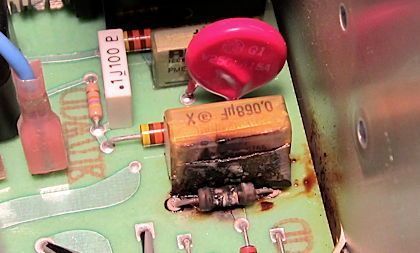
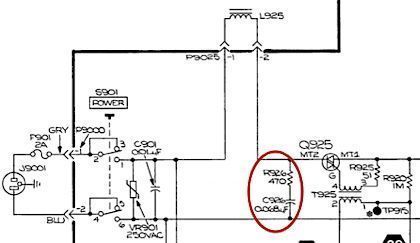
Neither was completely correct, but they both were close. See the photo and schematic below:

2215-problem

2215-problem-schematic

It looks like the problem is indeed a capacitor in the filter section, but my scope does not have a Schaffner AC filter, like they used on some of the earlier (and more expensive) scopes. Instead, this filter is right on the main board. I’m guessing that the 0.068 uF cap shorted out,which led to the resistor burning out.

One odd thing about troubleshooting this problem is that while it looks pretty obvious from the photo, it wasn’t that obvious right off the bat. As you can see from the schematic L925 is not on the board. Instead, it’s mounted in a little housing that sits right above these two components. I had to remove that housing before I could see them.

At any rate, now I just have to find a suitable replacement capacitor and solder it all back together.

Filed Under: Gear/Gadgets, Test Equipment

Station Notes: June 6 – June 9, 2014

June 9, 2014 By Dan KB6NU Leave a Comment

While going through some boxes last Friday, I came across a Heathkit IG-102 signal generator. It was in pretty good shape, so I thought I’d fire it up and see if it was still working. I fired up my Tek 2215 scope and connected to to the IG-102. Unfortunately, I wasn’t getting any output.

I pulled the cover off the signal generator, and was going to start poking around, when I heard some arcing, and then saw a puff of smoke come out the back of the scope. I quickly pulled the scope plug, but of course, the damage had probably already been done.

Today, I finally got around to getting the Torx screwdriver that I needed to take the covers off the Tek. After removing more than a half dozen screws, I was finally able to get the power supply shield off to look for damage. Oddly enough, I couldn’t find any obvious signs of arcing or burnt components, and the scope seems to power up and work.

Even so, I’m hesitant to just button it up and start using it again. There must be a problem in there that’s just waiting to happen. If you have any experience with Tek 2215s, I’d love to hear from you.

Museum ships ahoy!
On Saturday, I operated the Museum Ships Weekend special event. This was a lot of fun. In a couple of hours, I worked 15 of the museum stations, which qualifies me for some kind of certificate.

One of the more interesting contacts was with AC0TX, operating from the SS Grandcamp Memorial. This ship was the site of one of the worst industrial disasters in the U.S. The Grandcamp had docked in Texas City to pick up a load of ammonium nitrate fertilizer.

Just before the longshoremen finished loading the fertilizer, a fire broke out aboard ship. It eventually got so hot that the ammonium nitrate exploded. Hundreds of employees, pedestrians and bystanders were killed. This was truly a disaster.

Alabama QSO Party
Kind of surprisingly, I was the high scorer from Michigan in the 2013 Alabama QSO Party. I don’t think I’m going to repeat this year. Last year, I scored over 2,000 points. This year, I barely broke 200. I guess I spent too much time working the museum ships.

Filed Under: Contests, Operating, Special Events, Test Equipment

Press release: RF Test Blog

May 30, 2014 By Dan KB6NU Leave a Comment

From time to time, I get press releases that might be of interest to radio amateurs. Here’s one.

Making RF measurements can be difficult, especially if you need to make high-precision measurements. Fortunately, most amateur radio operators don’t need to make such measurements, but you can always learn something by reading articles by those who do it for a living…Dan

Agilent Technologies Announces Availablity of RF Test Blog – A Resource for Making Better Measurements

The RF Test Blog is a resource for finding ways to make better RF measurements. With over 10,000 visits since 2013, this popular blog includes information on equipment and measurement techniques that improve accuracy, measurement speed, dynamic range, sensitivity, repeatability, and more. Ben Zarlingo, an applications specialist for Agilent Technologies, shares what he has learned through several decades of working as an electrical engineer in test and measurement.

Filed Under: Press release, Test Equipment

From my inbox: 100 years of ham radio, spectrum analysis, mesh networks

May 28, 2014 By Dan KB6NU Leave a Comment

Celebrating 100 years of ham radio. This month marks the centennial of the American Radio Relay League, the largest ham radio association in the United States. That means it will be a special year for the hundreds who converge annually on W1AW, a small station known as “the mecca of ham radio” in Newington, Conn., to broadcast radio signals across the globe.

Spectrum Analysis Basics - Application Note 150Spectrum Analysis Basics – A Resource Toolkit. Learn about the fundamentals with Agilent’s most popular and recently updated application note, Spectrum Analysis Basics – Application Note 150, which is now paired with a toolkit of app notes, demo videos, web/mobile apps, and related material.

When the Internet Dies, Meet the Meshnet That Survives. The art and technology nonprofit center Eyebeam recently staged a small-scale scenario that mimicked the outage that affected New York after Superstorm Sandy hit in 2012. As part of the drill in Manhattan, a group of New Yorkers scrambled to set up a local network and get vital information as the situation unfolded.

Filed Under: ARRL, Computers, Digital Communications, Test Equipment, The Service

  • « Go to Previous Page
  • Page 1
  • Interim pages omitted …
  • Page 8
  • Page 9
  • Page 10
  • Page 11
  • Page 12
  • Interim pages omitted …
  • Page 15
  • Go to Next Page »

Primary Sidebar

No Nonsense Technician Class License Study Guide (for tests given between July 2026 and June 2030)

New No Nonsense Technican Class Study Guide now available!

The 2026 version of my Tech Class study guide is now available, and as always, the PDF version is FREE!. The ePub version costs $11.97, and a Kindle version and paperback version will be available on Amazon shortly.

Click here to get all of my "No Nonsense" study guides.

Also available: The CW Geek's Guide to Having Fun with Morse Code

W5SWL.Com
Retevis Ailunce H1 DMR Radio
DXpander: Cobweb antennas, Laser Cutting

You’ve got mail!

Enter your email address below and get an email every time I publish a new post.

Email


I frequently teach classes to help newcomers get their licenses. The next class will take place on Saturday, October 10, 2026 on the University of Michigan campus. Click here for more information.

If you can't make the class, subscribe to the mailing list to be notified of when the next class will be held.

You can always download my free study guide, and if you have any questions about the classes, or amateur radio in general, please feel free to email me directly.

Support KB6NU.Com

Donate $7.30 and get two of these cool stickers. Measuring 4.25-in. W by 2.75-in. H, it's perfect for your car, your shack, or wherever!

Contact me

If you have a question or comment about one of my blog posts, or a question about any of the material in my study guides, or just a question about ham radio in general, you can email me at [email protected].

Blogs You Should Also Read

  • AE5X: A CW-centric blog from Kingswood, Texas
  • K0LWC Blog
  • LA3ZA Ham Radio Blog
  • Little Radios, Big Fun – WB3GCK
  • Mr. Vacuum Tube's Blog
  • Radio Artisan – K3NG
  • The K0NR Weblog
  • VE3WDM's QRP Ham Radio Blog
  • W2LJ’s Blog

Ham Radio Websites

  • Dashtoons – The Hammin' Comedy by Jeff K1NSS

Podcasts

  • ICQ Podcast
  • Linux in the Ham Schack
  • No Nonsense Amateur Radio Podcast
  • Resonant Frequency Amateur Radio Podcast

Recent Comments

  • mike on Instant Character Recognition is the key to CW speed
  • Matt W1CDN on A completely different picture of Wayne Green, W2NSD (SK)
  • Chana Walsh on Rethinking ham radio education
  • Rob WfourZNG on Videos: What’s next for POTA, ham radio helps rescue man trapped in cave
  • Dan KB6NU on The EMF Explorer: A badge for ham radio?

Meta

  • Log in
  • Entries feed
  • Comments feed
  • WordPress.org

Footer

Copyright © 2026 Daniel M. Romanchik, KB6NU · Log in