• Skip to primary navigation
  • Skip to main content
  • Skip to primary sidebar
  • Skip to footer

KB6NU's Ham Radio Blog

KB6NU's Ham Radio Blog
  • HOME
  • Study Guides
  • Teach a One-Day Tech Class
  • W8SRC Repeater Guide
  • Advertise
  • Hire Me

VHF/FM/Repeaters

Amateur radio videos: ARDC community meeting, Hamvention award winners, send texts over VHF/UHF

March 11, 2024 By Dan KB6NU 3 Comments

ARDC Community Meeting 2024-02-24

Here’s the latest update from ARDC on their activities.

Hamvention 2024 award winners

The winners this year include:

  • Special Achievement Award: Anthony Luscre, K8ZT
  • Technical Achievement: Ward Silver, N0AX
  • Club of the Year: Young Ladies Radio League
  • Amateur of the Year: Edward Engleman, KG8CX

Text over radio with Rattlegram

This might be something interesting to try on a repeater that’s not very active.

Filed Under: ARDC, Hamfests, VHF/FM/Repeaters, Videos Tagged With: ARDC, Hamvention, Rattlegram

Amateur radio in the news: Repeater upgrades, POTA in DE, HamSCI

November 12, 2023 By Dan KB6NU Leave a Comment

$70,000 Upgrade Coming To Skywarn Ham Systems In The Ozarks

Almost $70,000 are on the way to expand and upgrade the Southwest Missouri Regional Skywarn Ham Radio Repeater System. The 49-repeater group, which includes KRMS Radio and TV, serves as a system which provides ground-level eye-witness updates to the National Weather Service in Springfield stretching from Lake of the Ozarks to Branson and from Lebanon to Joplin. Funding from the Amateur Radio Digital Communications will pass through the Southern Missouri Emergency Communications Fund to provide for the upgrades. The project is expected to take about 10 months to complete.

…read more


Is ham radio still a thing?

[DELAWARE] Ham radio, also known as amateur radio, has been around for more than 100 years. While it started as a way regular citizens could experiment with Morse code communication, it soon became wireless voice communication. With modern technologies such as cell phones and the internet, it would seem there is no need for radio communication. But ask any one of the almost 2,000 FCC-licensed ham radio operators in Delaware, and they will say it’s more than a thing. For many, it is a part of every day.

The month of October has been especially busy for ham radio. On Saturday, Oct. 7, a group of “hams” from the Nanticoke Amateur Radio Club set up their equipment at Redden State Forest just south of Georgetown. The purpose of the event was to give the operators experience in setting up an operational field station completely off the grid. They then spent several hours in “Parks On The Air” (POTA) conversation with other hams, many of whom were located in a variety of parks and public lands around the globe. The parks communication has become very popular, organizers said, and many operators can be found in a park using either Morse code or voice mode to make as many contacts as they can around the world

…read more


Ham Radios Crowdsourced Ionospheric Science During Eclipse

On 14 October, millions of people in North, Central, and South America peered through safety glasses and other viewing aids at the partially obscured Sun. Simultaneously, thousands of folks experienced the annular solar eclipse in a different way: through transmissions sent and received over amateur radios.

Before, during, and after the eclipse, ham radio operators pinged signals off the ionosphere and connected to people hundreds or thousands of kilometers away. The experiment, part of the Ham Radio Science Citizen Investigation (HamSCI), is gathering hundreds of thousands of those contacts to investigate how the ionosphere responds to the temporary loss of sunlight during an eclipse.

“This is our way of remote sensing the ionosphere,” said Nathaniel Frissell (call sign W2NAF), a space physicist and electrical engineer at the University of Scranton (W3USR) in Pennsylvania and the lead HamSCI organizer. “People have been doing this for about 100 years, and it’s gamified,” he said. “We used this idea to create a ham radio contest that would actually be a scientific experiment.”

…read more

Filed Under: Amateur Radio in the News, ARDC, Parks on the Air, VHF/FM/Repeaters Tagged With: Delaware, HamSci, Missouri

A blast from the past: the Icom TriBand Delta 1A.

September 16, 2023 By Dan KB6NU 2 Comments

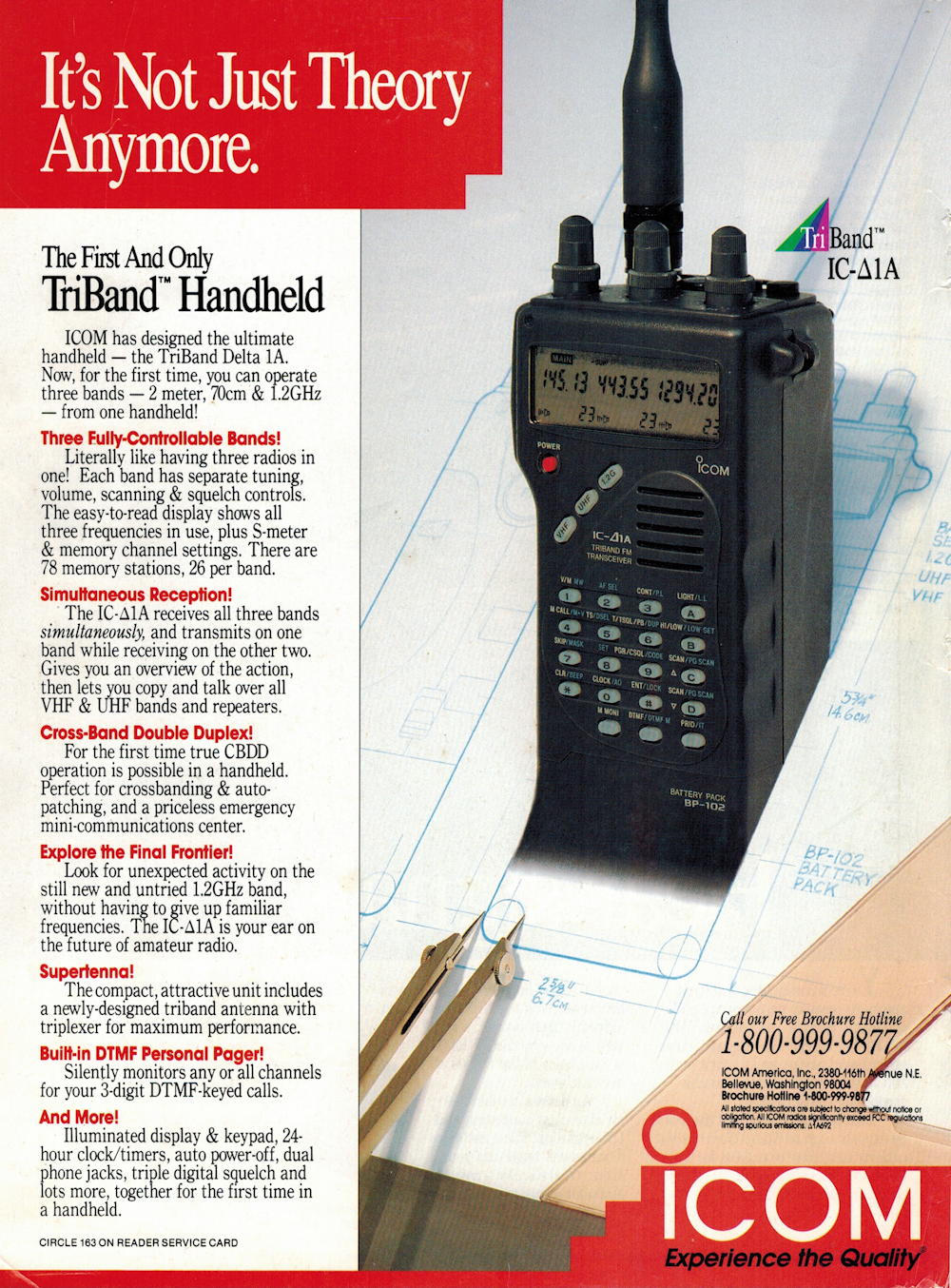
So, I’ve recently been going through some old magazines and cam across this advertisement. I forget what issue it came from, but RigPix says that it was manufactured in the early 1990s. Aside from being a bit chunky—and probably pretty expensive—this looks like it could have been a great radio. And, just the thing to encourage more activity on 1.2 GHz.

Anyone remember this radio? How much did it cost? Did it work well?

Click to see larger image.

Filed Under: Gear/Gadgets, VHF/FM/Repeaters Tagged With: 1.2 GHz, Icom

ICQ Podcast #399 – Hamzilla 2023

March 26, 2023 By Dan KB6NU Leave a Comment

In this episode, I joined Martin Butler M1MRB, Caryn Eve Murray KD2GUT and Edmund Spicer M0MNG and discussed the following topics:

  • Echo of BBC’s first broadcast in Scotland 100 years ago is heard from centenary event at Pacific Quay

  • Steubenville-Weirton Amateur Radio Club Donates Books to Library System

  • Is there a Better Way to Safeguard Vital Repeaters?

  • In the Car, Podcasts and Online Audio Continue to Grow

  • FreeDV Aims to Bring Open-Source HF Digital Voice Into the Mainstream

  • Astronauts from UAE Taking on Space Education

The episode’s feature is about Hamzilla 2023, a hamfest in the U.K.

Hams actually listen to us?

I’m always pleasantly surprised when I run across hams who say that they listen to the podcast. Mostly, it just seems like we’re babbling when we record the podcast, but when people say that they enjoy listening to it, it makes doing it all worthwhile.

Last week, at the HamSCI Workshop, I introduced myself to a fellow who said, “I know who you are. I recognized your voice from the podcast.” We proceeded to have a really nice conversation about the workshop.

Last night, I worked someone on 30 meters, and my being on the podcast made it possible. He emailed me after contact saying, “I’m a new CW operator and I heard your call tonight and recognized it from podcast fame, so I answered. I appreciated that you slowed down right away, but I immediately regretted my decision when you sent more than RST and state.” That is to say that he probably wouldn’t have answered my CQ if he hadn’t recognized my call sign.

I replied, “I could tell that were a bit unaccustomed to ragchewing, but kudos to you for trying!” I went on to say that I hoped that he should feel free to call me anytime. The only way to get better, after all, is to make contacts. I hope that I get to work him many times in the months ahead.

I’ll extend that invitation to all of you. If you ever hear me on the air, or see me at an amateur radio event, please feel free to say hi.

Filed Under: Clubs, Digital Modes, SWLing, VHF/FM/Repeaters Tagged With: BBC, FreeDV, libraries

Latest browser tabs: G7FEK antenna, SWR, repeater activity

February 13, 2023 By Dan KB6NU Leave a Comment

If you’re like me, you have a lot of browser tabs open. These tabs have web pages that you keep meaning to get around to reading, but often do not. You could bookmark them, but bookmarking those pages just puts them out of sight, and they shortly become out of mind.

Right now, I have four different amateur radio-related tabs open. Since I think that many of you will also be interested in reading them, I’ll do a short review of each one here.

G7FEK antenna: 80 meters in a limited space

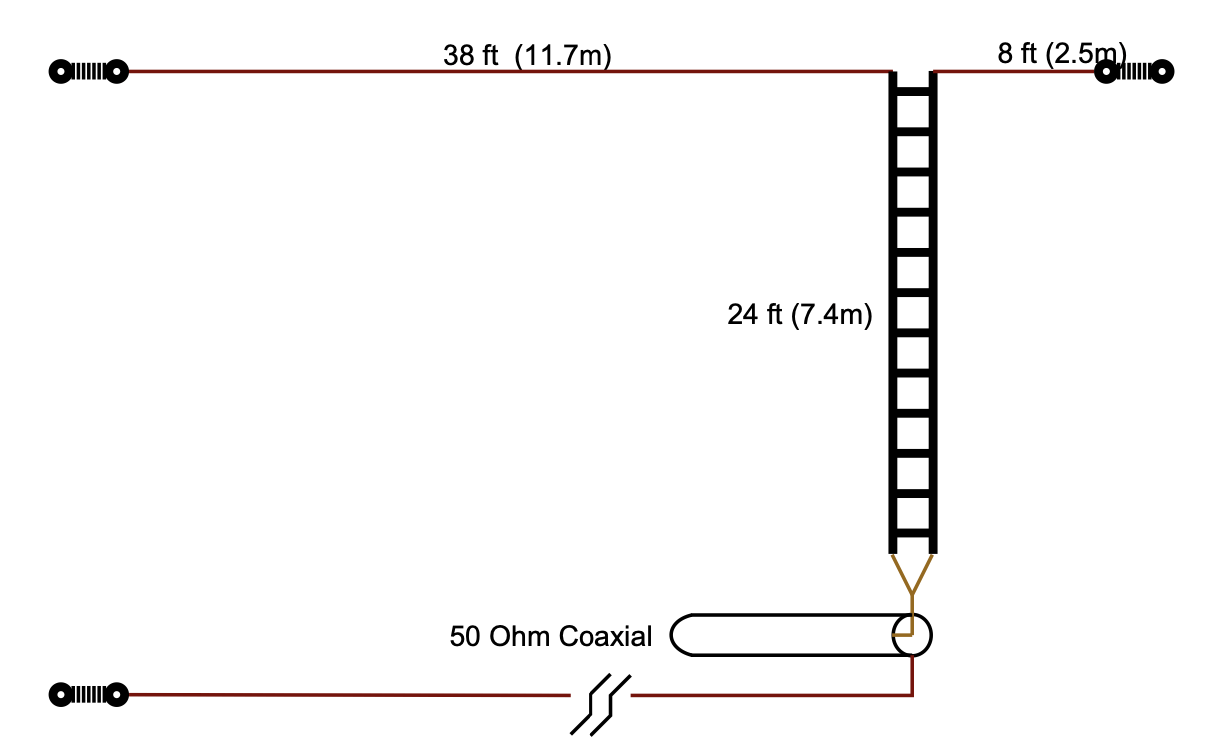
Before I found and put up my Cobra antenna, I did a little research and found several possibilities, including a loaded dipole and a 43-ft. vertical. Another good option that I recently came across is the G7FEK antenna. G7FEK describes his antenna as “a 46-ft., multi-band antenna for small gardens that works well on 80 meters.” And, according to G7FEK, its impedance is nearly 50 Ω on 40 meters, 30 meters, 17 meters, 15 meters, and 12 meters, and it can be used with a tuner on 20 meters and 10 meters.

Here’s what it looks like:

The G7FEK antenna needs only 46 feet of space.

If any of you are using this antenna, please let me know. I’d like to hear your thoughts.

The REAL SWR page

As I’ve often noted, I’m not an antenna guru. I know enough to get something in the air and working well enough to make contacts, but not a heckuva lot more. I know that low SWR at the transmitter is a good thing, but that it’s not really necessary that the antenna itself have a low SWR. The REAL SWR page backs me up on this.

Here are the 7 points that WC7I makes on this page:

  1. Reflections happen at the coax – antenna connection and they also happen at the coax – tuner connection. The last part of this statement seems to be missing from most discussions of SWR and mis-matched conditions.
    This is why a lot of people think that reflected power gets into the radio and does damage. That does not happen!
  2. These reflections do not cause energy loss. All losses are due to the coax itself.
  3. Energy moving backwards in the coax is subject to the exact same losses as energy moving in the forward direction.
  4. The amount of energy reflected at the coax – antenna connection depends on the amount of impedance mis-match (read SWR) between the antenna and the coax. The greater the mis-match, the greater the reflection.
  5. The amount of energy re-reflected at the coax – tuner connection is 100% of the energy that gets there, but not all the energy that was originally reflected gets back to the coax – tuner connection. There will be losses in the coax. All the reflected energy that reaches the coax – tuner connection is re-reflected back into the coax headed for the antenna. (Yup, another lossy trip in the coax.)
  6. The re-reflected energy will be in phase with the generator so the two signals will add. This can create more forward power in the coax than the transmitter is actually producing. It is possible to measure 125 Watts forward power from a 100 Watt transmitter because the re-reflected power adds to the transmitter power.
  7. Coax losses are the only losses in the whole system. These losses can be significant, but they are the ONLY losses in the antenna system. If you have been paying attention, you know that this last step is just a re-statement of other steps above.

He goes into much more detail on why this is so, so read the web page. Two things pop out from this discussion:

  1. WC7I says, “You should always use an antenna tuner. It goes near your rig, in the shack. Its duty is to match your antenna and coax to the impedance of your rig, not to change the SWR in the coax that goes from the antenna down to the antenna tuner.”
  2. Electrical energy moves forward and backward in a coaxial cable and in ladder line. (Everything I tell you about coax is also true for ladder line, except that ladder line has far less loss.)

How to activate your local repeater

A frequent lament is that repeaters these days are quiet most of the time. In an attempt to get more people on their local repeater, a Reddit user asked for suggestions on how to increase activity. Here are some of the ideas that you might want to try:

  1. Throw out your call sign and let people know you’re listening. It won’t change it overnight,  but I think you, plus a few others, could make a world of difference.
  2. We have a daily net, round table style. It is open from 5 to a minimum of 5:30. longer if we are having discussions. If we run out of check ins or things to say, the net control remains on frequency and makes a call every few minutes until 5:30. Encourage discussions and conversations. Some net controls do words of the day, finding odd words and asking if folks know their meaning. I do trivia, sometimes ham related, sometimes not. As a NC, engage with people, ask questions, ask how that thing they were doing last week went or whatever. The point is to make it more than a simple check in and personal, not just some call sign checking in.
  3. Does the repeater have a website? Make sure any regular nets are published there, and promote it in clubs, newsletters, etc.

The post also has some good ideas about how to make nets more interesting and get more check-ins.


Filed Under: Antennas, VHF/FM/Repeaters Tagged With: G7FEK antenna, SWR

A little of this, a little of that: 8-yo talks to astronauts, SHF transceiver from ICOM, Raspberry Pi logic analyzer

August 24, 2022 By Dan KB6NU 4 Comments

8-year-old girl in Kent, England, has an out of this world story to tell her friends

This is a great story. Kjell Lindgren has been doing a great job on the ISS amateur radio station.

ICOM debuts SHF transceiver

Icom showed a mockup of this transceiver, capable of operation at up to 10 GHz at Dayton. Apparently, it got a good enough response that they’re going to start manufacturing it. How much would you pay for a rig like this?

$4 Logic Analyzer Based on Raspberry Pi Pico

In a recent EE Journal, Steven Leibson writes:

Here’s a truly inspired project. Dr. Agustín Gimenez Bernad, a Senior Developer in ServiZurich S.A. in Spain, has created one of the most brilliant hacks I’ve seen yet. He’s built a 24-bit logic analyzer that samples at 100 Msamples/sec and stores 32K samples from nothing more than a $4 Raspberry Pi Pico board and some clever code. There’s a lot to learn from this project, which is posted with some very fine documentation on GitHub, but if you just need a $4 logic analyzer, there’s still a lot to be admired.

For four bucks, why wouldn’t you want to have a logic analyzer in your shack, especially if you do any microcontroller projects at all.

Filed Under: Gear/Gadgets, Test Equipment, VHF/FM/Repeaters Tagged With: IC-905, ISS, logic analyzer

Amateur radio videos: 6-year-old ham on David Letterman, KB6NU on Operator of the Week, how to make your own DMR codeplug

April 4, 2022 By Dan KB6NU 1 Comment

Young ham on David Letterman

Veronica Harrington, KC6TQR, appeared on March 26, 1992. She was six years old at the time. David Letterman actually had a ham license at one point.


KB6NU on Operator of the Week

Yours truly appeared on the podcast, Operator of the Week by WA7PBE. It’s always fun to appear on podcasts like this.


Make your own DMR codeplug

This video by BridgeCom aims to take some of the mystery out of DMR codeplugs. The video talks about the Anytone radios that Bridgecom sells, but you should be able to set up your own after viewing the video. If you need more info, the YouTube page lists a bunch of other videos explaining how to do this.

Filed Under: Kids, Podcasts, VHF/FM/Repeaters, Videos

W8SRC repeater features unique IDs and announcements

December 21, 2021 By W8SRC 6 Comments

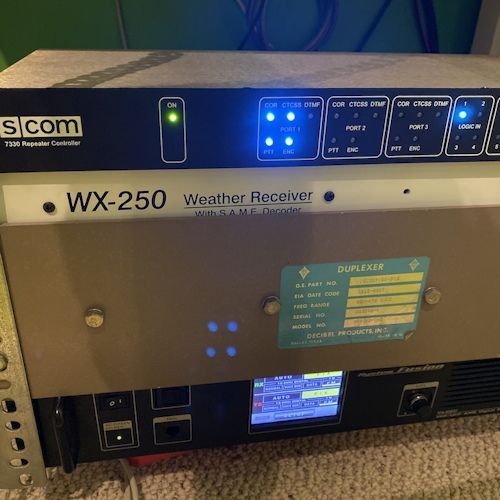
The W8SRC UHF repeater in Dexter, MI may not have the best coverage in the world (although it does well for its terrain), but it can be a lot of fun to use for those in the area.  It has a number of features including Yaesu System Fusion, a NOAA Weather Radio alert receiver, and an HF/VHF/UHF remote base.  However, one of the most interesting features of this repeater, in my opinion, is its vast number of IDs and announcements.  In fact, you can ragchew for many hours on the system and not hear the same ID twice!

The W8SRC repeater controller.

The piece of equipment responsible for generating these announcements is the repeater’s controller.  The first repeater controller I used had numerous issues over the years, including one instance where it locked up my repeater in transmit mode and never identified.  Because of this, I figured that it was time for an upgrade.  Of course, I could have used my repeater’s internal controller (I use the Yaesu DR-1X repeater); however, I believe that a repeater should be an information source as opposed to having only a CW ID.  I received the S-COM 7330 controller as an early Christmas gift from my family in 2019.

With the help of Bryan, KC8LMI, and his father, Bruce, KA8ZXX, I quickly learned the programming language of the S-COM controller and started to create many messages on it before it hit the airwaves.  Bryan used scripts from Kim, WA8KIM (who uses an extremely similar setup to mine, and whose entire script file is available on his website , and I decided to expand the number of IDs and announcements on the repeater in the years that followed.  These announcements were put together by combining individual words out of a 1,600+ word vocabulary list recorded by broadcast radio voiceover Sean Caldwell, N4VOX.  To hear examples of these announcements, check out this post on my SoundCloud account.

One day in the fall of 2021, my great friend Chad Beach, W9GGA asked me about my opinions on the 7330 compared to my older controller.  I told him that the only thing I missed about my old controller was the fact that it had the ability to record custom announcements via a DVR (to which I would record the messages over the air).  This allowed me to implement a number of the IDs that many other broadcast radio voiceovers have recorded for me (Dan made a post a few years back on his favorites of these IDs), and I missed hearing these voices on my repeater for nearly two years.  I saw in the 7330 manual that it can do the same thing using a different process.  However, I was unaware of a piece of equipment I needed to make this work, so Chad suggested that I contact S-COM to find out.

With the 7330, I needed to take my existing .mp3 and .wav files and convert them to the .ulaw raw file format with an 8 kHz sample rate using Audacity.  While I did that on the day after Thanksgiving, I edited down some of the dry files and amplified the levels to those similar to Sean’s vocabulary.  I even added Kim’s free-to-use custom vocabulary word files that Sean recorded for him in 2015.  Because I am a broadcast radio enthusiast myself (I host a morning show on my own Part 15 compliant FM radio station in Ann Arbor, of which Chad is the voiceover), this was a relatively straightforward procedure for me.  I even recorded an ID myself in the process.

As I converted and edited the files, I posed my question to the S-COM email list, and a number of 7330 users from across the country were kind enough to help me with my issue.  They told me that the utility I needed was called BuildSpeechLib.exe and can be found on the latest firmware package via the S-COM website.  Because I am entirely a Mac user, though, I had to learn some basic Windows programming before I proceeded.  Believe it or not, the S-COM manual helped me with this process (specifically on how to create a directory)!

After transferring all of my raw files from my Mac to my mom’s PC, I used BuildSpeechLib to generate a single file from all the raw files (called CustomAudioLib.bin).  At first, I used a different filename than suggested on the manual, which didn’t work, so I changed the name and it did work.  I then used a terminal emulator called TeraTerm (through which I program all the messages into my controller) to store the messages into the controller’s memory.

I was a little confused on the instructions to do so; however, they made sense to me as I read the manual.  I was shocked to find out, however, that it took a few hours to load it when it should take only a half hour at most.  I finally pressed the delete key to cancel, and I tried seemingly every troubleshooting resort possible.  I even powered off the repeater for a few minutes to see if it made a difference.  Nothing seemed to work – until I found out that my CustomAudioLib file that the controller generated was empty!  After re-running BuildSpeechLib to generate a new CustomAudioLib with all my files in it, I tried TeraTerm again (which, by the way, uses a similar process when storing my programming onto the PC), and it took no more than eight and a half minutes to load into the controller.

I decided to hit the hay at that point, and I started to program the messages into the controller the next morning.  Because I had a boatload of IDs already programmed into the 7330, I replaced some of Sean’s vocabulary announcements with my custom recorded ones, creating a nice balance between the two types of messages.  I also implemented the words “Stuart” and “Fusion” from Kim’s custom list into some more vocabulary messages in the process (I first knew Kim in 2015 and he was kind enough to include my name in his list).  I immediately noticed that the audio quality is significantly better than a recorded DVR track on my old controller!

After loading the messages into the controller and storing the configuration into the PC, I decided to make a YouTube video (as a follow-up to my first video that showcases the controller) in case there are others out there who are struggling to get custom files into their 7330 controller.  In addition, I recorded all the messages that I could get with an old RadioShack handheld scanner and a Sony handheld recorder, editing the recording with Audacity.  You can hear it by clicking this SoundCloud link. I hope you enjoy the recording as much as I enjoyed hearing the custom IDs for the first time!

Filed Under: VHF/FM/Repeaters Tagged With: W8SRC

Operating notes: Tell operators when they’re off frequency, working DXpeditions, repeater crawl

November 11, 2021 By Dan KB6NU 3 Comments

Tell operators when they’re off frequency

Hams can sometimes be hesitant to notify others when their signal isn’t quite up to snuff or when they’re off frequency. After a recent contact, I’ve decided that I’m always going to mention this to someone that I’m in contact with.

What happened is that a station answered my CQ, but he was so far off frequency that I missed his first call. I could see him answer me on the waterfall, but he was outside my passband, which was set to 250 Hz, so I couldn’t hear him. I set my RIT so that I could hear him and sent QRZ?, and when he replied to that I picked him up just fine.

We went through the RST/QTH/name first exchanges, and on my second transmission, I mentioned that he was transmitting about 500 Hz below my frequency. When it was his turn, he thanked me for mentioning that, and said that he was wondering why CQing stations never seemed to hear him. He spent the next couple of transmissions zeroing in on my frequency. Hopefully, he’ll now be heard by stations he’s calling.

Of course, if I’d had my passband set wider, I would have heard him on his first call. That’s my bad, but he will have better success if he zero beats the station he’s calling in the first place.

Working DX on 30m during the contest

A week and a half ago, during the CQ WW CW contest, I got on 30 meters, not wishing to throw myself into the pileups on 20 meters or 40 meters. I was pleasantly surprised to find the 7P8RU DXpedition to Lesotho. And, since all the other CW ops were working the contest, they weren’t getting many takers. I was able to work them on the third call.

After working 7P8RU, I looked around a bit and happened upon the HD8R DXpedition to the Galapagos Islands. I got them on the first call! I already had HD8 in the log, but 7P8 is a new one for me.

Repeater crawl

They guys here in Southeast Michigan do an amusing thing called the Repeater Crawl. On the first Friday of every month, a group of operators congregate on the General Motors repeater on 443.075 MHz (123Hz PL), which has the best coverage of any repeater in the Detroit area and then set out to see how many of the other repeaters the folks in the group can hit.

I happened to be in the shack with my VHF/UHF radio on when they turned their antennas towards Ann Arbor. I was hoping that they’d call for local checkins, but was disappointed when they did not.

In any event, I think that this is a great activity. If you live in an area with several repeaters, you should consider setting up a “crawl” where you live.


Filed Under: DX, Operating, VHF/FM/Repeaters

Videos for newcomers: Repeater 101, CTCSS for the Baofeng UV-5R, Understanding CTCSS and DCS

September 26, 2021 By Dan KB6NU 2 Comments

I’ve gotten a couple of inquiries from new hams lately about using repeaters and programming their radios. So, I did a little searching for YouTube videos, and came up with the following:

Repeater 101 for new Amateur Radio Operators

In this presentation Bob Schmid, WA9FBO, of the Northern Colorado Amateur Radio Club discusses all you need to know to get started with using repeaters. He talks about transmitters, receivers, controllers, duplexers, combiners, repeater sites and of course, antennas. It’s a little long, but worth the watch.

Baofeng UV-5R: Add CTCSS and DCS Codes & Tones On The Keypad And Connect To & Talk On A Repeater

The most common reason that newcomers are unable to access a repeater is that they’re radio isn’t programmed to send a CTCSS tone. This video offers step-by-step, button-by-button instructions to program a Baofeng UV-5R to use CTCSS tones or DCS codes using the keypad, not the CHIRP programming program.

Understanding CTCSS and DCS

This video explains the basic technical principles behind CTCSS (continuous tone coded squelch system) and DCS (digitally coded squelch) as well as how they are used in analog radio systems, such as amateur radio FM repeaters. The content in this video is not strictly related to amateur radio applications, but it’s still useful info.

Filed Under: VHF/FM/Repeaters, Videos Tagged With: Baofeng, CTCSS, UV-5R

  • « Go to Previous Page
  • Page 1
  • Page 2
  • Page 3
  • Page 4
  • Interim pages omitted …
  • Page 14
  • Go to Next Page »

Primary Sidebar

No Nonsense Technician Class License Study Guide (for tests given between July 2026 and June 2030)

New No Nonsense Technican Class Study Guide now available!

The 2026 version of my Tech Class study guide is now available, and as always, the PDF version is FREE!. The ePub version costs $11.97, and a Kindle version and paperback version will be available on Amazon shortly.

Click here to get all of my "No Nonsense" study guides.

Also available: The CW Geek's Guide to Having Fun with Morse Code

W5SWL.Com
Retevis Ailunce H1 DMR Radio
DXpander: Cobweb antennas, Laser Cutting

You’ve got mail!

Enter your email address below and get an email every time I publish a new post.

Email


I frequently teach classes to help newcomers get their licenses. The next class will take place on Saturday, October 10, 2026 on the University of Michigan campus. Click here for more information.

If you can't make the class, subscribe to the mailing list to be notified of when the next class will be held.

You can always download my free study guide, and if you have any questions about the classes, or amateur radio in general, please feel free to email me directly.

Support KB6NU.Com

Donate $7.30 and get two of these cool stickers. Measuring 4.25-in. W by 2.75-in. H, it's perfect for your car, your shack, or wherever!

Contact me

If you have a question or comment about one of my blog posts, or a question about any of the material in my study guides, or just a question about ham radio in general, you can email me at [email protected].

Blogs You Should Also Read

  • AE5X: A CW-centric blog from Kingswood, Texas
  • K0LWC Blog
  • LA3ZA Ham Radio Blog
  • Little Radios, Big Fun – WB3GCK
  • Mr. Vacuum Tube's Blog
  • Radio Artisan – K3NG
  • The K0NR Weblog
  • VE3WDM's QRP Ham Radio Blog
  • W2LJ’s Blog

Ham Radio Websites

  • Dashtoons – The Hammin' Comedy by Jeff K1NSS

Podcasts

  • ICQ Podcast
  • Linux in the Ham Schack
  • No Nonsense Amateur Radio Podcast
  • Resonant Frequency Amateur Radio Podcast

Recent Comments

  • Rob W4ZNG on The EMF Explorer: A badge for ham radio?
  • STW on You know POTA. You know SOTA. How about BOTA?
  • Dan KB6NU on Some Ham-Vention History
  • David Pompea on Some Ham-Vention History
  • Walter Underwood on One lump or two (or three)?

Meta

  • Log in
  • Entries feed
  • Comments feed
  • WordPress.org

Footer

Copyright © 2026 Daniel M. Romanchik, KB6NU · Log in