From my Twitter feed: N1MM, good-looking hams, ham-radio growth

EC7AKV
New Version 13.05.00 of #N1MM is available from website http://t.co/wtmm4Q8bj4 #hamr#hamradio #cqwpx #cqww #ure @ure_es

K1NSS
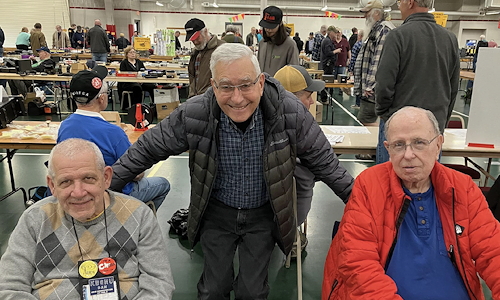
WHY HAMS SO GOOD-LOOKING? Miracle Mask secret coverup shockerhttp://t.co/ZVkrcQQsu8 #hamr #hamradio#RSGB #QRP #CQWW

nnerdsllc
Ham Radio Growing In The Age Of Twitter : NPR - #nerd #hamradio #hamr -http://t.co/4kZ1VJHDSS

Got a tip? Get a book.

I’m already up to a dozen subscribers!
To get on the list, click on the link below.

I’m starting something new here on KB6NU.Com: KB6NU’s Ham Radio Tip of the Day. The plan is for this to be separate from the blog, appearing in your e-mail inbox every day. The e-mail will contain a single tip. For example,

If a deal at a hamfest seems too good to be true, it probably is. A couple of years ago at the Dayton Hamvention, I found a Vibroplex bug for only $50. When I got it home, I discovered that the silver-plated contacts had been filed, making it practically useless. Fortunately, I was able to purchase new contacts, but that cost me $45, making the deal not nearly as good as it first appeared.

I already have more than a month’s worth of tips to get me started, but I will also use user-submitted tips. If I use your tip, I’ll send you one of my books. Also, every week, I will randomly select one of the subscribers and send them one of my books.

To subscribe to the newsletter, simply click on the link below.

Subscribe to KB6NU’s “Ham Radio Tip of the Day” newsletter

My slides have gone viral….well, sort of

I got this in my e-mail this morning:

You’re featured on the SlideShare homepage

Congratulations kb6nu!

Your presentation has been featured on the SlideShare homepage.

Kudos from our editorial team for your effort. Your presentation was chosen from thousands uploaded to SlideShare every day from around the world.

Ham Radio? Do They Still Do That?

Your presentation will remain on the homepage for a limited time.
Share with your friends on Twitter, Facebook and LinkedIn. Guess what, we’ve already tweeted it on @SlideShareToday!

— The SlideShare Team

How cool is that? It’s gotten close to 500 views in the last 24 hours.

Why you should upgrade to General Class

While getting a Tech license is no small feat, one of the first things you should do as a Technician is to start studying for the General Class license. Oh, I can hear the complaints and excuses already. “I’m never going to get on HF, so why should I get my General?” “I only care about emcomm and public-service communications, so why should I bother?” “I just don’t have the time right now to study for the General Class exam.”

Well, if you ask me, all of that is just hooey. If you don’t upgrade to General (and steadfastly refuse to learn code), then it’s a certainty that you’ll never operate on the HF bands. It’s a self-fulfilling prophecy. Why deny yourself that capability before you even try it?

Similarly, saying that all you intend to do with your ham radio license is to participate with your local CERT or SkyWarn group is fine and dandy, but public-service and emergency communications do take place on HF as well as on VHF/UHF. Why limit your usefulness as an emergency communicator by not having HF privileges?

And, if you don’t have time now, when will you have time? It’s a matter of priorities, and while the material on the General Class exam is more difficult than the material on the Tech exam, it shouldn’t take you all that much more time to study for the General Class test than it did for the Technician Class test. Not only that, waiting is only going to make it that much harder to start studying again when you do decide to do it.

Here are three great resources to help you upgrade to General Class.

Here are three great resources to help you upgrade to General Class.

Resources
One excuse that you can’t make is that there aren’t any resource available. There are more than you could ever use. My favorite, of course, is The No-Nonsense General Class License Study Guide. It’s my favorite because I wrote it! A PDF version is available for free from my website. E-book versions are available for $7.99 from Amazon or Barnes&Noble.

Another resource is the ARRL General Class License Manual. When you buy this book, you also get practice exam software. This Windows software allows you to take randomly-generated practice exams using questions from the actual examination question pool.

Also popular is the General Class Manual by Gordon West, WB6NOA. “Gordo,” as he is known in the ham world, has been around a long time and does a great job explaining the answers and highlighting keywords. This study is also available as an audio book.

There are many more resources out there. To find them, simply Google “amateur radio general class license study guide.”

There really is no excuse not to upgrade. Once you do, you’ll be more knowledgeable about our great hobby, be a more effective communicator, and have a lot more fun with amateur radio.

Ham radio? Do they still do that?

When I tell people that I am a ham radio operator, I often get asked, “Do they still do that?” Well, of course, we still do that. So, when I was asked to speak to a Mensa group here in SE Michigan, I decided to use that as the theme of my talk.

Feel free to download this from SlideShare and use it whenever you’re asked to give a talk about amateur radio, adding or deleting what ever slides you think are appropriate.

From my inbox: 43 years of 73 magazine, SP DX contest, useless answer

I found these three items in my inbox this past week…Dan

73-apr-67-cover43 years of 73 on-line
Wayne Green has now released all back issues of 73 to the public domain. Although the last issue was published more than ten years ago, there’s still lots of good stuff to be found in them. You can download individual issues by going to archive.org. Indexes can be found on these web pages…

The first lists the contents of each issue. The second has direct links to the to the issues at archive.org.

The cover shown at right, a takeoff on MAD Magazine, is one of my favorite covers. Take a closer look at the soldering job Al Freddy is about to attempt. Click on the image to get a larger version if you can’t quite make it out.

Wayne Green actually published the first article that I ever wrote, “Assembling Robots with a TRS-80.” I was 23 or 24 at the time. It was published in Byte, arguably the first widely-read magazine for computer hobbyists. The article was a short one on how to program in assembly language on the TRS-80. It displayed a robot-like thing on the screen using the blocky graphics available on the TRS-80.


SP DX Contest actually wants my log
A month ago, I made a few contacts in the SP DX Contest. It was only 20 contacts or so, and I had meant to submit the log, but I soon forgot about it. Well, this morning, I go this e-mail:

The first review of logs received for the SP DX Contest 2013 shows that your callsign KB6NU apears in many logs. However you propably have not submitted your log.

The SP DX Contest took place during the first weekend of April (2013.04.06-07). This year we are celebrating 80th Anniversary of the SP DX Contest as it was organized for the first time in 1933. We would like to make the log checking process as accurate as possible. It will also be a honour for us to list your callsing in the final results.

We would kindly ask to send your log to the SP DX Contest Committee, even if you made only a few contacts, even if perhaps you are a causal contester.

Well, how can I refuse? I’ll have to do this as soon as I can get down to the museum again.


Useless answer department
I’ve been doing writeups for the product pages on AmateurRadioSupplies.Com. (Yes, that’s a plug for them, but they’re paying me to do these writeups, and they’re even advertising here on KB6NU.Com.) For the past week, I’ve been working on coax descriptions.

In doing this, one question that came up is why does marine grade coax have a white jacket? I e-mailed a question to Marinco tech support, and got the following answer, “It’s hard to say but I think it is to distinguish it  as marine grade vs. house cable.”

Seriously? That’s all there is to it? Does anyone know the real answer?

From the trade magazines, impedance matching, EMI basics, open-source hardware

elelctronic-design-logoBack to Basics: Impedance Matching. electronic design editor (and amateur radio operator) Louis Frenzel is the author of this short e-book on impedance matching. Note: this e-book was intended for engineers and does use a fair amount of math, but nothing you can’t figure out if you work at it.

EMI Basics. This article  comes from the book Signal Integrity Issues and Printed Circuit Board Design by Douglas Brooks. I like the discussion of how twisted pair wire helps prevent radiation.

Interview With SparkFun’s Director Of Engineering. Peter Dokter is director of engineering for SparkFun, one of the major suppliers of open source hardware. SparkFun designs and sells things useful and interesting to the aspiring electronics tinkerer, including microcontroller boards, Bluetooth, GPS, Wi-Fi, LCD displays, e-textiles components, robots and robotic parts, motors, motor drivers, buttons and switches, tools, and books.

From my Twitter feed: software-defined scanner, TAPR in Seattle, the art of electronics

n0rc
How to get started using the #rtlsdr as a scanner for as little as $19http://t.co/VK3qKdpMJS #sdr #hamr

This looks like fun…..Dan


HamBeat1
Seattle Will Host the 32nd Digital Communications Conference:http://t.co/0xGJUpjw1C #hamradio #hamr

I should have gone last year, when it was a lot closer……Dan


o0ToTOm0o
The Art of Electronics – Horowitz & Hillhttp://t.co/4p2rYYfcvV

A classic! Get it. It’s free……Dan

Amateur Radio in the News; CERT, RFI, “magic band”

San Ramon CERTCERT volutneers, amateur radio operators ‘leap’ into action
The San Ramon Valley Community Emergency Response Team (CERT) program along with local amateur radio operators participated in a mock communications drill on Saturday. Volunteers placed hundreds of stuffed “CERT green” frogs placed throughout the community to help simulate victims of a major disaster.

Florida resident cited for ham interference
In an unusual case, the FCC cited Ruben Lopez of Pomona Park, Fla. for harmful interference with amateur radio frequencies. He has 30 days to respond to the Enforcement Bureau or risk being fined up to $16,000 for each violation and having his equipment seized. In this case, the subject of the interference is a well pump, according to the agency.

Sweet sound of ham radio
Timaru (New Zealand) radio enthusiast George Boorer is thrilled with the national switchover to digital television. It means after 40 years he can head back out to his “radio shack” and tap into the six-metre international amateur band, otherwise known as “the magic band”.


Think the bands are crowded during contests? You’re right.

While writing a post for Radio-Sport.net on the CQ WPX contest, I ran across this slide in a recorded webinar on rules changes for 2013:

cq-wpx-activity

I’m sorry about the quality of the slide, but that’s the best I could do. Even with the poor resolution, you can see that the number of logs that have been submitted for the CQ WPX have just about doubled in the last ten years. Nearly, 5,400 logs were submitted for the CQ WPX SSB contest last year, while more than 4,000 were submitted for the CQ WPX CW contest. These numbers do not include stations who participated in the contest in some way, but did not submit a log.

Want to get in on the action? Well, the RTTY and SSB contests are done for the year, but the CW contest is coming up on May 25-26, 2013.