• Skip to primary navigation
  • Skip to main content
  • Skip to primary sidebar
  • Skip to footer

KB6NU's Ham Radio Blog

KB6NU's Ham Radio Blog
  • HOME
  • Study Guides
  • Teach a One-Day Tech Class
  • W8SRC Repeater Guide
  • Advertise
  • Hire Me

Antennas

From the Fediverse: Ham gallery, M17 mailing list, 44-ft. doublet

June 6, 2024 By Dan KB6NU Leave a Comment

I’ve quit Twitter/X, and am now part of the Fediverse. There are quite a few radio amateurs in the Fediverse, and if you’d like to follow me there, you can follow @[email protected]. Mastodon.radio is a space for radio amateurs and SWLs, but it’s not the only radio-focused Fediverse server. It connects with the servers listed on fediverse.radio, including mastodon.hams.social, a server here in the U.S.

Mastodon seems to have a much higher signal-to-noise ratio than Twitter. Here’s a few links I found and things I learned on Mastodon last night:

K8CX Ham Gallery. K8CX has an interesting collection of photos from Dayton, DX sound clips, and a QSL card museum. I’ve submitted a couple photos of me and the ICQ Podcast crew at Dayton 2024.

M17 Users mailing list. The  home page for this mailing list says, “The primary assumption of this mailing list is that M17 is (in June, 2024) in usable (enough) form for actual deployment and use in amateur radio.” They believe that all the pieces are there now.  Typically, to use M17, you’ll have to be “somewhat of an experimenter” to work around the inevitable glitches in using M17, but in the opinion of this list founder, “all the pieces are there now”.

44-foot doublet. Last night, there was some discussion of portable antennas, mainly the 44-ft. doublet antenna. This is the antenna that L. B. Cebik describes on the web page, “1 Wire, 7 Bands, 2 Directions, or The 44′ Doublet as a 40-10 Meter Antenna.” There’s a similar antenna out there called the NorCal Doublet. The NorCal Doublet uses ribbon cable as the feedline to reduce weight. These two antennas look like they’d be worth experimenting with.
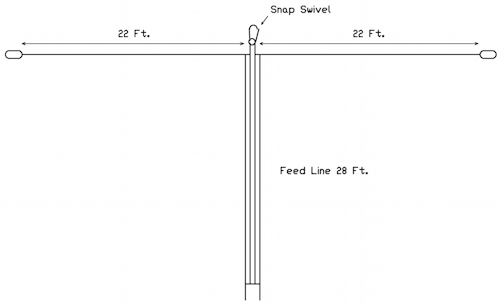
Schematic diagram of an antenna.
The NorCal Doublet.

See you in the Fediverse!

Filed Under: Antennas, Digital Modes, On the Internet Tagged With: doublet, gallery, M17

ARRL making headway on antenna legislation, looking for help

June 4, 2024 By Dan KB6NU 2 Comments

I received this from Fred Hopengarten, K1VR, yesterday via the CWops mailing list:

While ARRL suffered on other fronts recently, the ARRL Legislative Activities Committee enjoyed a big win. On May 14th, the Vice-Chair of the relevant subject matter committee in the U.S. Congress (Rep. Randy Weber, R-TX-14) signed on as a co-sponsor of H.R. 4006, our bill to aid HOA residents. We now hope to get others on the relevant sub-committee of the House Energy & Commerce Committee to co-sponsor (“to sign on to”) our bill. Can you help?

To find a list of the members of the Sub-committee on Communications & Technology, see https://democrats-energycommerce.house.gov/subcommittees/communications-and-technology . Do you know any of these people? Even if you don’t live in a district listed, if you are member of a club based in that district, please let me know.

If you would like to see a copy of the bill, just ask me.

Your two ARRL volunteer lawyers engaged in lobbying this bill in Washington are Gulf Director John Robert Stratton, N5AUS, and me. The bill has already been introduced in the Senate with both a Republican and a Democrat as co-sponsors. If you can help us lobby another member of the House Communications & Technology subcommittee, please let me know.

CWOps #57
Fred Hopengarten, Esq. K1VR
[email protected]

Filed Under: Antennas Tagged With: HOAs

Amateur radio videos: W6LG on SWR, CW without Morse Code?, M0NTV on impedance matching

April 15, 2024 By Dan KB6NU 3 Comments

W6LG on SWR

Standing wave ration (SWR) is arguably one of the most debated—and misunderstood—topics in amateur radio. Here is Jim, W6LG’s, take on it.

CW without Morse Code?

In amateur radio, we tend to use the terms “CW” and “Morse Code” interchangeably. Technically, though, we send Morse Code using continuous wave (CW) transmissions.  CW could be used to send other codes, such as the one proposed by this video.

It doesn’t’ seem like the code proposed here is all that practical, but YMMV. Let me know what you think.

MONTV on impedance matching

Impedance and impedance matching are two more misunderstood topics. Here, Nick, M0NTV, explains some of the basics of LC matching networks. What good is knowing this? Well, for example, if you really want to understand how your antenna tuner works, you’ll want to watch this. This is Part 1 of 2 videos.

Filed Under: Antennas, CW Tagged With: impedance matching, SWR

Random Noise: Wet antenna, POTA ragchewing, more ops sending BK

April 12, 2024 By Dan KB6NU 3 Comments

Rain puts a damper (literally!) on 30m operations

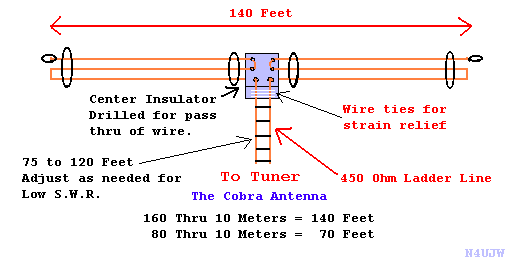
I love my homebrew Cobra antenna…

…but it suffers from one big drawback. When it rains, the ladder line impedance changes and I have to retune the antenna. And, when it rains constantly for more than a couple of hours—like it has been here for the past 24 hours or so—I can’t tune it at all on 30 meters. That’s a bummer because 30 meters is my favorite band.

Oh well….It looks like the rain has finally let up here, so I should be back in business on 30 meters this evening.

POTA Ragchewing?

One of my ragchewing buddies is Howard, K4LXY. He’s fun to chat with because he always has something interesting that he’s doing or working on. A couple of days ago during our QSO, he suggested that POTA would be even more fun if somehow one could get credit for ragchewing from a park.

I like this idea. Perhaps if one had a ragchew of 15 minutes or more from a park, that one contact would qualify the operation as a legal activation and 10 contacts. What do you think?

More breaking, less IDing

It used to be that, at the end of a transmission, one would send the other station’s call, then “DE”, then your call, then “K”. So, for example, if I was working W1ABC, I’d send “W1ABC DE KB6NU K”.

Lately, however, I’ve been noticing more stations simply sending “BK” when they’re done with their transmission. I’m cool with this. The regulations say that one only has to identify every ten minutes, so why waste time sending call signs over and over? What do you think?


Filed Under: Antennas, Operating, Parks on the Air Tagged With: Cobra, ragchewing

Random stuff: Circuit debugging tips, choke cookbook, Bluetooth observation

March 24, 2024 By Dan KB6NU 1 Comment

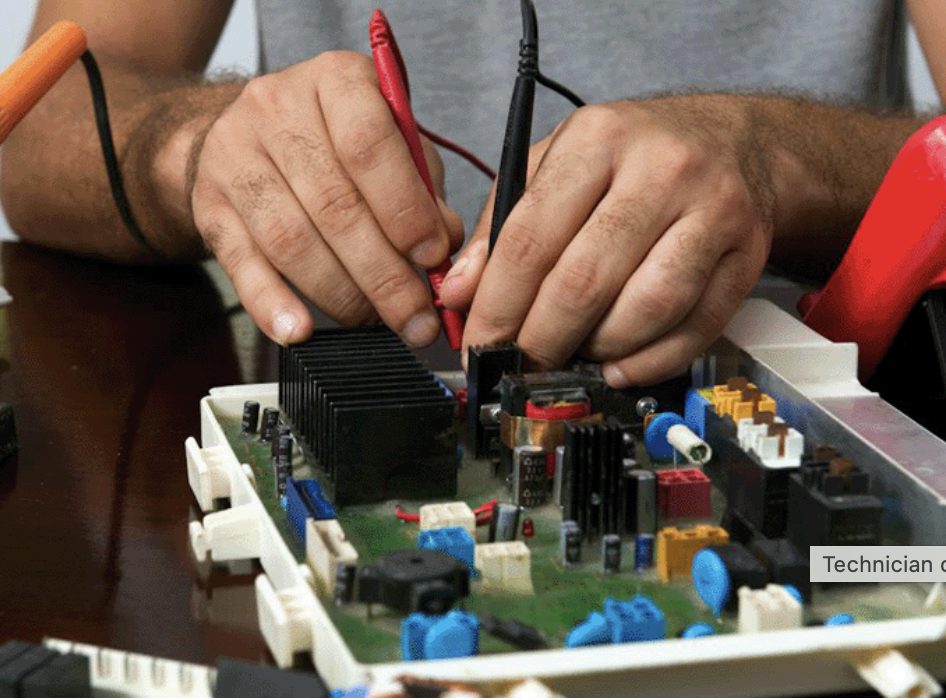
8 Tips for Debugging Electronic Circuits

Technician probing an electronic circuitJameco’s eight tips for debugging circuits include:

  1. Understand the circuit.
  2. Do a visual inspection.
  3. Use the right tools.
  4. Check power supply and ground connections.
  5. Consider signal tracing and analysis.
  6. Conduct incremental testing and isolation.
  7. Learn from documentation and community resources
  8. Develop a methodical approach

For a more complete description, visit the Jameco website. My advice would include a combination of #2 and #4. After doing a visual inspection, the first thing I do is to check all the cables and connectors. It’s been my experience that bad cables and connections account for approximately 80% of electronics problems.


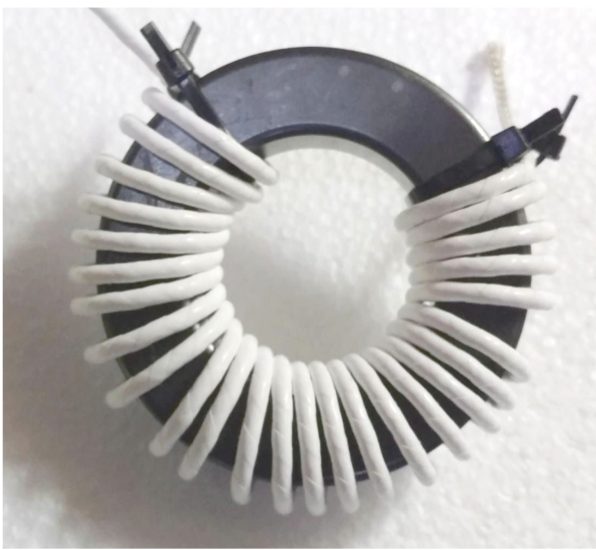
Toroid core wound with RG-179 coax
An RG-179 choke.

A New Choke Cookbook for the 160–10M Bands
Using Fair-Rite #31 2.4-in o.d. (2631803802) and 4-in o.d. (2631814002) Toroids

This article by K9YC is chock-full of information about RF chokes for HF antenna systems, including circuit theory and practical construction techniques. The introduction reads:

Common mode chokes are added as series elements to a transmission line to kill common mode current. The line may be a short one carrying audio or control signals between a computer and a radio, video between a computer and a monitor, noisy power wiring, or feedlines for antennas. This application note focuses on the use of chokes on the feedlines of high power transmitting antennas to suppress received noise, to minimize RF in the shack (and a neighbor’s living room) and to minimize crosstalk between stations in multi-transmitter environments.


Bluetooth multi-path distortion

I’ve started using a set of Bluetooth ear pods to listen to podcasts on my Android phone when walking around town. (I do a lot of walking.) I’ve noticed that when I’m walking around downtown, sometimes the sound will go out in one or both ear pods.

At first, I thought that might be because my hand or my body was shielding the Bluetooth signal when my phone was in my pocket. Thinking more about it, though, I’ve decided that I’m losing the signal due to reflections from buildings as I walk by them. It’s multipath distortion!

I should have realized this right off the bat, as I’ve been teaching this very thing in my one-day Tech classes for at least the last ten years.

Filed Under: Antennas, Building/Homebrew Tagged With: Bluetooth, Chokes, debugging

Amateur radio videos: ARDC Interview, microwaves, operating 160 meters

February 27, 2024 By Dan KB6NU Leave a Comment

A Free VPN Service from ARDC

This interview took place at the 2024 HamCation.

Amateur Microwave It’s easier than you think

Can You Do 160 Meters on Two Wolf River Coils?

K8MRD connects two Wolf River loading coils in series to see if he can use that lashup to tune on 160 meters.

Filed Under: Antennas, ARDC, Digital Communications, Microwave Tagged With: VPN, Wolf River

Amateur radio videos: One CW question, ham radio is for hackers, antenna masts

February 12, 2024 By Dan KB6NU Leave a Comment

One CW Question

Vince, VE6LK, has been on a quest to learn CW. Being a YouTuber, he’s asked a bunch of current CWops for tips on how to learn CW and improve one’s skills. He has a whole series of them on his YouTube channel. Here’s my contribution.

Ham Radio is for Hackers

It’s often said that hams were the first electronic hackers, so it’s really a shame that ham radio has a reputation for being a stodgy hobby. Here, Ward de Ritter, ON8WR, gives a talk on ham radio to the Hacker Hotel 2024 Conference.

Masts for your “Garden”

The tree supporting the far end of my Cobra antenna is not long for this world. That means I’m going to have to find a way to support it back there. In this video, Peter Waters, G3OJV, the founder of the English ham radio retailer Waters & Stanton, discusses three mast options that I might consider. Coincidentally, I worked G3OJV on 30m CW a couple weeks ago.

Filed Under: Antennas, CW Tagged With: antenna mast, Hacker Hotel, VE6LK

Amateur radio videos: Make the most of solar cycle 25, backyard ISS contact, build a mini-HF loading coil

February 3, 2024 By Dan KB6NU Leave a Comment

How to make the most of Solar Cycle 25

It’s no secret that the bands have been in great shape lately. In this video, W3LPL shows how to make the most of it.

Michigan ham talks to astronauts aboard the ISS from his backyard

This video has been gotten a lot of press, but I think it’s pretty cool, so I’m posting it here. It’s kind of cool that KB8M happens to be in Michigan, my home state.  You can tell how geeked Doug was about the contact.

How to build a mini HF loading coil

Here’s another video on how to build your own version of a Buddipole or Wolf River loading coil. VA5MUD has a lot more interesting videos on his YouTube channel, Mr MuDs Radio Time.

Filed Under: Antennas, Propagation, Satellites Tagged With: ISS, KB8M, loading coil, VA5MUD, W3LPL

Random ideas and observations: Ice on the antenna, what happens to a signal in a scope, the Anarchist Radio Relay League.

January 19, 2024 By Dan KB6NU 2 Comments

Ice on antennas

Last Friday, we got about six inches of snow here. That was followed by the rain, covering everything— including antennas—with a coating of ice. Ice, in general is not a good thing on antennas or feedlines.

We noticed this last Monday night on our weekly club net. Stations that were not really strong into the repeater, including yours truly, sounded scratchy. Those that were marginal before, were unreadable.

The temperature hasn’t gotten above freezing here since then, and I can still see ice on my 2m antenna. That being the case, I hope it warms up enough to melt the ice by this coming Monday evening.

Understanding the Journey of a Signal

What happens between the tip of a scope probe and the scope screen?

This white paper explains everything that happens to your signal inside a digital storage oscilloscope (DSO). Having this fundamental knowledge will help you make accurate measurements by correctly selecting the probes and oscilloscope that will work best for your test needs.

You do have to fill out a form with some personal information, but you can easily fake the information if you’re skittish about it.

Anarchist Radio Relay League

Radio amateurs tend to be very conservative, but not all of us are. Case in point: the Anarchist Radio Relay League. On their website, you’ll find their zine, For an Anarchist Radio Relay League.

It’s really not a zine, per se, but rather an introduction to the radio world for those whose politics may be a little to the left of the average radio amateur. It does a good job of explaining what radio waves are, the different frequency bands, how to get a license, what’s the difference between HF and VHF/UHF, how to build some basic antennas, etc.

What makes it anarchist? Well, the zine compares the two ARRLs. It says,

An Anarchist Radio Relay League, we think, would have a similar function to the original ARRL, but in the spirit of mutual aid and solidarity, and with an explicit anticapitalist and anti authoritarian orientation.

This has the potential to take many forms.

I’ll let you read the rest for yourself.

Filed Under: Antennas, Clubs, Test Equipment Tagged With: Anarchist Radio Relay League, ice, oscilloscope

Random noise: My first Olivia contact, antenna efficiency, Straight Key Night

January 2, 2024 By Dan KB6NU 7 Comments

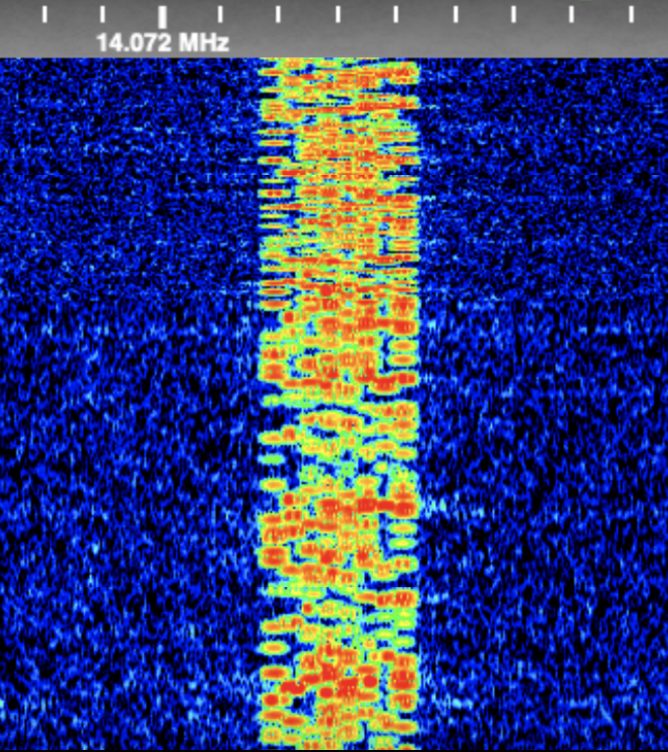
My first Olivia contact

An Olivia 8/250 signal on an SDR waterfall.

I just made my first Olivia contact. The biggest hurdle was getting fldigi to work with my IC-7610. When I first ran fldigi, it received just fine, but I couldn’t get it to transmit. One of the problems was that, for some reason, there’s no official fldigi RigCAT XML file for the IC-7610, despite it being a very popular radio. 

Fortunately, I was able to find a couple of web pages that helped me get fldigi set up properly:

  • fldigi Failures Troubleshooting by N8GD
  • Configuring Icom radio for USB operation by SM7IUN

Thanks, guys, and thanks to M1GEO for coming up with a RigCAT XML file that works.

For more information on Olivia, go to the Olivia Digital Mode on HF web page. It has a bunch of information that will help you get started include a list of frequencies, links to videos by NW7US, and a link to join the Olivia Discord.

Antenna efficiency

On the X-6100 mailing list—as on many amateur radio mailing lists—there’s a discussion about the best antenna to use for portable operation. I like my 66-ft. doublet. I’ve had good success with it, and I have to believe that it’s more efficient than loaded verticals and end-fed antennas. I said as much on the list.

Of course, I can’t verify that. Not only am I not an antenna guru, there’s really no instrument that can measure antenna efficiency. Maybe some measurements could be made with a field strength meter to determine relative antenna efficiencies. Anyone have any thoughts on that?

Straight Key Night 2023

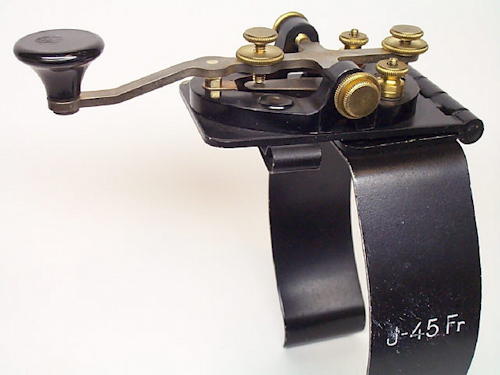
I’ve never been a big straight key guy, but even so, I dug out my J-45 key (a J-37 mounted on a leg clamp, see above) and hooked it up to the radio last night. The first contact I made was with SP7ASJ, which was nice. I made another contact before I decided to call it quits. I had intended  to make a couple more today, but I just never got around to it.

Filed Under: Antennas, CW, Digital Modes Tagged With: doublet, J-45, Olivia

  • « Go to Previous Page
  • Page 1
  • Page 2
  • Page 3
  • Page 4
  • Page 5
  • Interim pages omitted …
  • Page 36
  • Go to Next Page »

Primary Sidebar

No Nonsense Technician Class License Study Guide (for tests given between July 2026 and June 2030)

New No Nonsense Technican Class Study Guide now available!

The 2026 version of my Tech Class study guide is now available, and as always, the PDF version is FREE!. The ePub version costs $11.97, and a Kindle version and paperback version will be available on Amazon shortly.

Click here to get all of my "No Nonsense" study guides.

Also available: The CW Geek's Guide to Having Fun with Morse Code

W5SWL.Com
Retevis Ailunce H1 DMR Radio
DXpander: Cobweb antennas, Laser Cutting

You’ve got mail!

Enter your email address below and get an email every time I publish a new post.

Email


I frequently teach classes to help newcomers get their licenses. The next class will take place on Saturday, October 10, 2026 on the University of Michigan campus. Click here for more information.

If you can't make the class, subscribe to the mailing list to be notified of when the next class will be held.

You can always download my free study guide, and if you have any questions about the classes, or amateur radio in general, please feel free to email me directly.

Support KB6NU.Com

Donate $7.30 and get two of these cool stickers. Measuring 4.25-in. W by 2.75-in. H, it's perfect for your car, your shack, or wherever!

Contact me

If you have a question or comment about one of my blog posts, or a question about any of the material in my study guides, or just a question about ham radio in general, you can email me at [email protected].

Blogs You Should Also Read

  • AE5X: A CW-centric blog from Kingswood, Texas
  • K0LWC Blog
  • LA3ZA Ham Radio Blog
  • Little Radios, Big Fun – WB3GCK
  • Mr. Vacuum Tube's Blog
  • Radio Artisan – K3NG
  • The K0NR Weblog
  • VE3WDM's QRP Ham Radio Blog
  • W2LJ’s Blog

Ham Radio Websites

  • Dashtoons – The Hammin' Comedy by Jeff K1NSS

Podcasts

  • ICQ Podcast
  • Linux in the Ham Schack
  • No Nonsense Amateur Radio Podcast
  • Resonant Frequency Amateur Radio Podcast

Recent Comments

  • Dan KB6NU on 2015 General Class study guide: Section G2E – Digital operating: procedures, procedural signals, and common abbreviations
  • Jimi on 2015 General Class study guide: Section G2E – Digital operating: procedures, procedural signals, and common abbreviations
  • Ali on Some Good Advice on Learning Morse Code
  • mike on Instant Character Recognition is the key to CW speed
  • Matt W1CDN on A completely different picture of Wayne Green, W2NSD (SK)

Meta

  • Log in
  • Entries feed
  • Comments feed
  • WordPress.org

Footer

Copyright © 2026 Daniel M. Romanchik, KB6NU · Log in