• Skip to primary navigation
  • Skip to main content
  • Skip to primary sidebar
  • Skip to footer

KB6NU's Ham Radio Blog

KB6NU's Ham Radio Blog
  • HOME
  • Study Guides
  • Teach a One-Day Tech Class
  • W8SRC Repeater Guide
  • Advertise
  • Hire Me

Antennas

Amateur radio videos: directional antenna edition

June 3, 2023 By Dan KB6NU 1 Comment

I got this from this morning’s Amateur Radio Weekly newsletter. This looks like an interesting antenna to try on some POTA activation.


After watching the above video, I got to thinking about other directional antennas that I could possibly use for portable operation. Moxon antennas, in particular, would seem well-suited to this task because they are smaller than Yagis. Searching YouTube yielded this video on building a 15-meter Moxon.

I found a number of other interesting videos on Moxons for portable use, but in the interest of space, I’ll just list them here:

  • Portable QRP with a Moxon Rectangle. This is another VK3YE video.
  • How to make a 20m Moxon for home or portable use
  • Ham Radio – Moxon Antenna 20m Portable

And, finally, here’s a video on how phased arrays work to begin with.

Filed Under: Antennas, Parks on the Air Tagged With: Moxon, phased arrays, yagi

$30 Lowe’s Antenna

May 4, 2023 By Dan KB6NU 4 Comments

I’m a big fan of homebrewing antennas, especially commercially-available antennas. So, when I saw this posting on the qrptech mailing list, I asked the author, Will, KI4POV, if I could re-post it here. So, here it is, with his permission. Thanks, Will!….Dan


I recently decided that the antenna situation at the shack needed an upgrade. I’ve been using a fan dipole for a little over a year now. It worked great when I had it cut for 2 bands, 40 and 20. However as I started wanting more bands and adding more legs, the performance got progressively worse. I needed something else.

After a lot of reading and research, I kept coming back to a non-resonant doublet fed with ladder line. The low loss of ladder line seemed like that perfect solution to my issues. I looked into antennas like the St. Louis Doublet, but I didn’t have a huge roll of computer cable lying around, plus I wanted something that could potentially handle at least 100 watts in the future if I ever build an amp and go QRO.

I went to Lowe’s and after wandering around, here’s what I came up with.

I bought a 100 foot roll of 18 gauge speaker wire. my goal was a 100 foot doublet, so after splitting the two wires, this gave me 100 feet of antenna and 50 feet of feed line.

Next, I needed spacers for the ladder line portion. What I found was these bags of cable staples. They’re about $6 dollars per bag. I bought two bags worth to do the whole antenna.

These are a UV-resistant plastic spreaders that are a bit under an inch long with finishing nails through each side. They are made secure cable and wire runs in place. After pulling the two nails out, you are left with a plastic spacer that the two wires of the ladder line can be run through after drilling it out just slightly. Admittedly, pulling out all the nails and drilling all the holes took a couple of hours, but it really wasn’t to bad once I got a system going. After that, it was just a matter of sliding the spacers onto the wire, spacing them appropriately (I put one about every 4 inches), then securing them in place with some weather-resistant hot glue.

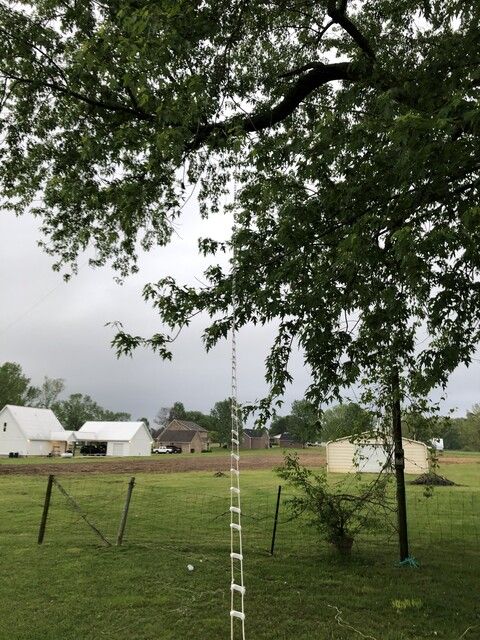
From there on out, the rest was pretty quick and easy. I made my center insulator out of a small scrap of plexiglass I had and zip-tied the wires to it through small holes I drilled. I’ve got it up around 25 or 30 feet in a tree behind our house.

I’m matching it with a t-match tuner and a tiny 1:1 current balun that I plan to show in a separate post. I was able to get a good match on 80-15 meters, and based on RBN data, I think it may be a better performer than my fan dipole. I need more time to determine how it stacks up. Band conditions have not been great the past few days.

Anyway, there’s nothing new or earth-shattering here, but just wanted to share that even with today’s prices, you can still put together a decent “all-band” antenna on a budget if you’re willing to invest a little time and effort.

Filed Under: Antennas

Amateur radio videos: DIY Wolf River Coil, tripod idea, Buddipole sliding contact

April 17, 2023 By Dan KB6NU 2 Comments

DIY Wolf River Coil

If you’ve read my blog before, you know that I’m a fan of homebrew versions of commercial antennas. Here’s an excellent video fo how one Aussie made his own version of a Wolf River coil.

Simple, portable tripod antenna

Having said that ‘m a fan of homebrew versions of commercial antennas, I have to admit that I own a BuddiStick antenna. And, while I am confessing things, I also have to confess that I don’t use it much.

One reason for this is that I’ve never really figured out how to mount it when I’m operating portable. Here’s an idea for using a simple tripod to mount the antenna. After watching this antenna, I remembered that I have a microphone tripod that I might be able to use. While writing this blog post, I pulled it out of the closet, and I will give that a go next time I operate portable.

Sliding contact for the BuddiPole

One of the knocks on the Buddipole is that the clips used to tune the antenna are a bit clunky. Here’s a video that shows a modification to give the Buddipole a sliding contact that should make tuning the antenna a little easier. I think I will give this a try as well.

Filed Under: Antennas, Mobile/Portable Tagged With: Buddipole, tripod, Wolf River Coils

100, 50, and 25 years ago in QST: 100 meters, 10-meter tips, build your own rubber duck

March 24, 2023 By Dan KB6NU 2 Comments

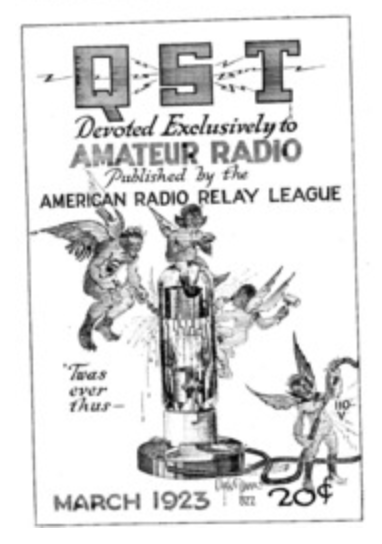
Here are some interesting articles from the March 1923, March 1973, and March 1998 QST. To find and download the articles, go to http://www.arrl.org/arrl-periodicals-archive-search. Note that you do have to be an ARRL member to make use of this service…..Dan


March 1923: “Exploring 100 Meters.” This article describes some of the work going on to induce amateurs to operate on wavelengths of 100 meters and below. That’s 3 MHz and up, frequency-wise. That was “short wave” back in the day. Activities described included a 100-meter CQ Party and weekly “short-wave tests.”

The March 1923 issue also included a couple of other interesting articles:

  • “What the Department of Commerce Things of our A.R.R.L. Voluntary Lid” is a compilation of letter extracts describing agreements between amateur and broadcast stations.
  • 1XM, the radio station at the Massachusetts Institute of Techology is showcased in the “Who’s Who in Amateur Wireless” column.

March 1973: “Beginner and Novice: Tips on Ten.” In 50 years time, amateur radio has gone from its first steps into the shortwave region to operating on 10 meters. And, now that we’re headed towards the peak in the sunspot cycle, 10 meters will be plenty active again. In this article, Ed Tilton, W1HDQ, gives some great advice on the propagation modes that you can take advantage of on 10 meters and covers a wide variety of antennas that you can use for this band.

Another great article in this issue is “The W2FMI Ground-Mounted Short Vertical” by Jerry Sevick, W2FMI. In addition to writing the book on baluns and ununs, Sevick did quite a bit of work on short verticals. The example in the article is a 6-ft. vertical for 40 meters.


March 1998: There are a number of interesting articles in this issue, including:

  • “What is Good Amateur Practice?” by Dave Sumner, K1ZZ. Specifically, K1ZZ addresses the issue of good amateur practice as it relates to band planning.
  • “Helping New Hams Get Started” by Dennis Agosta, KB0RFA. This is a nice article on how to engage new hams.
  • “Understanding UTC” by Gary L. Trice, K4xxx. This is a one-pager on what UTC is, and how to use it.
  • “Make Your Own ‘Rubber Duckies'” by Paul Stump, N0LRF. Paul writes, “You can build a replacement antenna that delivers a lower SWR and more RF output than the one that came with your radio—and you can do it for $10 or less and a couple hours of fun!”

Filed Under: Antennas, Books and Magazines, Classes/Testing/Licensing, Operating

HamSCI 2023: Some first impressions

March 20, 2023 By Dan KB6NU Leave a Comment

I’m on my way home from the HamSCI 2023 Conference, and while waiting in the airport, I thought I’d record some first impressions. As the date approached, I was feeling kind of reluctant about going. In fact, I almost didn’t go. In the end, though, I’m glad I did.

Impressions:

  1. Scranton seems to be typical of a lot of East Coast and Midwest cities that enjoyed an industrial past, but are not as vibrant today as they once were. It’s in a beautiful spot, and the people are very nice, and I’d say that things will get better in the future.
  2. Scranton is called The Electric City. This is partly due to their steel works’ early adoption electrical power and because they opened they opened what was was recognized as the first street car system in the country to run exclusively on electric power in 1886.
  3. I stayed at the Radisson Lackawanna, which is a very cool hotel (see right). It used to be a train station for the Delaware, Lackawanna and Western Railroad that ran from Hoboken, NJ to Buffalo, NY. From its construction, you can see how prosperous Scranton was at its peak. One of the unique features of this station/hotel are the 36 ceramic portrayals of scenes along the  railroad line. The first depicts the Hoboken ferry. The 36th depicts a resort near Buffalo.
  4. This was a small, but mighty conference. There were lots of presentations because they used the academic format, which gives presenters only 20 minutes instead of the hour that’s usually given to presenters at ham radio conferences.
  5. The focus was on ionospheric research, but there were topics of more general interest as well. For example, because the Doppler shift is of interest when describing the behavior of the ionosphere, there’s also an interest in accurately measuring signal frequencies.
  6. There were lots of students, as you may expect. The median age was, therefore, much lower than at many ham gatherings.
  7. The attendees were more diverse, too. There were many women and people of color present.

As a result of attending this conference, I’ve added a couple of things to my list of projects I’d like to do at some point. The first is connecting a GPS disciplined oscillator (GPSDO) to my IC-7610 in order to make my frequency measurements more accurate.The second is to play around with VLF reception and listen to some of the naturally-occuring phenomena that produce  RF signals, such as “whistlers.”

Filed Under: Antennas, Propagation Tagged With: HamSci, ionosphere, PA, Scranton, VLF

Balun or no balun?

March 5, 2023 By Dan KB6NU 5 Comments

On the Elecraft-KX mailing list, an item popped up on a topic that I’ve been pondering for a while. Titled Balun necessary? Barry N1EU asked the question:

I’m planning some 40M-15M portable operation with a 44ft doublet fed with 25ft of twinlead into the KX2 ATU.  Is it, or is it not, necessary to use a balun between twinlead and KX2 antenna terminals for this application?

I’ve been pondering this very question myself, as my go-to antenna for portable operation with my KX-3 is a 66-ft. doublet fed with twisted pair. I’ve just been connecting the twin-led feed line directly to the radio with a BNC-binding post adapter, but it occurred to me last summer that I should perhaps be connecting the unbalanced output of the KX-3 to the balanced feed line. The antenna seems to work just fine without the balun, but I wonder in the antenna system would be more efficient with one. At 10 – 15 W out, you want your antenna system to be as efficient as possible.

As you might expect, this question generated a lot of replies. Many of the replies simply said, “A balun is preferred,” without really giving a reason for this. Many write that using a 1:1 balun or current choke would prevent common-mode currents on the feedline. The purpose of this being to reduce the chance of the feedline radiating and causing RFI or to reduce noise pickup.

I jumped into the conversation when it was well underway  and mentioned that I have been using a doublet with twisted-pair feed line. That prompted a private reply from Barry, and we struck  up a conversation on the relative merits of twisted-pair feedline vs. 300 Ω twinlead and whether or not to use a balun. In one of the emails, he wrote:

FYI Dan, did a little experiment. I set up a 44ft doublet on a summit yesterday and ran some 1 watt WSPR transmissions on 40, 20, and 15m using first a 300-ohm twinlead feedline and then a twisted pair feedline (PTFE insulated, harvested from surplus CAT5e cable). I’ve always been intrigued by the super lightweight twisted pair and several years ago used it once with very good results (high score in 2014 QRPTTF/SOTA event). But I always wondered about the loss involved, especially with the high SWR encountered in a non-resonant antenna.

I lacked sufficient time on the summit to be very thorough and methodical but I believe the data is valid. 30-45 minutes separated the transmissions for the different feedlines.

  • 40m – 24 reports for both – twisted pair averaged -3.75dB down from twinlead
  • 20m – 27 reports for both – twisted pair averaged -1.56dB down from twinlead
  • 15m – 13 reports for both – twisted pair averaged -4.15dB down from twinlead

Perhaps one day I’ll do a more thorough and methodical test but I think these results show that PTFE twisted pair is a viable balanced feedline and makes for an ultralight option for SOTA activation, although twinlead is preferred when weight is not an issue.

Other equipment used included an Elecraft KX2/ATU and Android phone running WSPR Beacon. The 300-ohm twinlead was connected using a homebrew dual FT140-43 core 4:1 Guanella current balun and the twisted pair was connected using a homebrew FT140-43 common mode choke (12 turns).

I should probably do some of my own testing. While scouring the shack for stuff to take to a hamfest a couple of weeks ago I ran across some quality 300 Ω twinlead, so I could make up a 66-ft. doublet with the twin lead feedline. I also have ferrite cores and try winding the twisted pair feedline around it to see if that makes any difference. Barry’s test show that the twin lead is more efficient, but twisted pair is easier to handle and does wind up into a smaller and lighter package for transporting to and from a POTA or SOTA site.

It would be interesting to do some testing with the 44-ft. doublet. In general, of course, the more wire in the air the better, but less wire again makes it more manageable. I’m going to have to download WSPR Beacon to my Android phone, too. In any event, it looks like I’ll have a lot of fun stuff to play with this summer when I can get out and do some activations.

Filed Under: Antennas, Operating, QRP Tagged With: baluns, twinlead, twisted pair

Latest browser tabs: G7FEK antenna, SWR, repeater activity

February 13, 2023 By Dan KB6NU Leave a Comment

If you’re like me, you have a lot of browser tabs open. These tabs have web pages that you keep meaning to get around to reading, but often do not. You could bookmark them, but bookmarking those pages just puts them out of sight, and they shortly become out of mind.

Right now, I have four different amateur radio-related tabs open. Since I think that many of you will also be interested in reading them, I’ll do a short review of each one here.

G7FEK antenna: 80 meters in a limited space

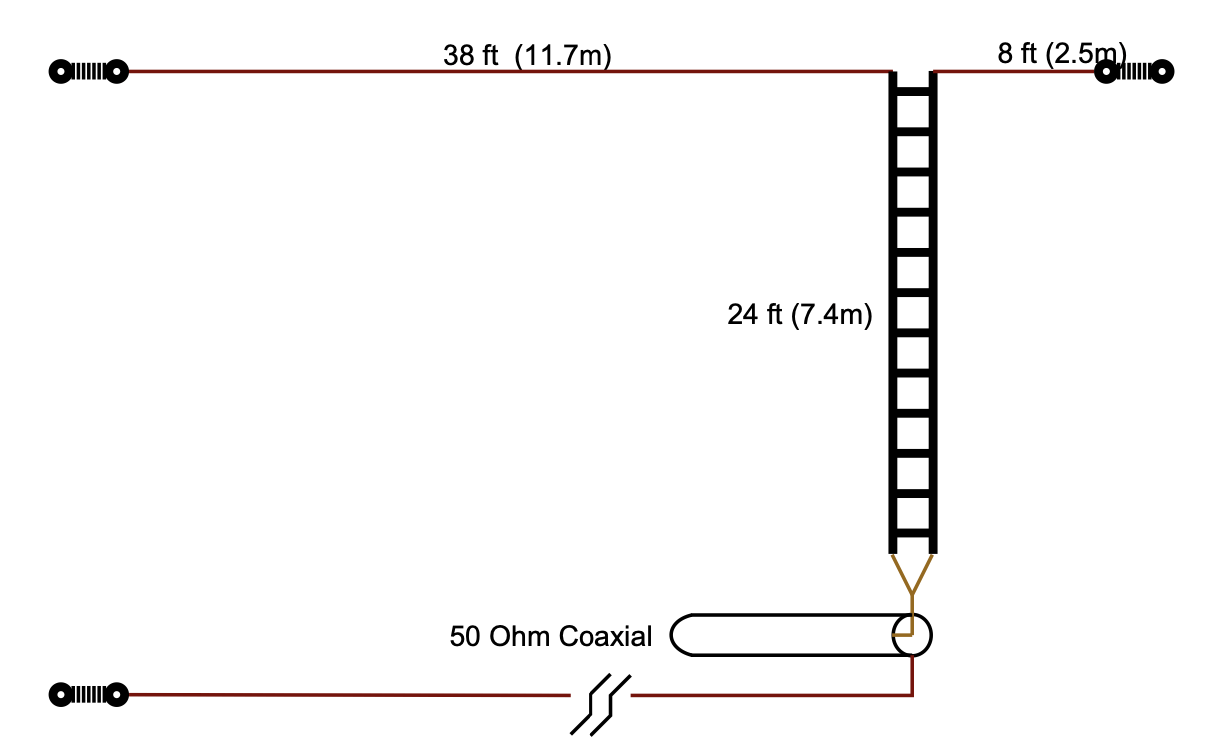
Before I found and put up my Cobra antenna, I did a little research and found several possibilities, including a loaded dipole and a 43-ft. vertical. Another good option that I recently came across is the G7FEK antenna. G7FEK describes his antenna as “a 46-ft., multi-band antenna for small gardens that works well on 80 meters.” And, according to G7FEK, its impedance is nearly 50 Ω on 40 meters, 30 meters, 17 meters, 15 meters, and 12 meters, and it can be used with a tuner on 20 meters and 10 meters.

Here’s what it looks like:

The G7FEK antenna needs only 46 feet of space.

If any of you are using this antenna, please let me know. I’d like to hear your thoughts.

The REAL SWR page

As I’ve often noted, I’m not an antenna guru. I know enough to get something in the air and working well enough to make contacts, but not a heckuva lot more. I know that low SWR at the transmitter is a good thing, but that it’s not really necessary that the antenna itself have a low SWR. The REAL SWR page backs me up on this.

Here are the 7 points that WC7I makes on this page:

  1. Reflections happen at the coax – antenna connection and they also happen at the coax – tuner connection. The last part of this statement seems to be missing from most discussions of SWR and mis-matched conditions.
    This is why a lot of people think that reflected power gets into the radio and does damage. That does not happen!
  2. These reflections do not cause energy loss. All losses are due to the coax itself.
  3. Energy moving backwards in the coax is subject to the exact same losses as energy moving in the forward direction.
  4. The amount of energy reflected at the coax – antenna connection depends on the amount of impedance mis-match (read SWR) between the antenna and the coax. The greater the mis-match, the greater the reflection.
  5. The amount of energy re-reflected at the coax – tuner connection is 100% of the energy that gets there, but not all the energy that was originally reflected gets back to the coax – tuner connection. There will be losses in the coax. All the reflected energy that reaches the coax – tuner connection is re-reflected back into the coax headed for the antenna. (Yup, another lossy trip in the coax.)
  6. The re-reflected energy will be in phase with the generator so the two signals will add. This can create more forward power in the coax than the transmitter is actually producing. It is possible to measure 125 Watts forward power from a 100 Watt transmitter because the re-reflected power adds to the transmitter power.
  7. Coax losses are the only losses in the whole system. These losses can be significant, but they are the ONLY losses in the antenna system. If you have been paying attention, you know that this last step is just a re-statement of other steps above.

He goes into much more detail on why this is so, so read the web page. Two things pop out from this discussion:

  1. WC7I says, “You should always use an antenna tuner. It goes near your rig, in the shack. Its duty is to match your antenna and coax to the impedance of your rig, not to change the SWR in the coax that goes from the antenna down to the antenna tuner.”
  2. Electrical energy moves forward and backward in a coaxial cable and in ladder line. (Everything I tell you about coax is also true for ladder line, except that ladder line has far less loss.)

How to activate your local repeater

A frequent lament is that repeaters these days are quiet most of the time. In an attempt to get more people on their local repeater, a Reddit user asked for suggestions on how to increase activity. Here are some of the ideas that you might want to try:

  1. Throw out your call sign and let people know you’re listening. It won’t change it overnight,  but I think you, plus a few others, could make a world of difference.
  2. We have a daily net, round table style. It is open from 5 to a minimum of 5:30. longer if we are having discussions. If we run out of check ins or things to say, the net control remains on frequency and makes a call every few minutes until 5:30. Encourage discussions and conversations. Some net controls do words of the day, finding odd words and asking if folks know their meaning. I do trivia, sometimes ham related, sometimes not. As a NC, engage with people, ask questions, ask how that thing they were doing last week went or whatever. The point is to make it more than a simple check in and personal, not just some call sign checking in.
  3. Does the repeater have a website? Make sure any regular nets are published there, and promote it in clubs, newsletters, etc.

The post also has some good ideas about how to make nets more interesting and get more check-ins.


Filed Under: Antennas, VHF/FM/Repeaters Tagged With: G7FEK antenna, SWR

Amateur radio videos: Intro to digital communications, putting up a hex beam, Begali paddles

October 16, 2022 By Dan KB6NU 1 Comment

Here are some more great YouTube videos I’ve come across lately. This first one is a pretty good introduction to all the digital modes we, as radio amateurs, can operate.


I’ve been thinking about putting up a hex beam here for a while. The only reason I haven’t done it yet is because I’m thinking about moving.


Have I ever mentioned that I’m a Begali fanboy?

Filed Under: Antennas, CW, Digital Communications Tagged With: Begali, hex beam, paddle

Amateur radio videos: Building a fan dipole, testing toroids, end-fed antennas

October 9, 2022 By Dan KB6NU Leave a Comment


Filed Under: Antennas, Building/Homebrew Tagged With: end fed antenna, toroids

After 50 years…..SUCCESS!

June 24, 2022 By Dan KB6NU 7 Comments

I’m really not great when it comes to antennas, and when I was a kid, I was even less so. And, because my family lived in a subdivision with hardly any tall trees, about the only antenna that I could get into the air was a 14AVQ vertical, mounted on the ground in my back yard.

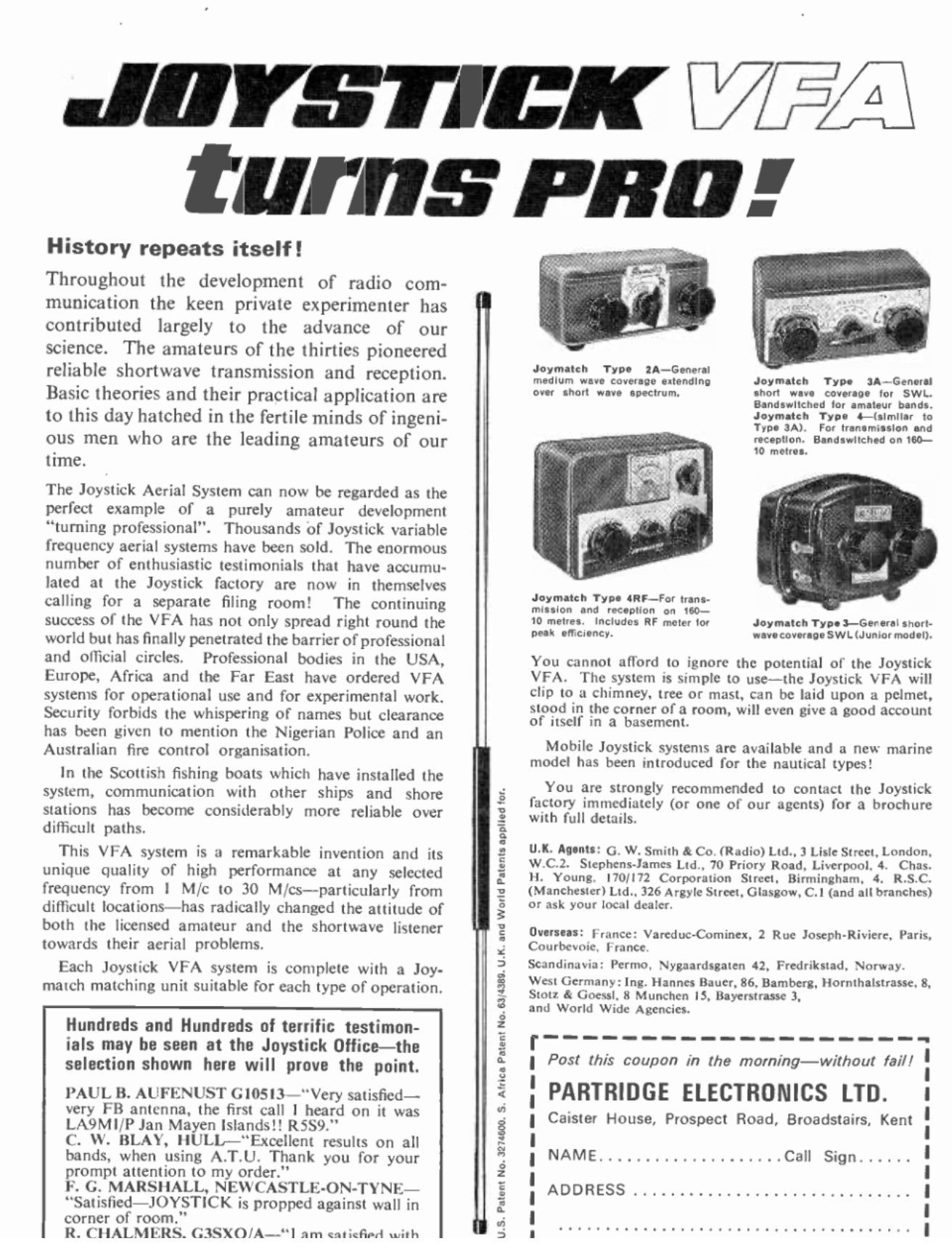
I yearned to have a better antenna, and fell prey to several scams, or perhaps I should say to over-blown claims. One of them was the Partridge Electronics Joystick VFA antenna (see below). I spent $80 or $90 on this antenna, and in 1970s dollars, that was a substantial amount of money. Alas, because I didn’t really understand antennas, I never got it to work.

But, even though I never got it to work, I carted it around with me for the past 50 years. It accompanied me to Sunnyvale, CA, then San Diego, CA, and then back to Michigan.  I kept thinking that someday things would fall into place, and I’d figure out how to make a contact with it.

Over the years, I did learn more about antennas, but the more I learned about them, the lower my opinion of the Joystick. It really is a compromise antenna. As you can see from the advertisement above, the antenna itself is just a metal rod with a loading coil in the center. One end of the antenna is connected to an antenna tuner. The radiating element is only about 7 feet tall, so honestly, how good of a radiator can it be, especially at lower frequencies?

Well, this Monday, the opportunity arose for me to try to make a contact with the Joystick. On the third Monday of each month, our club, holds an event with call AMP Team meetings. AMP stands for “ARROW Mobile and Portable,” and we drag out all kinds of QRP  and portable gear to a local park and try to make contacts. It’s kind of like a mini-Field Day. Our June AMPTeam meeting was held in Hunt Park, which is just up the street from where I live.

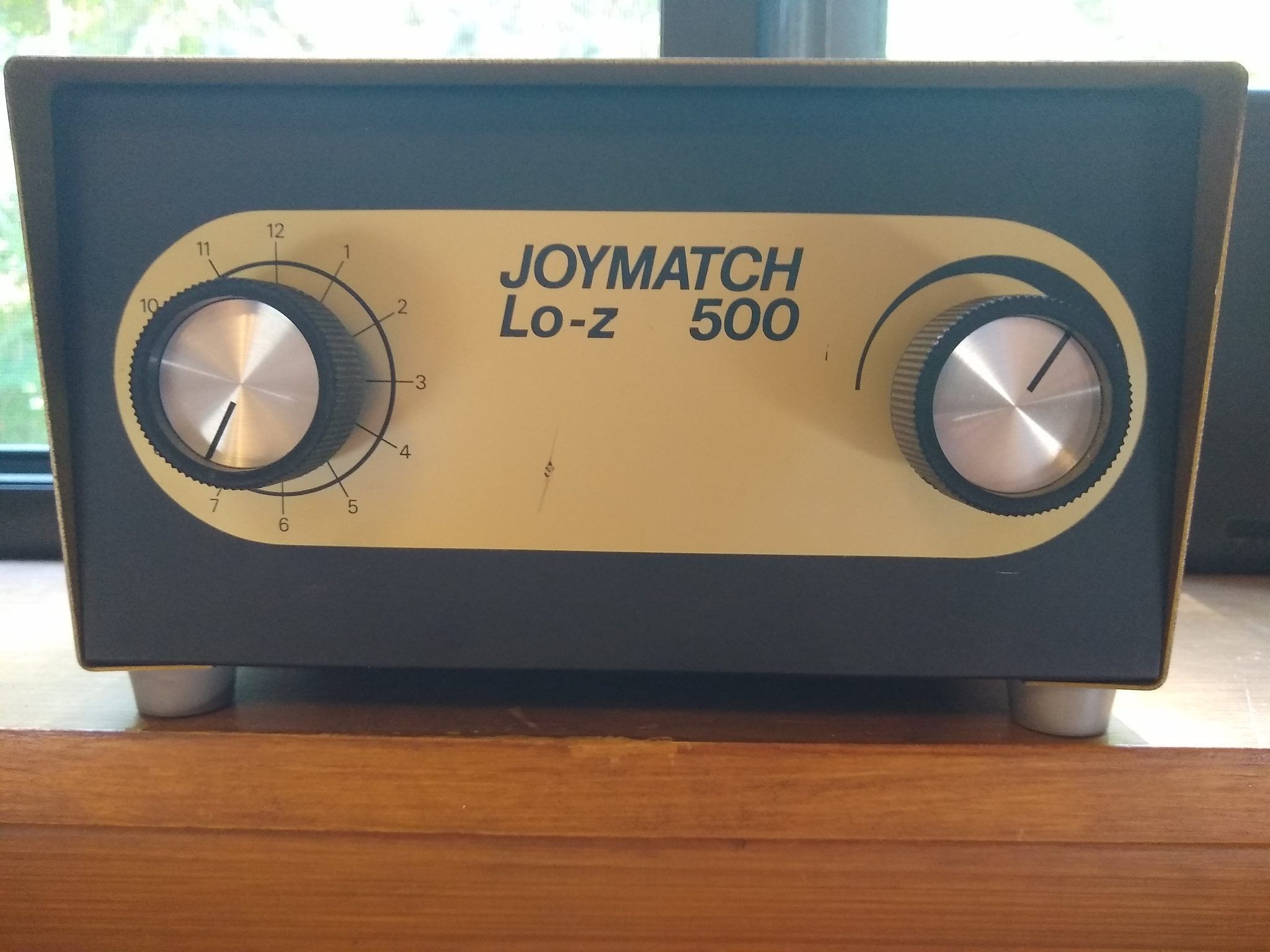
The Joymatch antenna tuner is a simple L-network, suitable for tuning random-wire antennas, which is what the Joystick is, after all.

I got there early to reserve a couple of picnic tables at the northeast end of the park. I set up my gear and hoisted the Joystck up in the air using a convenient tree branch, plugged the single-wire feedline into the antenna tuner (see right), the strung out a counterpoise. My first thought was to try 20 meters, since the antenna is so short.

Unfortunately, I couldn’t get it to tune on 20 meters for some reason. The lowest SWR I could obtain was about 3:1. After fooling around with it for more than a half hour, I decided to try 40 meters instead.

On 40 meters, I was successful right away, achieving a 1.3:1 SWR with a few twists of the tuner’s dials. I hooked the antenna up to my KX-3 and began scouting around for contacts. Unfortunately, it didn’t sound like anyone could hear me. Calling CQ yielded no calls, and when I tried to answer CQs or tail-end a QSO, I got the same results. Finally, someone heard me, but I guess I was too weak because they never did get my call right.

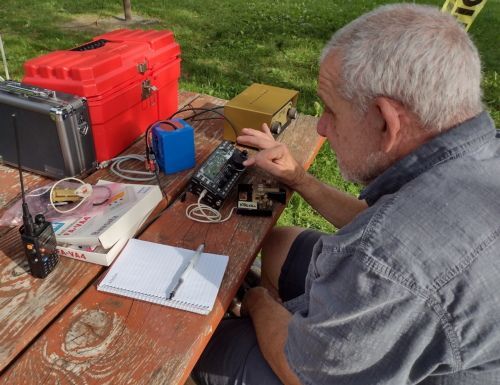
Yours truly hunched over my KX-3, trying to scratch out a contact with my Joystick antenna.

I kept at it, though, and finally managed to make a contact, with K9ID in Wisconsin. He bailed on me pretty quickly, but still it was my first contact in 50 years with this antenna!!

I managed to make two more contacts Monday evening. The second contact was kind of like the first, very short with the other operator bailing on me because my signal was so weak. The third, however, was a very nice contact, with signal reports of 569 both ways. The funny thing was this third op was also running QRP.

The final verdict is that this antenna is definitely not an antenna for QRP work. With it being so short, I’m sure that it’s very inefficient. I was, however, quite excited to actually make a contact with it, finally.

Filed Under: Antennas

  • « Go to Previous Page
  • Page 1
  • Interim pages omitted …
  • Page 3
  • Page 4
  • Page 5
  • Page 6
  • Page 7
  • Interim pages omitted …
  • Page 36
  • Go to Next Page »

Primary Sidebar

No Nonsense Technician Class License Study Guide (for tests given between July 2026 and June 2030)

New No Nonsense Technican Class Study Guide now available!

The 2026 version of my Tech Class study guide is now available, and as always, the PDF version is FREE!. The ePub version costs $11.97, and a Kindle version and paperback version will be available on Amazon shortly.

Click here to get all of my "No Nonsense" study guides.

Also available: The CW Geek's Guide to Having Fun with Morse Code

W5SWL.Com
Retevis Ailunce H1 DMR Radio
DXpander: Cobweb antennas, Laser Cutting

You’ve got mail!

Enter your email address below and get an email every time I publish a new post.

Email


I frequently teach classes to help newcomers get their licenses. The next class will take place on Saturday, October 10, 2026 on the University of Michigan campus. Click here for more information.

If you can't make the class, subscribe to the mailing list to be notified of when the next class will be held.

You can always download my free study guide, and if you have any questions about the classes, or amateur radio in general, please feel free to email me directly.

Support KB6NU.Com

Donate $7.30 and get two of these cool stickers. Measuring 4.25-in. W by 2.75-in. H, it's perfect for your car, your shack, or wherever!

Contact me

If you have a question or comment about one of my blog posts, or a question about any of the material in my study guides, or just a question about ham radio in general, you can email me at [email protected].

Blogs You Should Also Read

  • AE5X: A CW-centric blog from Kingswood, Texas
  • K0LWC Blog
  • LA3ZA Ham Radio Blog
  • Little Radios, Big Fun – WB3GCK
  • Mr. Vacuum Tube's Blog
  • Radio Artisan – K3NG
  • The K0NR Weblog
  • VE3WDM's QRP Ham Radio Blog
  • W2LJ’s Blog

Ham Radio Websites

  • Dashtoons – The Hammin' Comedy by Jeff K1NSS

Podcasts

  • ICQ Podcast
  • Linux in the Ham Schack
  • No Nonsense Amateur Radio Podcast
  • Resonant Frequency Amateur Radio Podcast

Recent Comments

  • Dan KB6NU on 2015 General Class study guide: Section G2E – Digital operating: procedures, procedural signals, and common abbreviations
  • Jimi on 2015 General Class study guide: Section G2E – Digital operating: procedures, procedural signals, and common abbreviations
  • Ali on Some Good Advice on Learning Morse Code
  • mike on Instant Character Recognition is the key to CW speed
  • Matt W1CDN on A completely different picture of Wayne Green, W2NSD (SK)

Meta

  • Log in
  • Entries feed
  • Comments feed
  • WordPress.org

Footer

Copyright © 2026 Daniel M. Romanchik, KB6NU · Log in