• Skip to primary navigation
  • Skip to main content
  • Skip to primary sidebar
  • Skip to footer

KB6NU's Ham Radio Blog

KB6NU's Ham Radio Blog
  • HOME
  • Study Guides
  • Teach a One-Day Tech Class
  • W8SRC Repeater Guide
  • Advertise
  • Hire Me

Antennas

Amateur radio videos: Carry a 2m Yagi in your pocket, conventional current vs. electron flow, W1SFR: made in Vermont

December 31, 2023 By Dan KB6NU 2 Comments

This is a great project. It’s simple, cheap, and looks like it works great.


I received an email this morning from a fellow who had downloaded my study guide. He wrote:

On page 5 you state, “In Figure 1, the letter I stands for current. Current flows from the positive (+) terminal of the voltage source through the circuit to the negative terminal of the voltage source.” Is this correct? I’ve read a couple of other places that it is from negative to positive.

I get this question all the time. I think that this video does a great job of explaining that while electrons do flow from negative to positive, we still use the convention that current flows from positive to negative.


Steve Robert, W1SFR, makes some great keys. His keys are unique in that they use torsion bars for tensioning instead of springs or magnets. After watching this video, I think I might want to pick up one for myself.

Filed Under: Antennas, CW, Electronics Theory Tagged With: paddles, W1SFR, Yagi antennas

100, 50, and 25 Years Ago in QST

December 19, 2023 By Dan KB6NU 1 Comment

Here are some interesting articles from QST in December 1923, 1973, and 1998.

December 1923 QST

Shortwave Tuner Design by K.E. Hassel, 9ZN

Most, if not all new designs, are now software-defined, digital radios, but if you ever decide to build your own receiver, this might be a good article to consult. 9ZN gives a lot of good advice on how to make good coils and variable capacitors. This article caught my eye because of the call 9ZN because Bill Crane, W9ZN, a fellow who was a great CW operator, recently became an SK.

A High-Performance 20-, 40-, and 80-Meter Vertical System by J. Sevick, W2FMI

Jerry Sevick, W2FMI, wrote many articles and books about short vertical antennas. Here, he describes his design for a three-band antenna system consisting of one vertical for 80 meters and one for 20 meters/40 meters. He notes that they could be built separately. This article is worthwhile reading if you’re considering how to work more DX, especially on 80 meters.

Low Power, Crummy Antenna by Rob Henderson, KB7PWJ

Rob writes, “Ingenuity compensated for a limited budget in the Golden Age of Radio, and it’ll do the same today. The tools and techniques to make radio magic are everywhere. If your wallet is a bit thin, it’s time to indulge your creativity. According to Rob’s QRZ.Com page, he’s still using crummy antennas 25 years later.

Filed Under: Antennas, Building/Homebrew, Circuit Design, QRP, Receivers Tagged With: 9ZN, KB7PWJ, W2FMI

Amateur radio videos: FCC to replace symbol rate limits with bandwidth limits, K5ATA’s vision for the role of ham radio in STEM education, rain gutter POTA antenna

November 2, 2023 By Dan KB6NU 2 Comments

FCC to lift symbol rate limitations

This is a topic that’s been in the news lately. The FCC is planning to remove the baud rate limitation on digital transmissions and replace it with a 2.8 kHz bandwidth limitation. This video goes into quite some detail on this.

You can find the complete text of the Report and Order and Further Notice of Proposed Rulemaking at https://docs.fcc.gov/public/attachments/DOC-397992A1.pdf.

K5ATA’s vision for the role of ham radio in STEM education

Steve, K5ATA, ARRL Education and Learning Manager, gave the keynote speech at the 2023 ARRL Pacific Division Ham Radio Convention Pacificon. I love the vision. The question now is how to turn that vision into reality.

POTA activation rain gutter


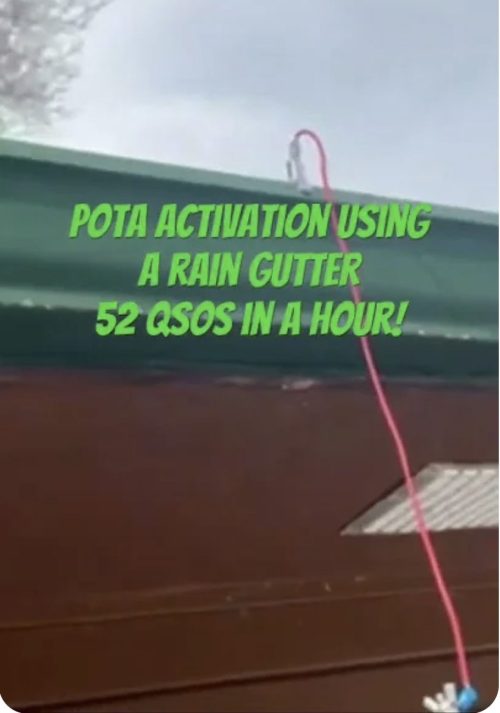
Mr MUD, VA5MUD, forgot to bring an antenna to one of his latest POTA activations. That didn’t stop him, though. As he shows in this video, he simply clips a wire to a nearby rain gutter.

Filed Under: Antennas, ARRL, Digital Modes, Kids, Parks on the Air, Rules, Regulations, Enforcement Tagged With: Canada, STEM, symbol rate

Amateur radio videos: Delta loop antennas, Morse Code speed vs. proficiency, matching diodes

October 6, 2023 By Dan KB6NU Leave a Comment

Here are some videos that folks have recommended either on reddit or one of the many #hamradio mailing lists that I subscribe to.

DX Commander on delta loop antennas

Delta loops are great antennas. Here’s a tutorial on how to build one.

AD0WE on Morse Code speed vs. proficiency

Kurt, AD0WE, has done a great deal of thinking about how we learn and get better at CW—way more than I have. He has a lot more info on his Morse Code Ninja website.

M0NTV on matching diodes

M0NTV likes homebrewing diode mixers, and because one of the keys to success is using matched diodes, he’s developed a methodology for doing this.

Filed Under: Antennas, Building/Homebrew, CW, Electronic Components Tagged With: delta loop, diodes

Would you pay $120 for this antenna?

September 25, 2023 By Dan KB6NU 5 Comments

On the X6100 mailing list, someone at Radioddity posted this message:

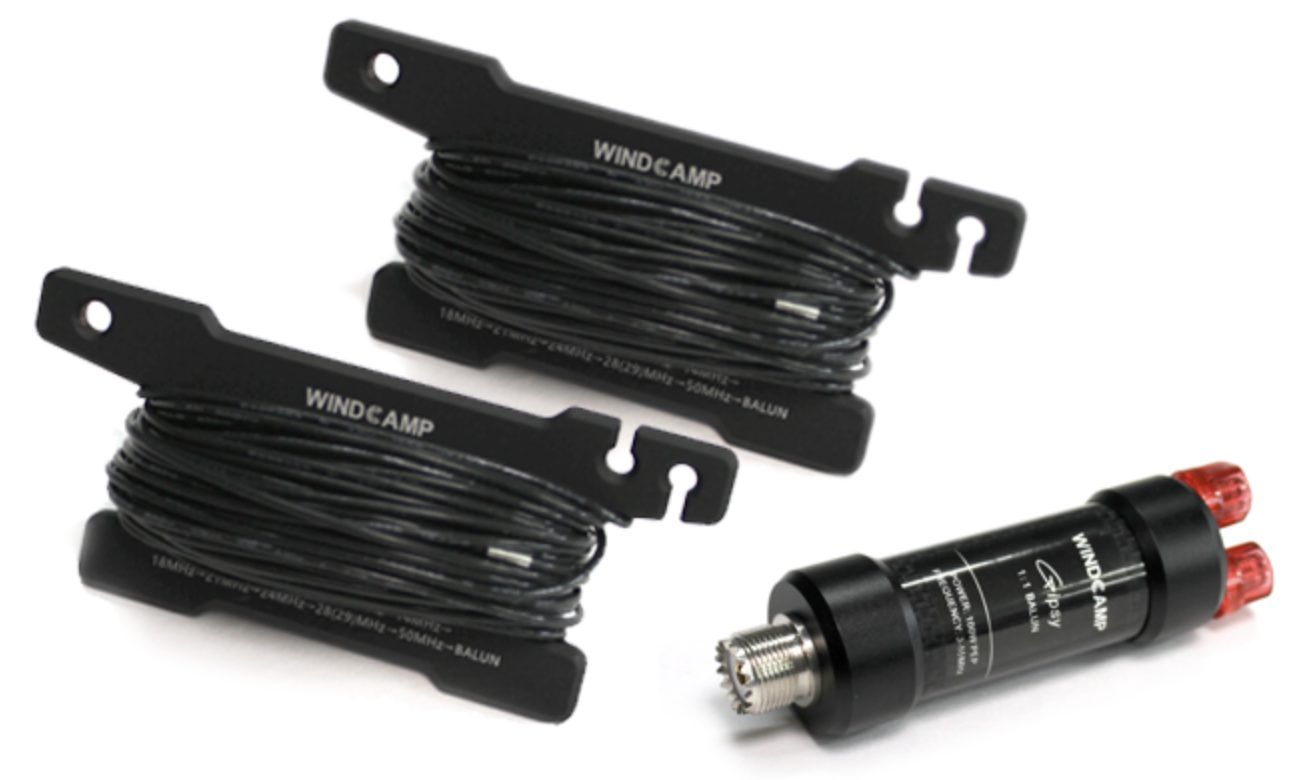
Tecsun TRA Portable Dipole Antenna

We are excited to share that we are exploring the possibility of introducing a portable HF antenna for our customers. In our research, we came across a highly portable antenna that caught our attention. We would love to hear your thoughts on it.

Have any of you had the opportunity to use this type of antenna before? Would you consider purchasing one at the listed price? Here is the antenna we found:

https://www.tecsunradios.com.au/store/product/hf-amateur-radio-dipole/

We greatly value your feedback and suggestions. Thank you in advance for your time and input.

The antenna costs $185 AUD, which translates to about $120 USD.

While this product appears to be a perfectly good antenna, and it may be convenient for someone new to the hobby to simply purchase it, there are several good reasons (in my humble opinion) for not paying for an antenna like this and building your own:

  1. You could easily make this antenna yourself for half that. It would cost even less if you already have a 1:1 balun (or build your own.) And, not only would you save money by doing it yourself, you’d learn a fair bit about antennas in the process.
  2. It’s designed to be a resonant antenna. To change bands, you have to lengthen or shorten the elements. That could be very cumbersome out in the field.
  3. I don’t like the RG-58 coax. If you’re only going to be operating 40 meters and 20 meters, it’s not that big a deal, but on 6 meters, your coax loss could be as high as 25%.

My experience has shown me that a non-resonant doublet, like my POTA Antenna, rev B, is a better solution, at least for me, for portable operations:

  • It’s inexpensive.
  • I don’t have to futz around with element lengths so I can set it up quickly.
  • It uses twisted pair wire for the feed line, which is very light.
  • I can change bands by simply hitting the ATU TUNE button on my radio.

Instead of offering this antenna, I would suggest that Radioddity develop a simpler doublet antenna kit that’s designed to be used with the internal antenna tuner of the Xiegu radios. It would cost less and probably work better than this antenna.

Filed Under: Antennas, Parks on the Air Tagged With: doublet

Amateur radio videos: A father and son get tickets, Slinky antenna, coiling cables

September 9, 2023 By Dan KB6NU 3 Comments

A software engineer and his father, a broadcast engineer, get their tickets and make their first contact. Thanks to Steve, N8GNJ, of Zero Retries for a pointer to this video.


When I first got back into ham radio, a friend of mine gave me a Slinky antenna. I used that antenna for quite a while, until it rusted….Dan


Learning how to coil cables properly can save you a lot of time when setting up a POTA or Field Day antenna.

Filed Under: Antennas, Classes/Testing/Licensing, Gear/Gadgets, Videos Tagged With: cables, Slinky antenna

POTA antenna, rev B

August 24, 2023 By Dan KB6NU 5 Comments

For almost exactly 16  years, I’ve been using a 66-ft. doublet antenna that I cobbled together with left-over wire wrap wire and some twisted pair for the feedline. It’s performed great over the years, and with my new telescoping mast, it works even better because I’m able to get the center up in the air higher more easily.

I recently completed rev B of the antenna. See below.

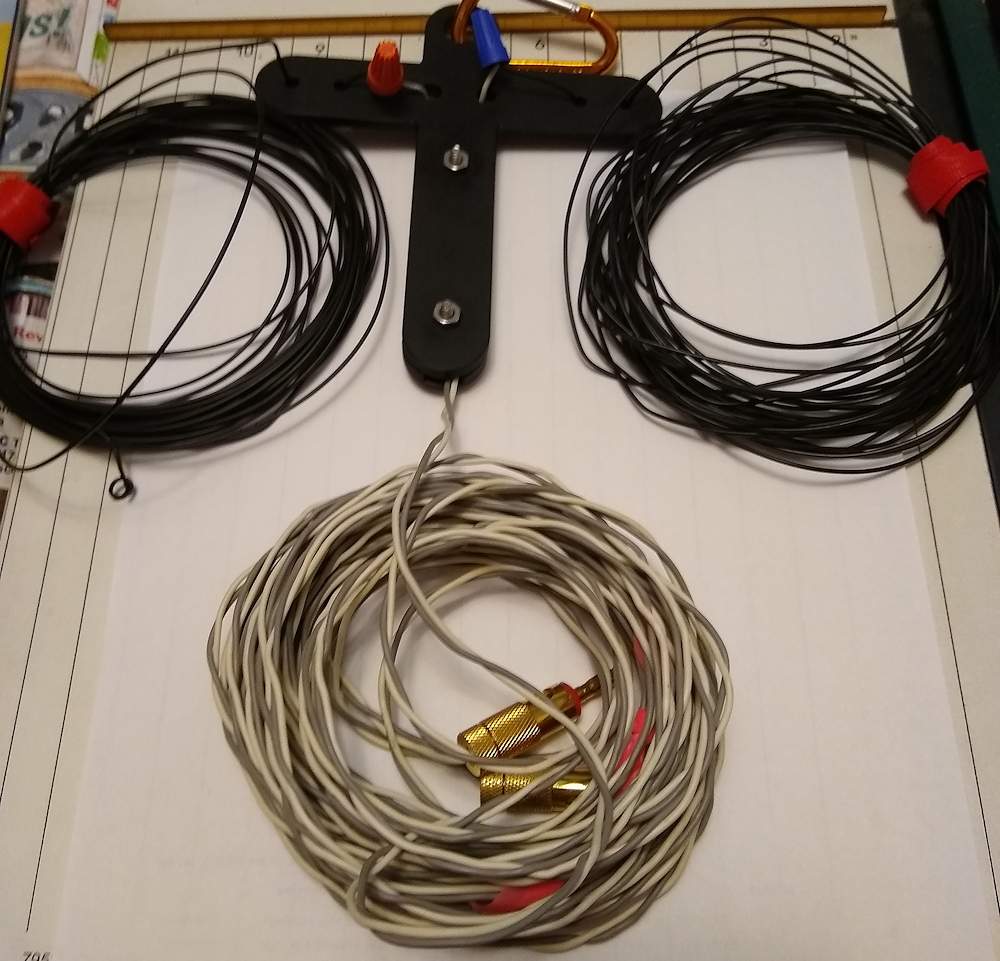
My new POTA antenna uses Poly-STEALTH antenna wire and a 3D-printed center insulator.

This version uses 26-ga. Poly-STEALTH antenna wire from Davis RF that my friend, Rick, K8BMA, gave me. It’s much more rugged than the wire I was using before, and while I never had any problem with the previous wire, I just get a better feeling using the Poly-STEALTH wire.

Another improvement is the center insulator. I’m now using a 3D-printed center insulator from Crazy Ham Sales. Previously, I was using a ceramic dogbone insulator as the center insulator. The twisted-pair feedline hung off the insulator with little or no strain relief. Again, I never had any problem with this arrangement, but it was kind of kludgey.

This center insulator provides strain relief for both antenna elements and the feedline. The model I purchased was designed for 300 Ω twinlead, but it does a decent job with the twisted pair wire that I use. I have a friend here in Ann Arbor who’s a big 3D printer, and I’ve got him working on a version of this center insulator that’s designed specifically for a twisted-pair feedline.

I used this antenna Tuesday on my last POTA activation and got good results. Of course, the bands were in pretty good shape Tuesday morning. Anyway, listen for me. I hope to get a bunch more POTA activations before it starts snowing. If you work me, chances are I’ll be using this antenna.

Filed Under: Antennas, Parks on the Air Tagged With: doublet, twisted pair

From the trade magazines: Semiconductor workforce shortage, vector network analyzer intro, DC-DC converters

August 16, 2023 By Dan KB6NU Leave a Comment

U.S. Semiconductor Workforce Shortage Reaching Critical Stage

The U.S. is on the brink of a new semiconductor manufacturing boom, leaving companies in urgent need of technicians to staff their new fabs and engineers to design the chips that these facilities will churn out. And unless things change, there soon may not be enough skilled chip workers in the U.S. to go around.

A top trade group for the U.S. semiconductor industry issued a report claiming there will not be enough skilled engineers and other workers to support their expansion plans, leaving it 67,000 workers short by 2030.

The way the semiconductor industry is growing, it will need a U.S. workforce of about 460,000 by the end of the decade, up from about 345,000 this year, according to a new study released by the Semiconductor Industry Association (SIA) and Oxford Economics.

…read more

Wayne Green, W2NSD, publisher of 73 Magazine, always used to tout the opportunities that an amateur radio license afforded hams. I’m sure that he’d be writing about this topic if he were still with us and editorializing today…Dan


An Introduction to the VNA and Vector Network Analysis

Most design engineers are familiar with tools of the trade such as voltmeters, oscilloscopes, signal generators, and spectrum analyzers. Some may not have had the opportunity to use a vector network analyzer (VNA). It’s the intent of this article to introduce VNA measurement and present a few typical applications.

What you’ll learn:

  • What does a VNA measure?
  • What can one do with the measured data?
  • What devices are measured with a VNA?

…read more

Although written by a a company that makes engineering-grade VNAs, you might find this an interesting article to read if you just purchased a nanoVNA…Dan


DC-DC Converter Design Basics (Part 1): Buck Converters

DC-DC converters are widely used to efficiently produce a regulated voltage from a source that may or may not be well-controlled to a load that may or may not be constant. This article shows how DC-DC converters can be built using the Renesas SLG47105 GreenPAK programmable mixed-signal matrix.

DC-DC converters are high-frequency power-conversion circuits that use high-frequency switching and inductors, transformers, and capacitors to smooth out switching noise into regulated DC voltages. Closed feedback loops maintain constant voltage output even when changing input voltages and output currents. At 90% efficiency, they’re generally much more efficient and smaller than linear regulators. Their disadvantages are noise and complexity.

…read more


Filed Under: Antennas, Electronic Components, Electronics Theory, Test Equipment Tagged With: Jobs, VNA

Having fun with POTA

July 15, 2023 By Dan KB6NU 2 Comments

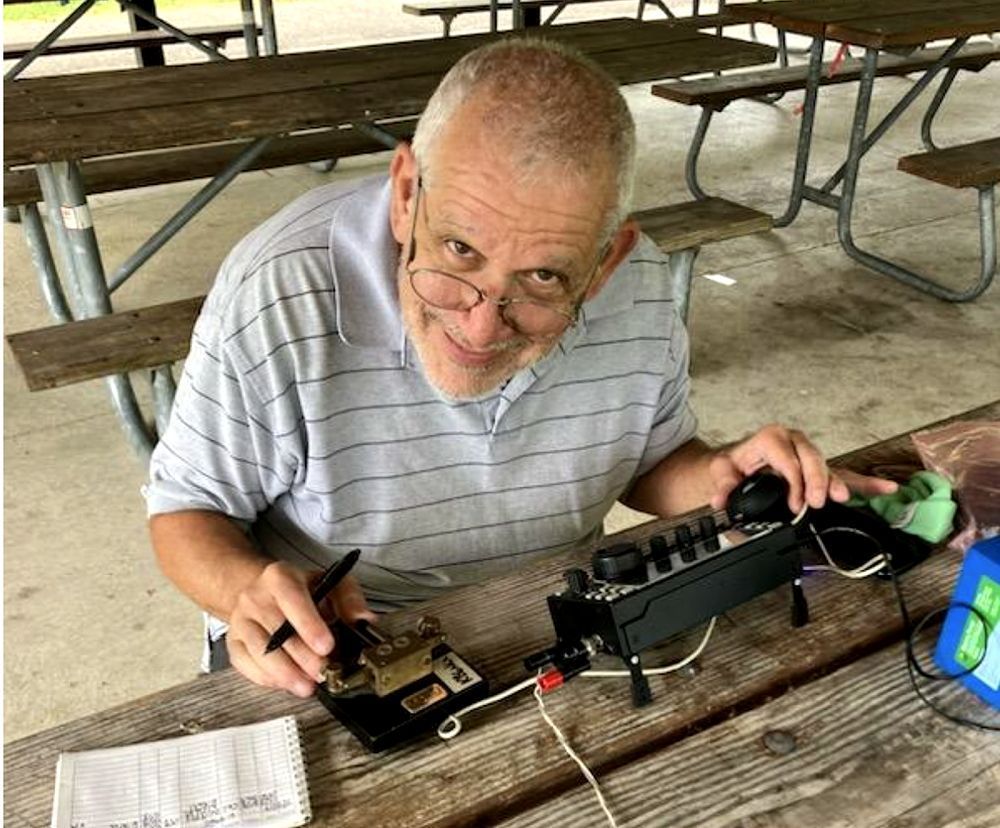
Yours truly having some POTA fun at K-3315 on Sunday, July 9, 2023.

I’ve been doing more Parks on the Air (POTA) operation this summer now that I’m “retired.” It’s been a lot of fun. Not only that, I’ve learned some stuff.

Here’s how my activations usually go. Two or three of us—my partners in crime have included Rick K8BMA, Paul KW1L, and my wife, Silvia—leave my house about 8:30 am and head up to K-3315, the Island Lake Recreation Area.  The park is less than a half hour from my house.

After we get there, we set up, play around with the radios for an hour or so, eat lunch, and then go home. We don’t make as many contacts as some POTA activators, but we enjoy the outdoors and have fun shooting the breeze with one another.

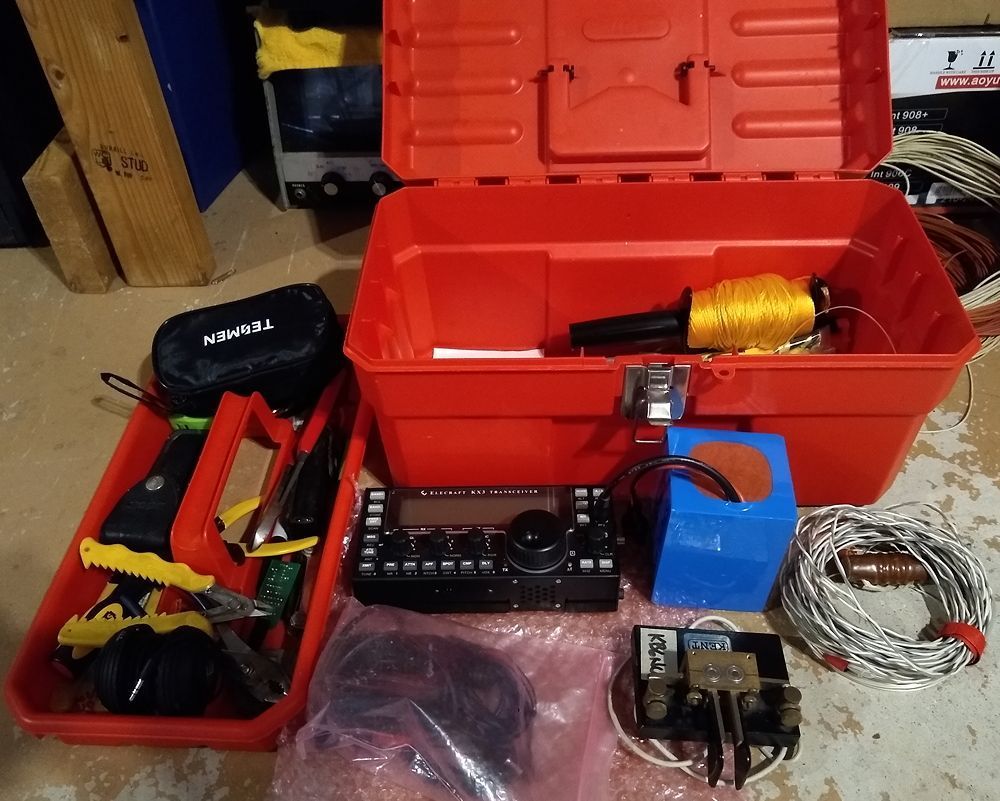
Setup is pretty quick. I can fit my entire station, including my KX-3, BioEnno 9 Ah battery, Kent paddle, antenna, assorted cables, and even the KX-3 microphone(!) in a small toolbox. I pull everything out of the toolbox, plug it all together, and then put up the antenna.

I can fit my entire POTA station into a small toolbox, including the KX-3, battery, antenna, accessories, and dual-lever paddle. And, I can even carry some tools along as well!

My doublet antenna

The antenna that I’ve been using is a 66-ft. doublet made with some wire-wrap wire that I salvaged from a company dumpster many years ago. The feedline that I’m using is some twisted pair that I just happened to have laying around. The antenna coils up nicely and fits into a corner of the bottom of the toolbox.

One thing that I like about this antenna is that because it’s a full half-wave on 40 meters, it’s more efficient than a Buddipole or other similarly short antennas. I connect the feedline directly to the KX-3 with a BNC-binding post adapter, and the KX-3 tuner cranks out a match on all bands above 7 MHz.

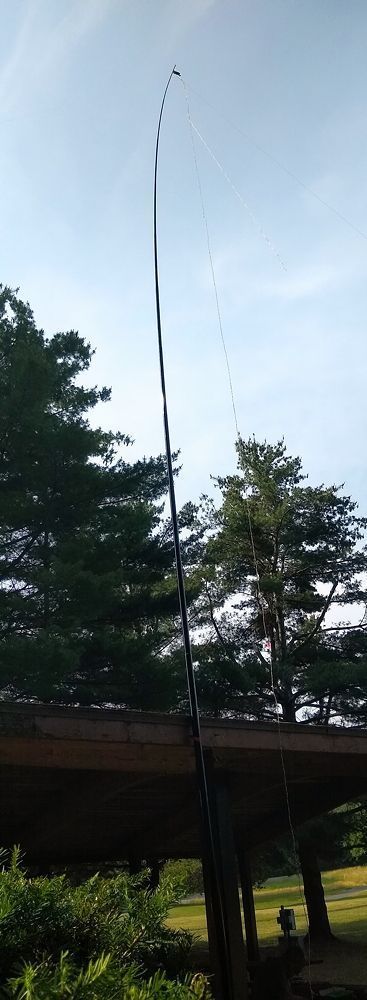
To hang the antenna, I had been using a tennis ball to toss a couple of lines up into trees to support the two ends of the antenna. This winter, though, I purchased a Spiderbeam 10-meter, telescoping, fiberglass mini pole from Vibroplex, and I’ve started using this pole to support the center of the antenna operate the doublet in an inverted-V configuraton. This works very nicely, and because I’m getting the center of the antenna up more than 25 feet, it seems to work better than when the ends were up 20 feet or less.

My first attempt at using this pole was kind of kludgey. We moved a picnic table, and tried lashing it to the table. That single point of support didn’t work out so well, so we also tie-wrapped it to a nail sticking out of the eaves of the picnic shelter. That kept the pole vertical, but it certainly wasn’t a optimum solution.

After that activation, I search for better ways to set up that pole and came across a couple of YouTube videos. I had meant to go buy the piece of PVC pipe and straps recommended in the videos, but as usual, I didn’t get around to it. So, before the next activation, I searched my basement and garage for something that I could use.

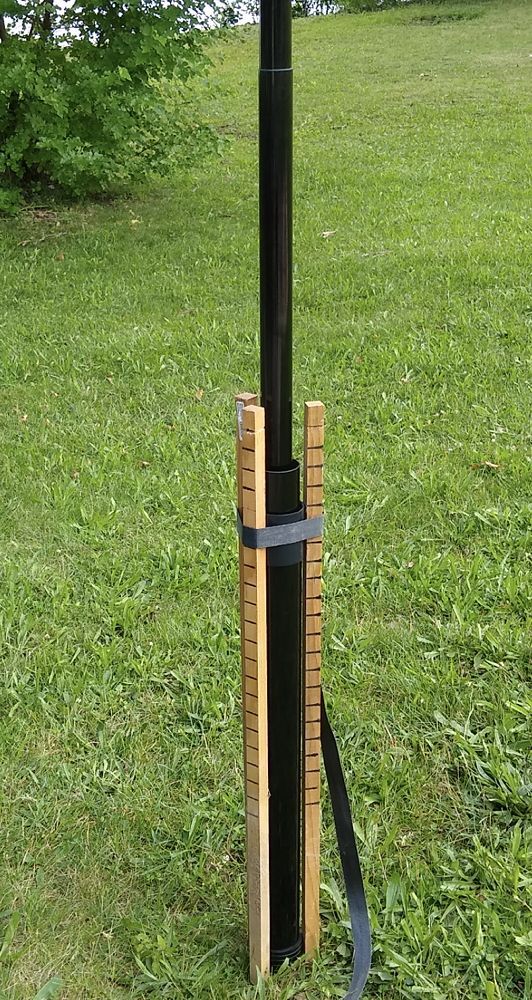
What I came up with you can see in the photo at right. I had the stakes that you see in the photo from a gardening project. I reckoned that if I could pound them into the ground in a triangular pattern around the pole, then strap it all together, it would be sturdy enough for a three- or four-hour POTA activation. And, indeed it was.

One of the reasons that it worked is that the Spiderbeam pole comes in a  tube that seems almost designed exactly for this kind of setup . The bottom has a rubber “foot” that provides a secure interface with the ground, and the other end of the pole had a ring that you can snug everything up to. I’m’ not sure that I’d try this on a DXpedition to Bouvey Island, but for a casual outing to the Island Lake Recreation Area, it works just fine. And, I didn’t have to buy a single thing!

My last activation

Yesterday, the team included my wife, Silvia, and me. We left the house just a little after 9:00 am, and by 10:00 am, I was on the air. I decided to get on 20 meters first, but after three contacts with stations in Florida, I QSYed to 40 meters.

On 40, the contacts came fast and furious. By 11:20 am, I’d made 29 contacts, filling up two pages in my mobile log book. That was enough for me. I turned off the rig, took a little hike to the platform overlooking the lake to enjoy the view, and then had lunch with my wife. After lunch, we packed up and got home about 1:00 pm.

One of the things that I want to do before my next activation is print out a WTH card for POTA activations. I have one for lighthouse activations, but one describing POTA would be cool.

I also want to experiment with antenna placement. It may be just coincidence that I worked Florida stations on 20 meters as my first three contacts, but the antenna ran east to west, meaning that north and south was broadside to the antenna. Perhaps, if I’d set it up differently, I’d have worked stations to the east and west as well.

Whatever happens, it’s all fun, and that’s the point of ham radio after all, isn’t it?

Filed Under: Antennas, Operating, Parks on the Air Tagged With: K-3315

How to put up a fiberglass pole antenna mast

June 28, 2023 By Dan KB6NU Leave a Comment

My Spiderbeam pole installation at a recent POTA activation.

I recently purchased a 10-meter Spiderbeam fiberglass pole for use on POTA activations. Last week, I set it up for the first time.

The first problem I faced was finding a place to set it up. I had some idea of how to do this because a couple of years ago I went out with Thom, W8TAM, who has one of these poles. What we did then was to lash it to a post.

Unfortunately, there was no such post like that where we were. So, we improvised. We did a quick-and-dirty lashup to one of the picnic tables. See photo at right. For good measure, we tied it to a nail sticking out of the shelter about ten feet up. To secure the base—a little bit, anyway—we pounded in a couple of tent stakes.

This certainly wasn’t the best installation, but the weather was nice, and we were only planning to be there for 2-3 hours. Once we got it set up, we didn’t have any problems at all. In fact, the antenna that we hung from it—my 66-ft. doublet fed with twisted pair wire—seemed to work very well. I’m guessing that this was the result of it being up higher than usual, and that band conditions were good that day.

Even so, I wanted to find a better way to set up this mast. So, when a link to a reddit post, How do you guys mount telescoping poles for temporary portable use, hit my inbox, I clicked on it. One of the commenters there, linked to the YouTube video below.

The Fastest and Easiest Way to Deploy a Fiberglass Mast

This video shows a very simple—and inexpensive—way to set up a fiberglass mast. This should work very well for most POTA ops, especially if you’re only planning on using it for a day or less.


Version 2 of The Fastest and Easiest Way to Deploy a Fiberglass Mast

But, wait, there’s more!

This video shows a variation on a theme. In this video, W4AOX uses paracord instead of cargo straps to set up the PVC pipe support, and instead of a hose clamp, he simply drills a couple of holes in the pipe and ties the paracord to it.

All of these videos show the fiberglass pole fitting into a PVC pipe. My Spiderbeam pole came in a holder, and I’m wondering if I can’t just clamp the cargo straps or paracord to the holder instead of buying a separate piece of pipe. One possible problem is that the holder isn’t that tall, so maybe

Filed Under: Antennas Tagged With: antenna mast, Spiderbeam

  • « Go to Previous Page
  • Page 1
  • Page 2
  • Page 3
  • Page 4
  • Page 5
  • Page 6
  • Interim pages omitted …
  • Page 36
  • Go to Next Page »

Primary Sidebar

No Nonsense Technician Class License Study Guide (for tests given between July 2026 and June 2030)

New No Nonsense Technican Class Study Guide now available!

The 2026 version of my Tech Class study guide is now available, and as always, the PDF version is FREE!. The ePub version costs $11.97, and a Kindle version and paperback version will be available on Amazon shortly.

Click here to get all of my "No Nonsense" study guides.

Also available: The CW Geek's Guide to Having Fun with Morse Code

W5SWL.Com
Retevis Ailunce H1 DMR Radio
DXpander: Cobweb antennas, Laser Cutting

You’ve got mail!

Enter your email address below and get an email every time I publish a new post.

Email


I frequently teach classes to help newcomers get their licenses. The next class will take place on Saturday, October 10, 2026 on the University of Michigan campus. Click here for more information.

If you can't make the class, subscribe to the mailing list to be notified of when the next class will be held.

You can always download my free study guide, and if you have any questions about the classes, or amateur radio in general, please feel free to email me directly.

Support KB6NU.Com

Donate $7.30 and get two of these cool stickers. Measuring 4.25-in. W by 2.75-in. H, it's perfect for your car, your shack, or wherever!

Contact me

If you have a question or comment about one of my blog posts, or a question about any of the material in my study guides, or just a question about ham radio in general, you can email me at [email protected].

Blogs You Should Also Read

  • AE5X: A CW-centric blog from Kingswood, Texas
  • K0LWC Blog
  • LA3ZA Ham Radio Blog
  • Little Radios, Big Fun – WB3GCK
  • Mr. Vacuum Tube's Blog
  • Radio Artisan – K3NG
  • The K0NR Weblog
  • VE3WDM's QRP Ham Radio Blog
  • W2LJ’s Blog

Ham Radio Websites

  • Dashtoons – The Hammin' Comedy by Jeff K1NSS

Podcasts

  • ICQ Podcast
  • Linux in the Ham Schack
  • No Nonsense Amateur Radio Podcast
  • Resonant Frequency Amateur Radio Podcast

Recent Comments

  • Dan KB6NU on 2015 General Class study guide: Section G2E – Digital operating: procedures, procedural signals, and common abbreviations
  • Jimi on 2015 General Class study guide: Section G2E – Digital operating: procedures, procedural signals, and common abbreviations
  • Ali on Some Good Advice on Learning Morse Code
  • mike on Instant Character Recognition is the key to CW speed
  • Matt W1CDN on A completely different picture of Wayne Green, W2NSD (SK)

Meta

  • Log in
  • Entries feed
  • Comments feed
  • WordPress.org

Footer

Copyright © 2026 Daniel M. Romanchik, KB6NU · Log in