• Skip to primary navigation
  • Skip to main content
  • Skip to primary sidebar
  • Skip to footer

KB6NU's Ham Radio Blog

KB6NU's Ham Radio Blog
  • HOME
  • Study Guides
  • Teach a One-Day Tech Class
  • W8SRC Repeater Guide
  • Advertise
  • Hire Me

Antennas

Ham Radio Ireland magazine relaunched

March 31, 2025 By Dan KB6NU 2 Comments

I received the following email a couple of days ago:

Following many requests over the last year we have relaunched Ham Radio Ireland, Ireland’s only independent amateur radio magazine. We have just published our April 2025 issue, and it may be downloaded for free. Back issues of the magazine are also available.

If you wish to contribute articles to our magazine we would be delighted to include them. Articles should be submitted in Word format and be 1.5 – 2 pages or more with good quality photographs (not compressed).

We hope you enjoy this free e-Magazine and our intention is to publish every two months from here onwards. Please feel free to share with friends and other groups/clubs and social media.

Steve EI5DD

We covered this story on the ICQ Podcast several episodes ago, and as a result, I sent them an article on my POTA antenna experiments, which they included in the April 2025 issue. This issue also includes articles on:

  • Diodes
  • Hex beam antennas
  • Bunkers on the Air
  • and more

Filed Under: Antennas, On the Internet Tagged With: Ham Radio Ireland

From the trade journals: The rise and fall of Heathkit, Antennas 101, circular polarization

January 22, 2025 By Dan KB6NU Leave a Comment

The Rise and Fall of Heathkit

Steve Leibson begins this six-part series with, “If you came of age in the 1960s or 1970s and then later became an EE, chances are you’re more than casually acquainted with Heathkit. Many engineers started their budding careers by building one or more kits made by the Heath Company. I certainly did.”

Since this is a ham radio blog, I’d say, “If you came of age in the 1960s or 1970s and then later became radio amateur, chances are you’re more than casually acquainted with Heathkit. Many hams started their budding careers by building one or more kits made by the Heath Company. I certainly did.”

This is a remarkable series based on an interview with Chas Gilmore. Gilmore started as a design engineer at the Heath Company in 1966 and worked at the Heath Company on and off for more than two decades. He eventually became vice president of product development, marketing, and sales.

…read more


Antennas 101

Lou Frenzel, W5LEF (SK), was a prolific writer and editor. He was also a ham. Here, he explains antennas in way that we call can understand.

He writes, “Antennas are much more than simple devices connected to every radio. They’re the transducers that convert the voltage from a transmitter into a radio signal. And they pick radio signals out of the air and convert them into a voltage for recovery in a receiver.”

…read more


Understanding circular polarization

John Dunn writes, “An electromagnetic wave or signal traveling from “here” to “there” has an electrostatic field component that we call its E-field and whose direction we assign as the signal’s polarity. Often, the E-field is either vertical or horizontal as developed by a dipole structure or a ground plane antenna, but it can also be rotary which means it can be rotating around the signal’s axis of travel. The conventional terminology for that case however is not the word “rotary”, it is the word “circular”. We thus speak of vertical polarization, horizontal polarization, and circular polarization.”

I’m still not sure that I understand circular polarization after reading this article, but take a look for yourself.

…read more


Filed Under: Antennas, Building/Homebrew, Vintage Radio

Operating notes: Straight Key Night 2025, freezing rain halts operation, are end-feds poor receiving antennas?

January 2, 2025 By Dan KB6NU 3 Comments

First of all, Happy New Year to everyone!

Straight Key Night 2025: 10 QSOs

I was going to start this portion of my blog post with a little of the history of Straight Key Night (SKN). Unfortunately, there is none to be found on the internet. Perhaps that’s some thing that someone at the ARRL can remedy by the time SKN rolls around next year.

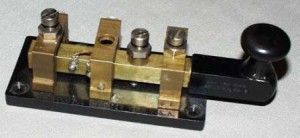
A Bunnel #9 straight key, like the one on I used for this year’s Straight Key Night.

This year, I operated SKN with my Bunnell #9 key (see right). This is a great little key, with a very nice action. I’m not sure how old my key is, but it still operates flawlessly.

First, I had to find a cable for it. Fortunately, I already had a two-conductor cable with a 1/4-in. phone plug on it, so all I had to do was crimp a couple of terminal onto the bare wires at the cable’s other end. In about 15 minutes, I was on the air.

Conditions were a little up and down on 40 meters, due to a geomagnetic storm, but even so, I managed to make eight contacts Tuesday night. I even “ran” the frequency I was on for a bit. Twice I called “QRZ?” after ending a contact and had someone come back to me. Wednesday morning, I got on again and made two contacts before deciding to call it quits.

The highlight of SKN for me was my contact with KE4GBE. He said that listening to my previous QSO had prompted him to dig out his straight key and that it was his first straight key QSO in over 25 years!

Freezing rain halts operation

About a week ago, we had some freezing rain here in southeast Michigan. Normally, when my 450 Ω window line feedline gets wet, I have to adjust my antenna tuner. This time, though, I couldn’t get SWR down enough to be comfortable operating. I just shut things down for the night.

Several years ago, I purchased a 43-ft. vertical antenna, but never did put it up. I’m going to have to set that up, so that I can get on the air even when there’s freezing rain.

Are end-feds poor receiving antennas?

I’ve never been a big fan of end-fed antennas, but I can certainly see their appeal. They are easy to set up, don’t require a long feedline, and can be quite stealthy.

I think that one disadvantage might be that they don’t receive as well as center-fed antennas. I have no science to back this up, but more times than not, when someone gives me a report where my signal strength is less than what I give the other station, they’re using an end-fed half-wave antenna or an end-fed random wire antenna.

I’d be interested in hearing what your experience has been. Does this hold true for you, too?

Filed Under: Antennas, CW Tagged With: end fed antenna, freezing rain, Straight Key Night

Interesting FREE antenna stuff on the internet: Flowerpot antenna, antennas for the non-technical, W2FMI’s book in the Internet Archive

December 31, 2024 By Dan KB6NU 42 Comments

I hate to admit it, but lately, I’ve been getting a lot of my ideas for blog posts from Reddit posts to /r/amateurradio. The first post asked whether or not you should fold over the braid when making a flowerpot antenna. I had never heard of a flowerpot antenna, so I did some searching.

Diagram showing the dimensions for a 2-meter flowerpot antenna.
The flowerpot antenna consists of a half-wavelength length of coax, with an RF choke at the bottom.

The flowerpot antenna is so-called, I think, because the base of it is often inserted into a flowerpot to make it a stealth antenna. It is basically a half-wavelength length of coax inside a PVC pipe to obscure its actual purpose. At the bottom of the antenna, the coax is wrapped around the PVC to make an RF choke. The first post to come up in my search describes a 2-meter flowerpot antenna designed by VK2ZOI.

The reddit post actually asked about a 10-meter version of the antenna. I found a design on VK1NAM’s blog. The 10-meter antenna is, of course, a lot longer than the 2-meter antenna, so instead of a length of PVC pipe, this design uses a telescoping mast to support the antenna.

If you have some RG-58 lying around, or perhaps find some at a ham swap meet, this looks like a fun antenna to play with.

Not technical? Read this.

While searching for information on the flowerpot antenna, I happened to run acrosss Understanding Antennas For The Non-Technical Ham. This book was written by Jim Abercrombie, N4JA (SK) and is now freely available on the web. It lives up to its name, offering descriptions for commonly-used HF antennas in language about as non-technical as it can be. It’s worth every penny. :)

Books by Jerry Sevick, W2FMI

Book cover for The Short Vertical Antenna and Ground Radial by Jerry Sevick, W2FMI.
The Short Vertical Antenna and Ground Radial is one of 6 books written by Jerry Sevick, W2FMI (SK).

Jerry Sevick, W2FMI, was renowned for his work on short vertical antennas and transmission line transformers. Over the years, he wrote many articles and books on baluns and ununs, and many hams consider his book, Building and Using Baluns and Ununs: Practical Designs for the Experimenter, to be the bible on the topic. He received the Dayton Hamvention Technical Excellence Award in 2005 and became an SK in 2009.

This morning, I came across a reddit post asking for information on a short vertical antenna. Since I happen to have a copy of W2FMI’s The Short Vertical Antenna and Ground Radial, I did a search for where to buy a copy. Amazon had some used copies, but at ridiculous prices, so I continued my search.

Fortunately, I found it in the Digital Library of Amateur Radio and Communications, which is part of the Internet Archive. And, it’s available for free!

Sevick’s two other books, Building and Using Baluns and Ununs: Practical Designs for the Experimenter and Transmission Line Transformers can be borrowed from the Internet Archive’s library.

Have fun and make some antennas!


Filed Under: Antennas, Books and Magazines Tagged With: flowerpot antenna, N4JA, W2FMI

A couple of things from my inbox: DLARC updates, W4RNL pages updated

December 23, 2024 By Dan KB6NU Leave a Comment

New stuff in the Digital Library of Amateur Radio and Communications (DLARC)

Kay, K6KJN, curator of the Digital Library of Amateur Radio and Communications (DLARC) recently posted the following to the ARDC-Community mailing list:

First,  my What’s New in DLARC column in the Zero Retries newsletter talks about archiving the Japanese language “Ham’s Radio” podcast, fascinating newly digitized material from the estate of satellite television pioneer Bob Cooper, and new scans of many amateur radio newsletters.

Second, the Internet Archive blog has a great new post about the college radio material recently added to DLARC. Highlights include 1980s radio interviews with LL Cool J, Sonic Youth and more, 1960s amateur radio footage, college radio oral histories, and radio station correspondence from the 1940s-1960s.

W4RLN antenna info now on GitHub

Thanks to Lonney, K1LH, the L. B. Cebik W4RNL (SK) Website and Document Collection is now on GitHub as well as on the website. What you’ll find there is:

  • a download of the Cebik website,
  • a topic index,
  • a collection of books by W4RLN
  • a collection of magazine article written by W4RLN,
  • transcripts of talks given by W4RLN, and
  • an “antenna potpourri.”
W4RLN was really quite prolific. If you’re at all interested in antennas, you really should check out this collection.

Filed Under: Antennas, On the Internet Tagged With: DLARC, W4RLN

Tinkering with an antenna

September 28, 2024 By Dan KB6NU 6 Comments

I don’t know that I’d call Clay Mitchell, W8JNZ (SK), my mentor exactly, but I did look up to him, both as a ham and as a person. I’ll always remember one thing that he told me. “Dan,” he said, “one of the best ways to learn about something is to ‘tinker’ with it.” He’d gotten this bit of advice from Dr. Richard Crane, W8CWN, who taught physics at the University of Michigan and was a a well-known science educator and great tinkerer.

I applied this bit of wisdom to the antenna that I use for portable ops. It’s nothing fancy—just a 66-ft. doublet—but by tinkering with it over the years, it’s a much better antenna than it was when I first built it. 

It started with a KX1

It all started about 20 years ago when I decided that I wanted to operate portable and bought and built an Elecraft KX-1. Out of the box, the KX1 covers 40 meters and 20 meters, and you can buy an option to add 80 meters and 30 meters to the radio. I also purchased and built the optional automatic antenna tuner.

The user manual for the KX1 antenna tuner suggested using a wire antenna of 24 – 28 feet and one or more radials of at least 1/8-wavelength. It also suggests connecting these directly to the radio without a feed line. I cut four, 24-ft. lengths of wire from a spool of wire-wrap wire that I had scavenged from the dumpster of one of my employers, purchased a BNC-binding post adapter, connected the driven element to the red binding post and the three radials to the black binding post. 

Antenna
The KX1 antenna featured a 24-ft. driven element and three 24-ft. radials.

The tuner found a match for this antenna, but I was never really thrilled with the performance. I made some contacts, but with only 4 watts output, most of those contacts were a struggle. I struggled with this setup for a couple of years, but since I was really enjoying portable operation, I decided that some tinkering was in order.  

A new antenna is born

In 2007, my 66-ft. doublet was born. Our club here in Ann Arbor, MI, ARROW, conducts mini-Field Days the we call AMP Team meetings every month. (AMP is short for ARROW Mobile and Portable.) We haul all kinds of radio gear out to a park and set up and operate. The gear you’ll find at one of these events includes HF, VHF, UHF, and even some microwave gear. Some club members, for example, are experimenting with AREDN mesh networking, and these meetings are a good place to test out their nodes without having to worry if their node’s antenna is line-of-sight with another node.

As I was contemplating what to use for an antenna for one of these outings, I scanned the shelves in my shack for antenna-making materials. I still had a fair amount of wire-wrap wire that I could use for the antenna itself, but what to use for feed line? When my eyes lit on a spool of twisted-pair wire, I thought why not give that a try? I cut two 33-ft. lengths of wire-wrap wire for the antenna elements and one 33-ft. length of twisted-pair wire to use as feed line. 

As this was going to be an experimental antenna, I didn’t care too much how kludgey the thing looked. For the center insulator, I dug a ceramic dog bone insulator out of my box of antenna parts. To connect the feed line to the antenna elements, I used a couple of small wire nuts.

Antenna
Rev. A of my POTA antenna used wire-wrap wire for the elements, 
a ceramic dogbone insulator, and twisted-pair wire for the feed line.

Cutting a 33-ft. length of wire for the feed line was actually a mistake. I figured that if I made the twisted pair feed line a half-wavelength long, then I’d have a relatively low impedance at the rig. Instead, in my haste, I cut it too short. 33 feet is only a quarter wavelength at 40 meters, which theoretically should have yielded a high impedance at the antenna input. In practice, however, the KX-1 managed to tune that antenna and feed line on 40 meters and 20 meters just fine. That just goes to show how much I know.

To hang up the antenna, I made a small loop at the end of each wire, and to that I tied some mason twine. I threw that twine up into a tree using a weighted tennis ball, and pulled up the antenna. One problem with this approach is that I was never able to get the antenna up all that high. Sometimes the antenna was less than 15 feet off the ground.

Another problem is that it took a long time to do this. It takes time to get two lines up into trees, raise the antenna, then tie off the lines. Not to mention that you need two trees relative close to one another. Sometimes, I would set up this antenna as an inverted-V, but I still had to find an appropriate tree for this.

Enter the KX3

In 2015, I bought a used KX3. Being a KX1 user, I had subscribed to the Elecraft-KX mailing list, and when someone offered to sell a KX3 with antenna tuner for about $1,200, I jumped on it. At first, I had visions of outfitting with with a PX3 band scope and some kind of amplifier to make a base station out of it, but when I found a good deal on a Flex 6400, I decided against that approach. The KX3 would be devoted to portable operation.

Because the KX3 antenna tuner has a wider range than the KX1 antenna tuner, I wasn’t anticipating any problems with it tuning the doublet. And, in fact, that was the case. The KX3 easily tunes the doublet on all bands between 40 meters and 10 meters.

POTA improvements

Improvements to the antenna accelerated once I started operating Parks on the Air (POTA). One of the first improvements was to purchase a 10-meter, telescoping, Spiderbeam fiberglass mast. With the Spiderbeam mast, I no longer have to throw lines up into trees. I slide a small eyelet into the top section of the telescoping mast and attach the center insulator of the antenna to the eyelet. I extend the mast and operate the doublet as an inverted V. No trees needed.

To anchor the telescoping mast, I pound three garden stakes into the ground at 120-degree intervals around the mast, then put a strap around the stakes and mast to hold the mast  upright. This arrangement is much easier to set up than others that I’ve seen that use ropes and tent stakes, and it is very stable. It’s certainly stable enough for a two- or three-hour POTA activation.

To anchor the elements, I use two-pound exercise weights that I bought for a buck each at a local thrift shop. Using the weights, it’s easy to extend the elements to whatever length I need quickly. Overall, setting up the antenna is very quick. I can be on the air within 20 minutes of arriving at a park.

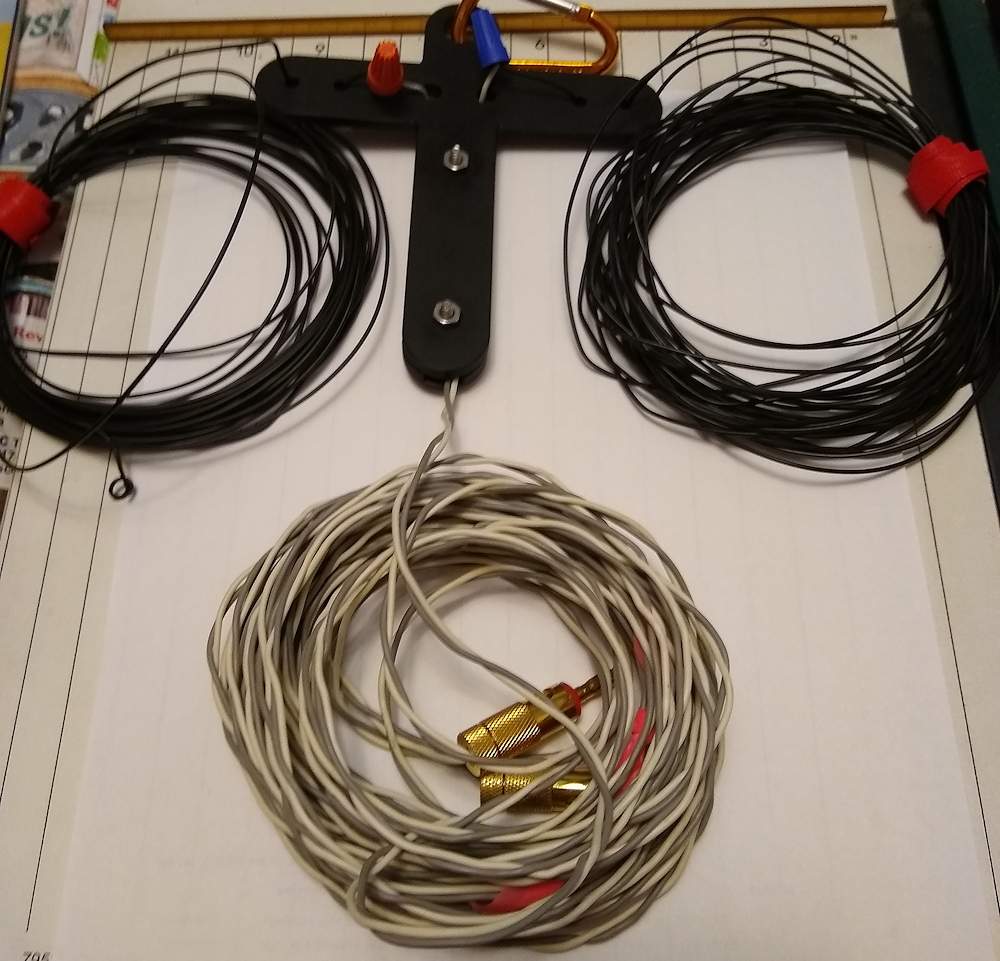
The next improvement that I thought I’d make is to find a center insulator that would provide better strain relief for the feed line. Searching the internet, I found a 3D-printed center insulator by an eBay seller who calls himself thecrazyham. He didn’t have anything designed for a twisted-pair feed line, but I guessed that a center insulator designed for 300 Ω twinlead would work just fine. It did work just fine, and as a bonus, it only cost five dollars!

After acquiring the new center insulator, my friend, Rick, K8BMA gave me some 26-ga. Poly-STEALTH antenna wire. I cut two,  33-ft. lengths and connected them to the feed line with wire nuts again. I hadn’t had any trouble with the wire-wrap wire I was using, but this wire was made with antennas in mind. It’s really first-rate stuff. I don’t think it works any better than the wire-wrap wire, but it coils up neatly and fits nicely into the small toolbox I use to carry around POTA station. 

antenna
Rev. B. of my POTA antenna uses Poly-STEALTH antenna wire and a 3D-printed center insulator.

A “real” feed line

Whenever I was asked about my POTA antenna, I would brag about the twisted-pair feed line. I was rather proud that I thought to use twisted-pair wire as a feed line, and that it actually worked. But, a  couple of months ago, my friend Paul, KW1L, bought a Cobra antenna. Before putting it up at his house, he asked if we could take it on a POTA activation and try it out. I agreed, and one morning, we took it up to the Island Lake Recreation Area.

Band conditions were good that morning, but even so, it seemed like the antenna was performing at least a little better than my doublet. Paul said, “Well, sure, it’s because the Cobra antenna has a real feed line.”

So, I decided to try a “real feed line” on my doublet. It just so happened that I had a 100-ft. roll of  300 Ω twinlead that I purchased at a dollar store many years ago. I cut off a 35-ft. hunk of it, soldered it to the antenna elements, and put some banana plugs on the other end of it. After using this  antenna for a couple of months now, I feel that I have to swallow my pride a little and say that the antenna with the 300 Ω feed line does work a little better than it did with the twisted-pair feed line. I’m guessing that it’s because the twisted-pair feedline has a higher loss than the twinlead.

Antenna
The major difference between the Rev B and this Rev C antenna is the 300-ohm twinlead feed line.

My latest improvement is to use a 4:1 balun between the feedline and the antenna tuner. Until just recently, I was connecting the feedline directly to the KX3 antenna tuner, but the fellow who sells Cobra antennas recommends using a 4:1 balun, so I thought that doing so might improve my antenna’s performance as well.

Several years ago, I purchased a couple of W1CG  current balun kits at a hamfest, and now was the time to build one. This is a really great kit, and if you ever see one at a hamfest or wherever, buy it. The New Jersey QRP Club that sponsored this kit is now defunct (despite the website still being online), and the kits are no longer available. (I’ve been thinking about kitting up some and selling them, but that’s  a discussion for another day.) The instruction manual is still available, though, and it’s not hard to find the parts. 

If you’re at all interested in baluns and how they work, you should download the instructions. They contain a great description of how baluns work and the difference between voltage baluns and current baluns.

At any rate, I built one of the kits, and have started to use the balun on my POTA activations. I can’t say for sure how much the balun has improved my results, but it certainly hasn’t hurt them, so I’m going to continue to use it. 

Tinkering gets results 

If you take away only one thing from this article, take away the idea that tinkering with something gets results. The antenna that I’m using today is basically the same antenna that I built 20 years ago, but the tweaks that I’ve made have significantly improved its performance and its ease of use.

One final note: I recognize that much of my success is due to the magic of the Elecraft antenna tuner. I have used this antenna with other antenna tuners, including the inexpensive Z-match tuners you can get from Ali Express or Amazon. It should also work well with the Emtech ZM-2 antenna tuner. If you purchase and tinker with this antenna and one of these tuners, please let me know how it works out for you.

Filed Under: Antennas Tagged With: POTA

Loop the loop on 6 meters

August 3, 2024 By Dan KB6NU 4 Comments

Question T3C07 in the Technician Class question pool reads:

What band is best suited for communicating via meteor scatter?
A. 33 centimeters
B. 6 meters
C. 2 meters
D. 70 centimeters

The answer, of course, is B. 6 meters.

I make a big deal out of this question when I teach my one-day Tech classes because I think meteor scatter is probably one of the coolest things that Techs can do. Have I ever done it? Well, no, at least not yet.

Two months ago, I came across this video:

After watching this video, I said to myself, “Hey, that looks simple enough that even I can do it.” Not only that, after looking around the shack, I realized that I had all the parts necessary to make it. I had a piece of PVC pipe that I bought for some other antenna project, and I had a terminal strip in my junk box to connect the loop to the coax.

I also had a bunch of 75Ω coax that was installed back in 1985 when the house was built to distribute cable TV to the living room, bedroom, etc. I’ve never had cable TV in the nearly 25 years I’ve lived here, so I just cut a length from one of the cable runs. So, not only did the antenna look easy to build, I wouldn’t have to spend a dime on it.

Today, I finally got around to putting it all together. As you can see from the photo below, I used the military surplus fiberglass mast to get it up off the ground.

The photo below shows how I connect the loop  to the matching stub using a terminal strip.

Troubleshooting the antenna

When I first connected my antenna analyzer to the antenna, I was a little dismayed that the SWR was 14:1! I hadn’t expected it to be perfect, but I did expect it to be a lot lower than that.

The first thing I did was make sure that the wires were connected to the terminal strips properly. When that proved not to be the problem, I thought that maybe it was too close to my other antennas, so I moved it to the other side of the yard. That didn’t change a thing, either.

My next guess was that perhaps the coax was bad somehow, so I disconnected the matching stub and measured the SWR again. At 50.1 MHz, the SWR was now a much better 1.76:1. Since the feed point impedance of just the loop is supposed to be about 100Ω, I knew the problem was the matching stub.

In another video, I’d seen the coax used for the matching stub coiled around a PVC pipe. The theory behind this is that not only the stub matching impedances, but also acting as a choke. I didn’t have any PVC pipe big enough, so I simply coiled the 75Ω coax and taped it together. WRONG! When I uncoiled the matching stub, the SWR came down dramatically, measuring about 1.1:1 at 52 MHz. Down at the bottom of the band, where I planned on playing, it was a bit higher, but it was still less than 1.5:1, and that is easily handled by my IC-7610’s antenna tuner.

Of course, now that I have the antenna, the band is just dead. I’ve been monitoring for the last hour or so, with nary a signal received. That’s just how it goes with 6 meters, I guess.

Meteor scatter here I come

I think that to be more successful on 6 meters, I’ll need to make some improvements to the antenna. For example, I’ll have to figure out a way to make the connections more robust and maybe add a little wire to the loop to bring the resonant frequency down a little. I probably should get the antenna up a little higher, too.

Building this antenna has been fun, and even though I still  haven’t made any contacts, I’m looking forward to operating 6 meters in the future. Maybe I’ll even get lucky and make some meteor scatter contacts. Then, when I cover that question in class, I can say that I’ve operated meteor scatter and it’s pretty cool.

Filed Under: Antennas, VHF/FM/Repeaters Tagged With: 6 meters, delta loop

Nothing lasts forever

July 17, 2024 By Dan KB6NU 6 Comments

Earlier this afternoon, I looked out my office window and noticed that something didn’t look quite right. For one thing, there was an odd shadow on the office window. So, I put on some shoes and went out to investigate.

What I found was that my cobra antenna had come down. Further investigation showed that the problem was with the end insulator. After being up in the air for nearly nine years, it just gave out. I’d say that nine years is decent service life for an insulator made from a Dollar Store cutting board.

As a temporary fix, I think that I’m going to stick the support rope through the hole at the bottom of the photo and get it back up in the air while I ponder how to replace it. Any ideas for the type of material that I should use?

Filed Under: Antennas Tagged With: Cobra

How to troubleshoot a jumper wire

July 4, 2024 By Dan KB6NU 2 Comments

Tuesday, my friend Paul, KW1L, texted me, and asked if I could come over to his house and help him with his new antenna. He had just purchased and installed a Cobra Ultra-Lite Junior, and he didn’t think that it was performing as well as it should.

A piece of wire with alligator clips on each end.
The suspect jumper wire.

I won’t go into all of the details, but one of the checks he had made was to measure the continuity of the feed line, which is 80 feet of 18-gauge, 450 Ω ladder line. To do this, he connected the jumper wire in the photo at right across the ladder line in his shack and then measured the resistance at the antenna feed point.

The measurement that he came up with was 16 Ω. Well, the National Institute of Science and Technology (NIST) says that the resistance of 18-gauge solid wire should be about .0064 Ω/ft. Using that figure, the resistance should be somewhere near 1 Ω.

So, Paul asked me to bring over my DMM, which I did yesterday. We dropped the antenna, put my Fluke 79 across the feed point, and measured close to 16 Ω.

It didn’t make much sense, but the only reasonable explanation was that the problem with this measurement was the jumper wire. This was somewhat troubling to Paul, as he had a sentimental attachment to this jumper wire. It was given to him by a fellow who worked for him at Xerox, and he pointed out to me how well-made it was. He noted, for example, that each end of the wire had been tinned before it was screwed to the alligator clip.

I agreed that it was well-made, but certainly one or both of the connections could have oxidized, resulting in a high-resistance connection. And guess what? When I measured the resistance of the jumper, it turned out to be about 15 Ω!

I then unscrewed the wire at one end and measured again. It measured 15 Ω. I unscrewed the wire at the other end, and voilá, I measured 0 Ω. I screwed the alligator clips back on, and the overall resistance was near 0 Ω again. My guess is that the second connection was a little loose, and that over the years, some oxidation built up on both the wire and the alligator clip.

Whenever we do something like this, Paul likes to ask, “So, what did we learn from this?” In this case, I think what we learned is that even jumper wires can go bad. It’s also a validation of the KB6NU Theory of Electronic Failures, i.e. at least 80% of the problems associated with electronic equipment are problems with cables or connectors.


Filed Under: Antennas, Gear/Gadgets, Test Equipment Tagged With: KW1L

POTA: QSO video, antenna update, 20-meter noise

July 2, 2024 By Dan KB6NU 4 Comments

Yesterday, I operated from the Silver Lake Day Use Area of US-3322, Pinckney State Recreation Area. This is a great park, and in many respects, I like it a lot more than US-3315, Island Lake Recreation Area. It’s just a little further from my house than Island Lake, and I think I’ll be spending more time at US-3322, now that I’ve hit 1,000 QSOs at US-3315.

One of the 40 contacts I made was with Jim, N4JAW. He’s not only a very active POTA operator, but also very active on Mastodon. Yesterday, after I returned home, I was pleasantly surprised to find this video posted to Mastodon. I’m re-posting it here with Jim’s permission.

Not so twisted anymore

As I mentioned a couple of weeks ago, I’ve been contemplating ditching the twisted-pair feedline I have been using on my POTA doublet antenna, after having such good success with my friend Paul’s Cobra antenna. That antenna uses 450 Ω ladder line. I happened to have a 100-ft. roll of high-quality, 300 Ω twinlead, so I thought I’d give that a go. I’ve used this antenna twice now, and while it’s hard to prove conclusively that the antenna works better with with the 300 Ω feedline, it “feels” as if it’s working better.

Of course, it could just be that band conditions have been better during my last two activations. That’s why I’d like to actually make some measurements. It’s not that easy, though. There are a couple of articles online that explain how to use an antenna analyzer to do this (1, 2), and I’ll give these a go once I’ve read and digested this material.

The downside to using 300 Ω twinlead is that it’s bulkier and less flexible than twisted-pair wire. It also seems more sensitive to environmental factors, such as touching the ground. But, taking a  little care when setting up the antenna takes care of those issues.

QRN?? At the park?

It wasn’t all good news yesterday, though. There’s something at the park generating a hellacious noise on 20 meters. The noise is so bad that the band is practically unusable. This noise is somewhat noticeable on the other bands, but just barely, and certainly not enough to make the bands unusable.

That being the case, every one of the 40 contacts I made yesterday were on bands other than 20 meters. I started out on 40 meters, then jumped to 17 meters, which fortunately was open and active. I tried 15 meters, too, and made a few contacts there, but it wasn’t very active, so I moved back to 17 meters.

This noise is new. Last Thursday was the first time I’d noticed it. I would have made a recording of it, but I didn’t have an audio recorder handy on my phone. I will do next time I get to that part of the Pinckney Recreation Area.

On Mastodon, someone suggested that the noise was coming from a solar inverter. I hadn’t thought about that at the park, so I wasn’t really looking for solar panels, but I’m guessing that this is correct. Next time I’m there, I’m going to have to walk around and see if I see any.  I might bring a small radio, too, to see if I can pinpoint the noise source.

Even if I do find the noise source, I’m not sure what I can do about it. I suppose that I can point this out to the park officials, but I’m not sure what, if anything, they’ll be motivated to do about it. Stay tuned for more on this. If you have any ideas of what I should look for, please let me know.

Filed Under: Antennas, Parks on the Air Tagged With: US-3322

  • « Go to Previous Page
  • Page 1
  • Page 2
  • Page 3
  • Page 4
  • Interim pages omitted …
  • Page 36
  • Go to Next Page »

Primary Sidebar

No Nonsense Technician Class License Study Guide (for tests given between July 2026 and June 2030)

New No Nonsense Technican Class Study Guide now available!

The 2026 version of my Tech Class study guide is now available, and as always, the PDF version is FREE!. The ePub version costs $11.97, and a Kindle version and paperback version will be available on Amazon shortly.

Click here to get all of my "No Nonsense" study guides.

Also available: The CW Geek's Guide to Having Fun with Morse Code

W5SWL.Com
Retevis Ailunce H1 DMR Radio
DXpander: Cobweb antennas, Laser Cutting

You’ve got mail!

Enter your email address below and get an email every time I publish a new post.

Email


I frequently teach classes to help newcomers get their licenses. The next class will take place on Saturday, October 10, 2026 on the University of Michigan campus. Click here for more information.

If you can't make the class, subscribe to the mailing list to be notified of when the next class will be held.

You can always download my free study guide, and if you have any questions about the classes, or amateur radio in general, please feel free to email me directly.

Support KB6NU.Com

Donate $7.30 and get two of these cool stickers. Measuring 4.25-in. W by 2.75-in. H, it's perfect for your car, your shack, or wherever!

Contact me

If you have a question or comment about one of my blog posts, or a question about any of the material in my study guides, or just a question about ham radio in general, you can email me at [email protected].

Blogs You Should Also Read

  • AE5X: A CW-centric blog from Kingswood, Texas
  • K0LWC Blog
  • LA3ZA Ham Radio Blog
  • Little Radios, Big Fun – WB3GCK
  • Mr. Vacuum Tube's Blog
  • Radio Artisan – K3NG
  • The K0NR Weblog
  • VE3WDM's QRP Ham Radio Blog
  • W2LJ’s Blog

Ham Radio Websites

  • Dashtoons – The Hammin' Comedy by Jeff K1NSS

Podcasts

  • ICQ Podcast
  • Linux in the Ham Schack
  • No Nonsense Amateur Radio Podcast
  • Resonant Frequency Amateur Radio Podcast

Recent Comments

  • Dan KB6NU on 2015 General Class study guide: Section G2E – Digital operating: procedures, procedural signals, and common abbreviations
  • Jimi on 2015 General Class study guide: Section G2E – Digital operating: procedures, procedural signals, and common abbreviations
  • Ali on Some Good Advice on Learning Morse Code
  • mike on Instant Character Recognition is the key to CW speed
  • Matt W1CDN on A completely different picture of Wayne Green, W2NSD (SK)

Meta

  • Log in
  • Entries feed
  • Comments feed
  • WordPress.org

Footer

Copyright © 2026 Daniel M. Romanchik, KB6NU · Log in