• Skip to primary navigation
  • Skip to main content
  • Skip to primary sidebar
  • Skip to footer

KB6NU's Ham Radio Blog

KB6NU's Ham Radio Blog
  • HOME
  • Study Guides
  • Teach a One-Day Tech Class
  • W8SRC Repeater Guide
  • Advertise
  • Hire Me

Antennas

Amateur radio videos: Contest University 2022

May 24, 2022 By Dan KB6NU Leave a Comment

This year, at the Dayton Hamvention, they once again held Contest University in person. They also livestreamed and recorded the presentations. Here’s the video:

This video includes the following presentations:

  • Low Band Receiving Antennas by W3LPL
  • Improving your Transmitting Antennas for Solar Cycle 25 by W3LPL
  • Improving the Competitiveness of Your Station by W3LPL
  • The ND7K Contest Station, Teamwork and Multi-operator Innovations by N6WIN
  • Grounding and Bonding by N0AX
  • Antennas and Propagation Questions and Answers by W3LPL
  • Optimizing your Receiver Performance by NC0B

Recordings of previous years’ Contest University presentations are also online.

Filed Under: Antennas, Gear/Gadgets, Installation/Grounding, Propagation, Videos Tagged With: contest university

Knots for ham radio

May 6, 2022 By Dan KB6NU 1 Comment

When I was a kid, a friend of mine tried to get me into Boy Scouts. The first thing that they tried to teach me was how to tie knots. At that point, I wasn’t really much of an outdoors type, so the utility of knowing how to tie a variety of knots was lost on me. As a result, I didn’t stick with the Scouts that long.

Now, I regret that. Knowing how to tie knots is extremely useful when putting up antennas, especially when operating portable. I did learn how to tie a bowline knot (see right), and that has been very useful, but there are other knots that I really should have in my repertoire.

Well, recently, someone on Twitter posted:

So here’s a statement of fact, and a question: I suck at tying knots. What types of knots should I learn how to tie, that would be most applicable to tying off antennas and such?

He got a lot of great responses, so I thought I’d post some here:

I like a tautline hitch for lines that need to be tightened and then secured. newlangsyne.com/doc/tautline.h… the bowline is good too.


4 knots you can’t go wrong with: -clove hitch -bowline -trucker’s hitch -sheet bend There are lots of fancier, more specific, or frankly better options, but this covers a lot of life. -Tie to something -Make a loop -Tie and tighten -Tie two ropes.


The bowline is my go-to for lots of things, including attaching a rope to the insulator of an end-fed antenna.


I usually revert to trucker hitch.


Clinch knot. Good for thinner rope, won’t slip or stretch with time.


I second all of these. Sheet bend is the all time most useful knot IMO, clove hitch close second. There’s also one called a taut line hitch, useful as well.


Learn the trumpet knot, because it’s fun. Really only used for taking slack out of lines.


Learn the Sheep Shank!


I find myself using arbor knots pretty often these days.

Lots of cool knots here. One site that I’ve found to help me learn these is Animated Knots. This site has short videos that step you through tying a knot. Do you have a favorite site for learning how to tie knots? If so, please enter in the comment section below.

Filed Under: Antennas Tagged With: knots

Trade magazine articles: home lab equipment, antennas 101, AC grounding

April 25, 2022 By Dan KB6NU Leave a Comment

Here are some articles from the electronics trade magazines (well, online “magazines,” anyway) that I found interesting:


Equipment Recommendations for a Home Electronics Lab

Some of the author’s suggestions may seem a bit pricey for a radio amateur’s home lab, but good test equipment will yield good results. He writes:

With one exception, I like test equipment with knobs. That refers to scopes, signal sources, and power supplies. Siglent makes a nice, economical line of these kinds of instruments and they’re all available tomorrow via Amazon. You will probably need multiple power supplies, and you’ll want an old-school linear supply for audio work. Once upon a time, I’d have said buy only HP T&M gear (because I worked there, so I have a preference), and older HP gear from eBay can be nice, but the Siglent stuff comes with a warranty.”


Welcome to Antennas 101

In a very short space, the author does a pretty good job of explaining antennas and some of their parameters. For example, here’s how he explains antenna efficiency:

Antenna efficiency is like efficiency in general—the ratio of power out to power in. However, it’s designated in several different ways. In most cases, efficiencies account for the I2R losses, losses in any dielectric, and losses based on coupling to other devices. What may not be included is any loss related to antenna and transmission- line mismatch losses, resulting in reflected power and a higher SWR.

However, some measures of efficiency factor in any change in antenna radiation resistance variation. Most small antennas aren’t that efficient. Anything better than 50% to 60% is usually good, but always seek to improve it if you can.


AC grounding: essential, dangerous or both?

The first thing that the author of this piece does is to explain that, “A large part of the confusion comes from the ambiguous and this sloppy terminology associated with that innocent-sounding seven-letter word.” He then explains that the word ground can refer to any one of three types of circuit connections:

  • Earth ground where the circuit is actually connected to Earth, which acts as an infinite source and sink for electrons;
  • Common (may also be called signal ground), which establishes a 0-V point in a circuit (and there is often more than one of these in the circuit). It’s usually very misleading to even use the word ground with this one.
  • Chassis ground, which connects all nominally zero-volt potential points in a circuit; it may be connected to Earth ground, but often cannot be as there is no Earth ground for many devices such as most portable, battery-operated ones; here, it may be misleading to use the word ground if it is not connected to a real Earth ground.

The rest of the article is equally enlightening.

Filed Under: Antennas, Electronics Theory, Test Equipment Tagged With: grounding

Trade magazine articles: Op amps, microcontroller measures frequency and period, antenna basics

January 22, 2022 By Dan KB6NU Leave a Comment

All three articles in this post are from Electronic Design….Dan

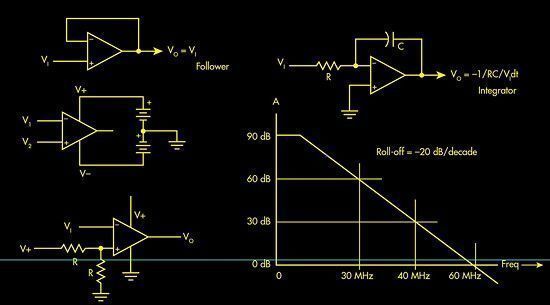
Op Amps for Linear Designs: Back to the Basics

Op amps are the basic building blocks for much of linear circuit design. You probably learned about them in college and even designed some products containing an op amp.  As an electronic engineer, you will at some point in your career probably need to design a linear circuit.

If you’re not an advanced linear or analog circuit designer, perhaps the best way to fulfill your linear design needs is to use an op amp. These ICs are widely available, inexpensive, and can be configured in hundreds if not thousands of ways to satisfy most linear requirements. Here’s a summary and update on these versatile devices…..more


Microcontroller Efficiently Measures Frequency and Period

When you need to take accurate timing measurements in hardware without overloading a microcontroller, the signal measurement timer module (SMT) in the Microchip16F1619 PIC microcontrolleris perfectly suitable for this application. The SMT module captures features of a signal such as Period and Frequency, among others. This design measures input frequency signals within the range of 8 Hz to 10 MHz, and Period signals within the range of 0.1 µs to 125 ms…..more


Welcome To Antennas 101

Antennas are much more than simple devices connected to every radio. They’re the transducers that convert the voltage from a transmitter into a radio signal. And they pick radio signals out of the air and convert them into a voltage for recovery in a receiver.

Typically taken for granted and left for the last minute in a design, antennas are nonetheless critical for establishing and maintaining a reliable radio connection. They may look complex and enigmatic to most engineers, especially EEs working with wireless applications for the first time—not to mention that they come in a seemingly infinite variety of sizes and shapes. However, a brief review of the essentials can help allay any design worries….more

Filed Under: Antennas, Building/Homebrew, Electronic Components, Electronics Theory, Microcontrollers Tagged With: op amps, PIC

Want to learn antenna modeling? EZNEC is now free!

January 7, 2022 By Dan KB6NU 3 Comments

EZNEC, the popular antenna-modeling software by Roy, W7EL, is now FREE!

This might be a good time to learn antenna modeling. EZNEC, the very popular antenna-modeling software written by Roy Lewallen, W7EL, is now FREE! The EZNEC website notes:

EZNEC IS NO LONGER FOR SALE. IT IS FREE (see below)

THERE WILL BE NO SUPPORT OR REFUNDS

The introduction of EZNEC Pro/2+ v. 7.0 has been unavoidably delayed. The estimated time of introduction is Jan. 14, 2022, but I’ll do my very best to have it ready before then. It is now undergoing extensive testing and updating of the manual.

EZNEC Pro/2+ v. 7.0 will have all the features of EZNEC Pro/2 v. 6.0, plus extra features including wire loss for individual wires and the ability to run external NEC-4.2 and NEC-5 programs for calculation.

Until EZNEC Pro/2+ v. 7.0 is available, you can download EZNEC Pro/2 v. 6.0 by clicking here:

Download EZNEC Pro/2 v. 6.0

Roy also notes:

I want to thank the many people who have sent encouraging and complimentary messages about my retirement. I’m very sorry I haven’t been able to respond because my time has been intensely taken up in getting the new EZNEC Pro+ programs ready. I’ll attempt to respond individually after the programs have been released.

Watch this page for the EZNEC Pro/2+ and EZNEC Pro/4+ announcement and other updates!

A fellow on Reddit writes, “For those of you that have never modeled before, I highly recommend reading the four part introduction to antenna modeling written by L. B. Cebik (W4RNL). It appeared in QST a number of years ago and is available on the ARRL web site.
http://www.arrl.org/antenna-modeling.” Also, the help file for EZNEC contains a decent tutorial as well.

Filed Under: Antennas Tagged With: antenna modelling, EZNEC, W7EL

Operating notes: LID!, iced out, short skip

December 19, 2021 By Dan KB6NU 1 Comment

About a week ago, I called CQ on 40 meters, and had a station reply, “GET AN 8 CALL LID.” Of course, there was no ID. Now, I thought I’d done everything right. I called QRL? before launching into my CQ and my sending was pretty good, I thought. So, who knows?

Ice on the ladder line

Friday night, we got some freezing rain here. It wasn’t a lot, and by late Saturday morning, the roads were clear. Oddly, though, the ice persisted on trees and bushes. It was quite beautiful, actually.  I actually should have taken some pictures.

The ice also failed to melt off my 450 Ω feedline. And, when I tried to make some contacts late Saturday evening, I found that the antenna wouldn’t tune up on 40 meters. Since it was cold and dark by that time, I just gave up for the evening.

This morning, I did go out in the backyard and knock as much ice off the feedline as I could manage. Voila! It worked!

NVIS propagation?

I don’t know if  antenna icing had any role in this, but I had a couple of really short-distance, 40-meter contacts today. The first was with NJ8D in Homer, MI, which QRZ.Com says is 68 miles away.  The second was with W8KZW, who is only 25 miles away from me. Both were nearly S9 here in Ann Arbor.

The first is definitely sky-wave propagation. The second could possibly be ground-wave propagation, but I doubt it. I’m also wondering if the higher solar flux index might have played a part in making these contact possible. As I’m writing this (at 8:30 pm EST), the solar flux is 117, and signals are still pretty strong on 40 meters.

Filed Under: Antennas, CW, Promotion & PR Tagged With: ice, NVIS

Would you buy an antenna tuner from Amazon?

July 31, 2021 By Dan KB6NU 10 Comments

I buy a fair amount of electronics stuff from Amazon. Not big items, but stuff like BNC-to-binding post adapters and the SMA-BNC adapters for my HTs. So, I shouldn’t have been surprised when I got an email from them three weeks ago titled, “KKmoon ATU-100 DIY Kits…” The email included link to two ATU-100 antenna tuner kits, several assembled antenna tuners, and three QRP antenna tuner kits. See below.

I think that the ATU-100 kits look kind of cool. For about $50, you get a 100 W, automatic tuner kit.

My question, though, would be how effective and reliable are these antenna tuners? Has anyone purchased and used one of them? If so, perhaps you could get in touch with me, and we could do a short review.

KKmoon ATU-100 DIY Kits 1.8-50MHz ATU-100 Mini Automatic Antenna Tuner by N7DDC 7x7 + 0.96 Inch OLED Firmware Programmed


KKmoon ATU-100 DIY Kits 1.8-50MHz ATU-100 Mini Automatic Antenna… $55.99

NOTE: A reader has reported that this link no longer works. If you go to Amazon, and search for “AT-100” you’ll find at least one other similiar kit.

SDRGEEK ATU-100 EXT 1.8-55MHz Automatic Antenna Tuner by N7DDC 7x7, Mini 100W Open Source Shortwave Automatic Antenna Tuner with Metal Housing Assembled


SDRGEEK ATU-100 EXT 1.8-55MHz Automatic Antenna Tuner by N7DDC 7×7,…

$114.99


Zerone 1-30 Mhz Manual Antenna Tuner kit for HAM RADIO QRP DIY Kit


Zerone 1-30 Mhz Manual Antenna Tuner kit for HAM RADIO QRP DIY Kit

$16.99


Automatic Antenna Tuner,ATU-100 EXT 1.8-55MHz 100W Shortwave Mini Automatic Antenna Tuner by N7DDC 7x7 + 0.96 Inch OLED Firmware Programmed


Automatic Antenna Tuner,ATU-100 EXT 1.8-55MHz 100W Shortwave Mini…

$116.89


Vbestlife Automatic Antenna Tuner Aluminum Alloy Tester C Type 1.8-30Mhz HY100 HAM 10-15VDC


Vbestlife Automatic Antenna Tuner Aluminum Alloy Tester C Type…

$120.49


TecMad ATU-100 EXT 1.8-55MHz Automatic Antenna Tuner by N7DDC 7x7,100W Open Source Shortwave Antenna Tuner for Amateur Radio,with 0.96 OLED and Metal Housing Mounted

TecMad ATU-100 EXT 1.8-55MHz Automatic Antenna Tuner by N7DDC…

$115.99


HAM HF Band Radio Antenna Balun QRP Tuner Amateur DIY kit NXO-100

HAM HF Band Radio Antenna Balun QRP Tuner Amateur DIY kit NXO-100

$17.99


HF Transceiver Kit Manual Antenna Tuner Tune DIY Precision Kit 1-30 Mhz for HAM Radio QRP DIY Kit


HF Transceiver Kit Manual Antenna Tuner Tune DIY Precision Kit 1-30…

$22.49


WSDMAVIS 1 Set 1.8-50 MHz ATU-100 Automatic Antenna Tuner DIY Kits 0.96 Inch OLED Firmware Programmed ATU100 Unassembled Parts
WSDMAVIS 1 Set 1.8-50 MHz ATU-100 Automatic Antenna Tuner DIY Kits…

$48.29


Filed Under: Antennas, Gear/Gadgets Tagged With: Amazon, antenna tuners

100, 50, and 25 years ago in QST: CW circuit, linear ICs, the “radio sky”

July 27, 2021 By Dan KB6NU 1 Comment

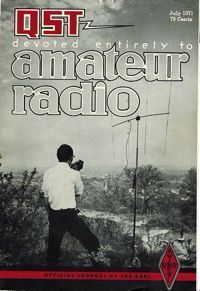
Say what you will about the content of QST, but the production values are certainly much better today than they were 50 years ago.

July 1971 was the month in which I got my first license. My first call sign was WN8KTZ, and the license was dated July 16, 1971, the date of my 16th birthday!


July 1921, A Sure-Fire CW Circuit, E. W. Whittier, 1DH

At this point in amateur radio, hams were still switching over from spark to CW. Indeed, another article in this issue is titled, “The Ideal Relay Spark Station.” This article describes a simple CW transmitter using two UV-202 tubes, capable of outputting 30W at a plate voltage of 600 V.


July 1971, The Ground-Image Vertical Antenna, Jerry Sevick, W2FMI

Antenna articles tend to age well. This article is no exception. I would guess that this is a report on Sevick’s beginning experiments with vertical antennas, which resulted later in his book, The Short Vertical Antenna and Ground Radial.

One article in this issue that has not aged so well is “A Second Look at Linear Integrated Circuits” by Douglas A. Blakeslee, W1KLK. It describes several of the linear ICs available 50 years ago and how to use them in amateur radio. The linear ICs that we have today far surpass the functionality and performance of the ICs available then.


July 1996, An Improved Multiband Trap Dipole Antenna, Al Buxton, W8NX

As I say, antenna articles age well. This article describes an 83-ft. antenna that resonates on 80 meters, 40 meters, 17 meters, and 10 meters with a single set of traps. The traps for this antenna are double, coaxial-wound traps that have lower reactance and a higher quality factor (Q) than most traps, and as a result, have less loss than conventional traps.

Filed Under: Antennas, Gear/Gadgets, Transmitters Tagged With: trap dipole, verrtical

Three from Twitter: OCF dipole covers 40-6 meters, generate your own azimuthal map, build an all-band receiver with an Arduino

July 4, 2021 By Dan KB6NU 37 Comments

OCF dipole covers 40 – 6 meters

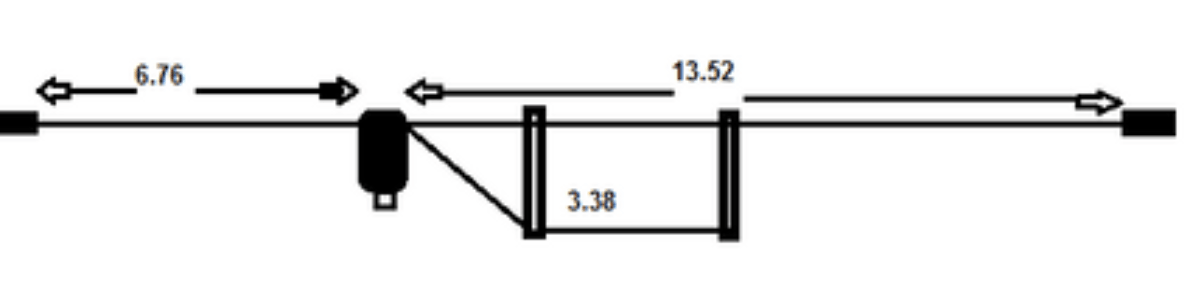
Dimensions are in meters. The balun at the feedpoint is a 4:1 balun.

I don’t usually plug products here, but I thought that this M0CVO off-center fed dipole was a clever design. Not only that, it can be easily built by the homebrewer. According to M0CVO,

The HW-42HP is an Off Centre Fed Dipole with a difference.  Designed to operate on all bands from 40m (7MHz) – 6m (50MHz).  It will operate on 40, 30, 20, 17, 15, 12 and 10m without an ATU (SWR <3) plus 6m with an ATU.  It is also possible to operate on both 80m (3.5MHz) and 60m (5MHz) via a good ATU.  This will handle 400W key down or 500W PEP.

Having a feedpoint 1/3 of the way along gives a feedpoint impedance of 200ohms.  This is not ideal for modern day transceivers requiring an antenna with a 50ohm impedance.  Therefore, a 4:1 balun is added at the feedpoint to alter the impedance to something closer to the 50ohms required.  This then allows the antenna to be fed using standard 50ohm coaxial cable such as RG8 or RG213.

The overall length of the antenna is 20.28m or 66ft.  It may be mounted horizontally, as a sloper or as an inverted vee.  If space is at a premium it may also be ‘bent’ to fit in with no loss in performance.

Generate your own azimuthal map

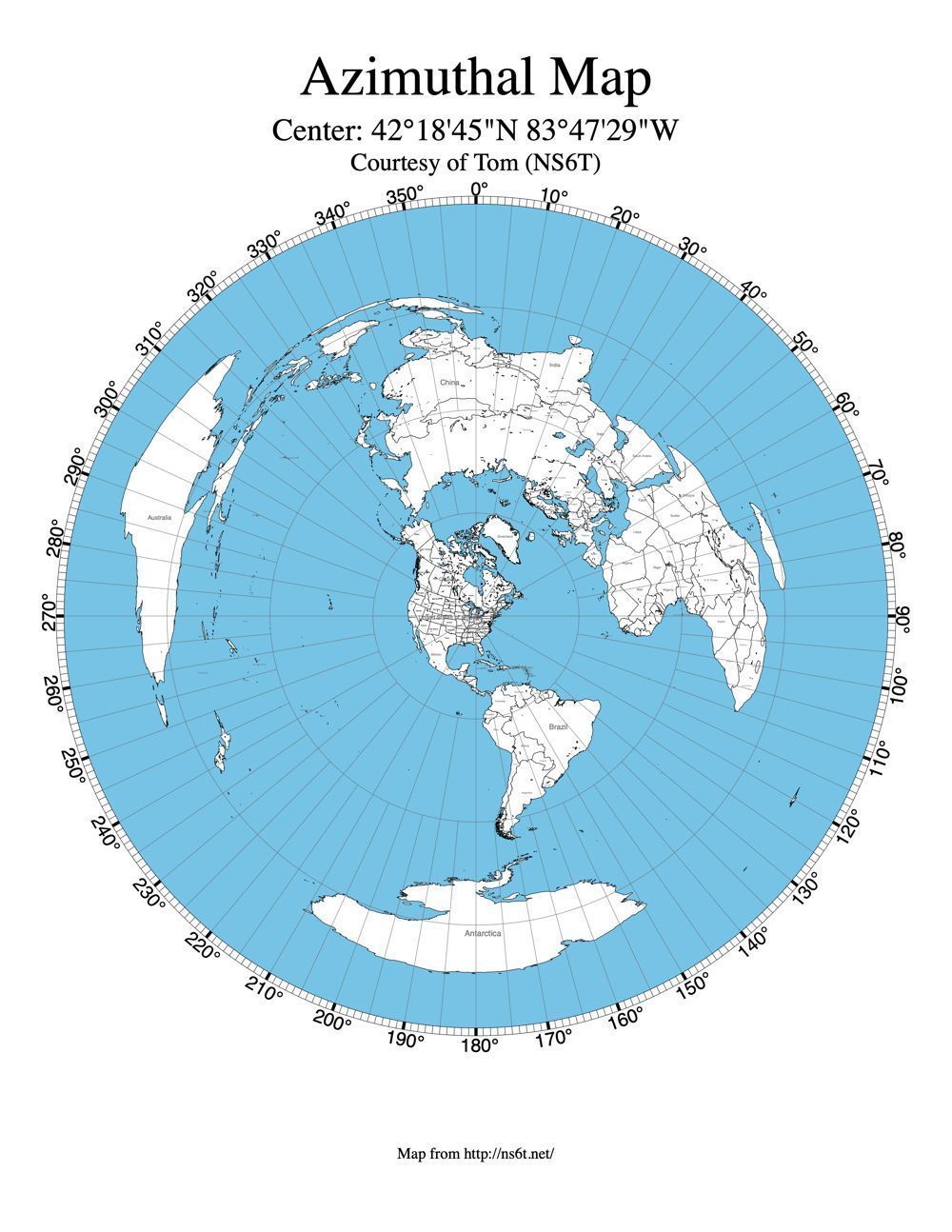
NS6T has made available an online azimuthal map generator, and it’s very cool. Here’s an azimuthal map centered on my location in Ann Arbor, MI.

To generate a map, all you have to do is to input your grid square or latitude and longitude, but wait, there’s more! You can also specify a distance from your location to get a smaller map, and have it include grid squares.

Build an all-band receiver with an Arduino (and an Si4735)


Here’s an interesting project that looks relatively simple to build. It uses an Arduino to control an Si4735, which is a fully-integrated, 100% CMOS AM/FM/SW/LW radio receiver on a chip. DigiKey has them for $18. You could probably build a complete receiver for less than $50.

This video shows some enhancements that Mirko has added to the software, but there are links to oprevious videos describing the original project.

Filed Under: Antennas, Building/Homebrew, DX, Microcontrollers, Receivers Tagged With: Arduino, azimuthal map, OCF dipole

From the trade magazines: Automatic impedance matching, AC grounding, rechargeable batteries

June 2, 2021 By Dan KB6NU 3 Comments

Automatic impedance matching in RF design

Impedance (Z) matching is an essential part of most RF circuit design. Regardless of what you’re designing, getting as much power to a load is a top target. Impedances must be matched to transfer the maximum amount of signal power between stages. And in power amplifiers (PAs), impedance matching is critical to getting the maximum power to the final load and maintaining PA linearity. Impedance matching to an antenna in a receiver or transmitter is an essential process.

Some loads are constant; thus, a single fixed Z-matching circuit can be used. But in other applications, that final load may change, or the frequency of operation will change, meaning that a fixed Z-match circuit will not produce the desired results. For these applications, a variable matching network that you can adjust is needed. Better still is a variable and automatic Z-match circuit that adjusts itself to the immediate load or frequency conditions.

Auto Z matching is more common than you think. If you own a recent smartphone, you’re probably using an auto Z-match antenna tuner. However, there are other applications. Here’s a primer on this topic for your elucidation and cogitation.

…read more


AC grounding: essential, dangerous, or both?

Most electrical engineers learn early-on about the importance of what are referred to as circuit grounds. In many cases, whatever your problem, adding a ground or improving the one you have (meaning lower impedance) is a good thing that can’t hurt. That’s what circuit EEs have drilled into them as they work and debug bench circuits prototypes, and more, and learn to connect the analog ground to the digital ground at one point only to minimize unwanted ground-current flow and associated noise.

In most cases, such grounding does improve circuit performance, but as every experienced engineer knows, every rule has legitimate exceptions, and grounding is one of them. A large part of the confusion comes from the ambiguous and this sloppy terminology associated with that innocent-sounding seven-letter word.

…read more


Rechargeable batteries enable greener electronics

While batteries provide untethered power, enabling convenience, dependability, and mobility, environmental responsibility suggests that rechargeable batteries have the same benefits, but can save money while reducing the amount of waste. This article examines the benefits offered by rechargeable battery technology, enabling us to make life better.

…read more

Filed Under: Antennas, Batteries, Electronics Theory Tagged With: grounding

  • « Go to Previous Page
  • Page 1
  • Interim pages omitted …
  • Page 4
  • Page 5
  • Page 6
  • Page 7
  • Page 8
  • Interim pages omitted …
  • Page 36
  • Go to Next Page »

Primary Sidebar

No Nonsense Technician Class License Study Guide (for tests given between July 2026 and June 2030)

New No Nonsense Technican Class Study Guide now available!

The 2026 version of my Tech Class study guide is now available, and as always, the PDF version is FREE!. The ePub version costs $11.97, and a Kindle version and paperback version will be available on Amazon shortly.

Click here to get all of my "No Nonsense" study guides.

Also available: The CW Geek's Guide to Having Fun with Morse Code

W5SWL.Com
Retevis Ailunce H1 DMR Radio
DXpander: Cobweb antennas, Laser Cutting

You’ve got mail!

Enter your email address below and get an email every time I publish a new post.

Email


I frequently teach classes to help newcomers get their licenses. The next class will take place on Saturday, October 10, 2026 on the University of Michigan campus. Click here for more information.

If you can't make the class, subscribe to the mailing list to be notified of when the next class will be held.

You can always download my free study guide, and if you have any questions about the classes, or amateur radio in general, please feel free to email me directly.

Support KB6NU.Com

Donate $7.30 and get two of these cool stickers. Measuring 4.25-in. W by 2.75-in. H, it's perfect for your car, your shack, or wherever!

Contact me

If you have a question or comment about one of my blog posts, or a question about any of the material in my study guides, or just a question about ham radio in general, you can email me at [email protected].

Blogs You Should Also Read

  • AE5X: A CW-centric blog from Kingswood, Texas
  • K0LWC Blog
  • LA3ZA Ham Radio Blog
  • Little Radios, Big Fun – WB3GCK
  • Mr. Vacuum Tube's Blog
  • Radio Artisan – K3NG
  • The K0NR Weblog
  • VE3WDM's QRP Ham Radio Blog
  • W2LJ’s Blog

Ham Radio Websites

  • Dashtoons – The Hammin' Comedy by Jeff K1NSS

Podcasts

  • ICQ Podcast
  • Linux in the Ham Schack
  • No Nonsense Amateur Radio Podcast
  • Resonant Frequency Amateur Radio Podcast

Recent Comments

  • Dan KB6NU on 2015 General Class study guide: Section G2E – Digital operating: procedures, procedural signals, and common abbreviations
  • Jimi on 2015 General Class study guide: Section G2E – Digital operating: procedures, procedural signals, and common abbreviations
  • Ali on Some Good Advice on Learning Morse Code
  • mike on Instant Character Recognition is the key to CW speed
  • Matt W1CDN on A completely different picture of Wayne Green, W2NSD (SK)

Meta

  • Log in
  • Entries feed
  • Comments feed
  • WordPress.org

Footer

Copyright © 2026 Daniel M. Romanchik, KB6NU · Log in