• Skip to primary navigation
  • Skip to main content
  • Skip to primary sidebar
  • Skip to footer

KB6NU's Ham Radio Blog

KB6NU's Ham Radio Blog
  • HOME
  • Study Guides
  • Teach a One-Day Tech Class
  • W8SRC Repeater Guide
  • Advertise
  • Hire Me

Test Equipment

From Electronic Design: Common-emitter amplifiers, intro to capacitors, evaluate oscilloscopes

August 30, 2018 By Dan KB6NU Leave a Comment

Here are three articles from Electronic Design that you might find amusing. Electronic Design is a magazine for electronics engineers, but these articles have good information for amateur radio operators as well…..Dan


A Closer Look at the Common Emitter Amplifier and Emitter Follower.
Usually targeted at audio applications, these circuit blocks find homes in all types of designs. Here’s a quick study of their operation and properties.

I’m not sure why the author decided to use a 2N5550 instead of the more common 2N2222 for this article, but it’s a good explanation of how the common emitter amplifier works. If you’ve never breadboarded one, I’d suggest that you do so and play around with it.


Capacitor Basics and Their Uses in Power Applications.
Capacitors play key roles in the design of filters, amplifiers, power supplies and many additional circuits. Here’s a brief guide to the different types and the applications they’re best suited for.


How to Evaluate Oscilloscope Signal Integrity.
Oscilloscope signal integrity impacts signal shape and measurement values. This article is intended to help you assess the signal integrity of your oscilloscope and make trustworthy measurements.

Filed Under: Electronic Components, Electronics Theory, Test Equipment Tagged With: amplifier, capacitor, oscilloscope

From my Twitter feed: Build your own calibration standard, calculate twisted pair cable impedance, /P mast

June 18, 2018 By Dan KB6NU Leave a Comment

hackaday's avatar hackaday
@hackaday
Build your own #electronics calibration standard wp.me/pk3lN-1jfD


All About Circuits‏
@AllAboutCircuit

Calculate characteristic impedance of a twister-pair cable. https://t.co/tqmyKIXWrj


w8lid's avatar Mike Diehl 🛰
@w8lid
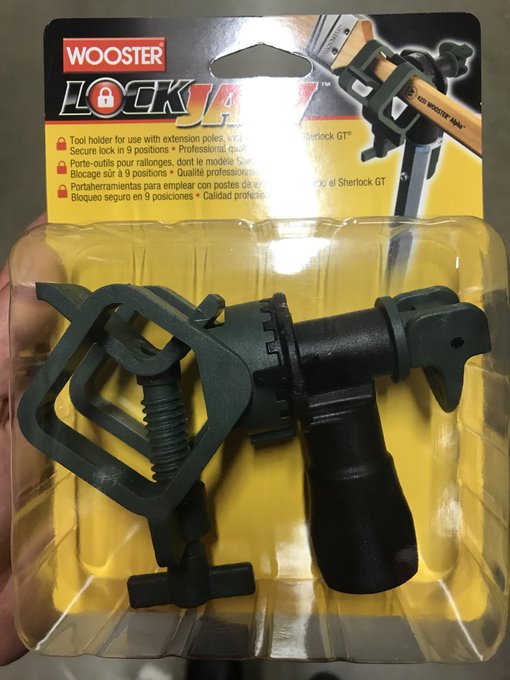
Found this at Home Depot, going to try it out with a painters pole for a cheap portable mast.

Media preview

Filed Under: Antennas, Electronics Theory, Test Equipment

From the trade magazines: Telephone museum teaches kids about electricity, how to use a VNA, noise cancellation

March 16, 2018 By Dan KB6NU 1 Comment


Telephone Museum Inspires Young Engineers to Take Things Apart. WALTHAM, MA—A city long known for mechanical timepieces now has a museum dedicated to electrical devices. The Telephone Museum opened here in November 2017. EE Times visited the museum on Feb. 22, 2018. Here, aspiring engineers can not only see historical telephones but learn about electricity, measurements, and how to fix their broken mobile phones.

Learn the ABCs of VNAs. This primer gives an in-depth overview of the vector network analyzer (VNA), explaining its functionality, types of measurements that can be performed, and more. This is perhaps more than most hams will need, but it’s interesting nonetheless.

What’s the Difference Between Passive and Active Noise Cancellation? Increased use of smartphones and other devices for music playback gives more weight to features like noise cancellation. So how can system developers determine the best noise-cancellation option to differentiate their products and still appeal to discerning consumers?

Filed Under: Communications Theory, Gear/Gadgets, Kids, Test Equipment Tagged With: musuem, telephone, VNA

From my Twitter feed: EA4GKY key, measure a cap with a scope, ,

February 21, 2018 By Dan KB6NU Leave a Comment

tortugascw's avatar
Tortugas CW @tortugascw

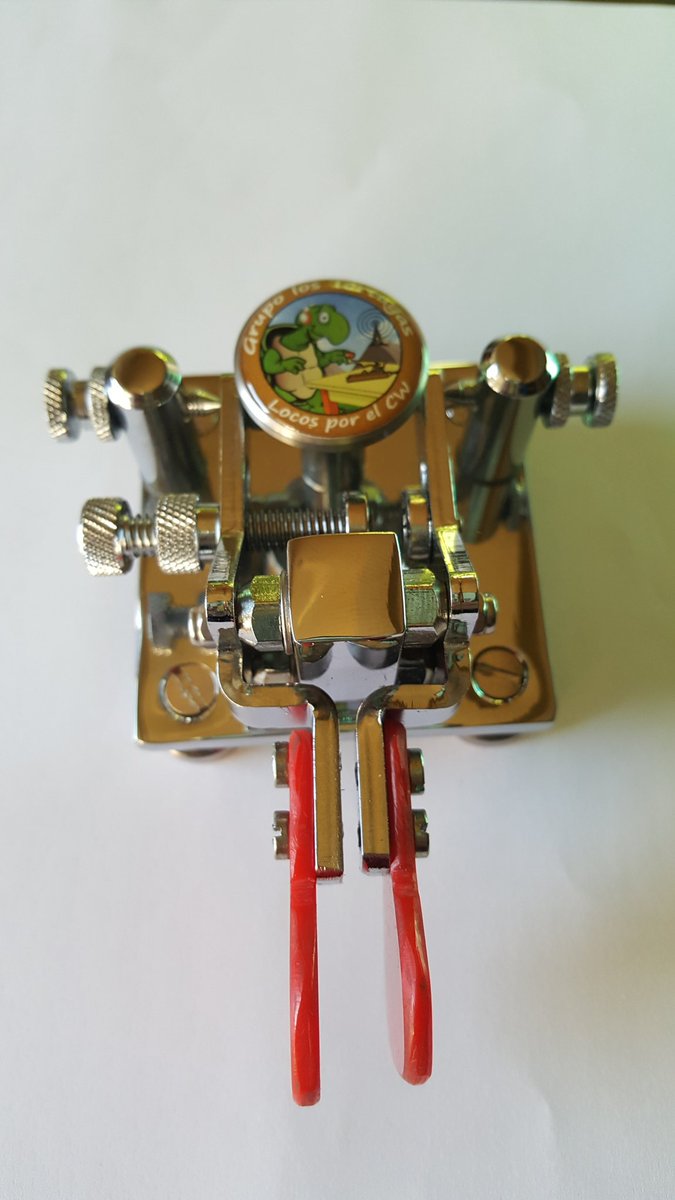
Gracias @EA4GKY por esta obra de arte, me gusta todo de ella, diseño,tamaño,funcionalidad, altura de palas y ya con nuestro logo Tortugascw has rematado la faena.


Siglent_Tech's avatar
SIGLENT TECHNOLOGIES @Siglent_Tech

@Learnelectronics video showing how to use an oscilloscope and generator to measure a capacitor: youtube.com/watch?v=M03RCx…


M0PZT's avatar
M0PZT @M0PZT


#PZTips: If you get a poor signal report, slow down your delivery, give details twice (and phonetically) also make it clear when you’ve ended your transmission. “Back to you”, “go ahead” or our callsigns. #hamradio

This is good advice for CW, too…..Dan

Filed Under: CW, Test Equipment Tagged With: EA4GKY, oscilloscope

What SWR meter should I buy?

December 7, 2017 By Dan KB6NU 11 Comments

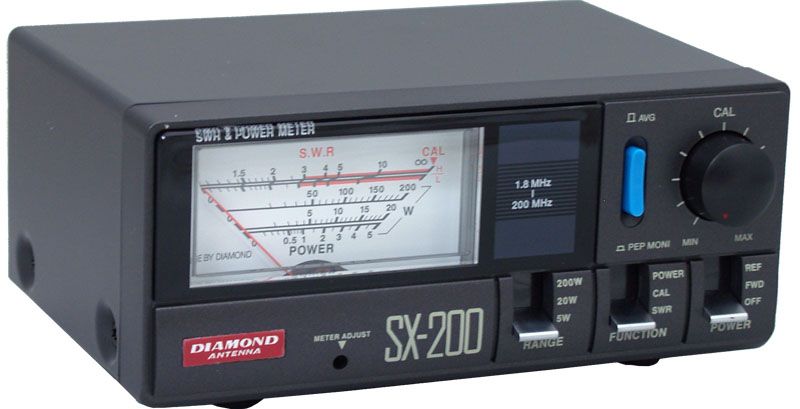
The Diamond SX-200 measures power up to 200 W and SWR from 1.8 MHz to 200 MHz.

Yesterday, one of my students asked:

I’m going to ask for an SWR meter for Christmas. When I look at various products there’s all sorts of types. What’s the basic kind I should look for?

I replied:

The first question you might ask yourself is whether or not you need an SWR meter. Most modern radios, including your FT-450D, have a built-in SWR meter. I currently do not use an SWR meter for HF.

What might be useful is a combination power/SWR meter. A couple of relatively inexpensive products in this category are the Diamond SX-200 and the Daiwa CN-501H. They are both just under $100.

These products are not really very accurate when it comes to measuring power. At best, their accuracy is ±10%. They are much more accurate when measuring SWR because SWR is a relative, not an absolute measurement.

To get better accuracy, you have to move up to something like the Elecraft W2. A factory-assembled version is $300. A no-solder kit version (basically, you’re just doing the final assembly) is $250. Another, more expensive option is the Telepost LP-100A. It costs $475.

What other advice would you give this student?

Filed Under: Test Equipment Tagged With: meter, SWR, wattmeter

Check your meter before measuring high voltage

November 29, 2017 By Dan KB6NU 8 Comments

A letter in the December 2017 QST caught my eye. It had a safety tip for dealing with high voltage circuits, and I thought I would pass it along. It’s reprinted with permission from the author, Joseph Birsa, N3TTE…..Dan


Reading the article on DMM’s in the October 2017 issue of QST reminded me of a safety practice I want to pass along. Always, always, ALWAYS check the meter leads using the resistance function of a meter BEFORE checking a hazardous voltage! (Or any voltage or current for that matter.)

To do this, BEFORE YOU DO ANYTHING ELSE, turn the meter to ohms and short the tips of the leads to verify continuity (zero or low reading). Then, switch the meter to the appropriate function and proceed.

When I was starting out as an electrical engineer, a field engineer, who was a ham by the way, told me a story about an electrician who opened an equipment cabinet powered by three-phase, 480 V. Before beginning, he used his meter to check the 480 V. Seeing no voltage, he proceeded and was subsequently electrocuted! When they checked his meter, they found one of the leads was opened. Or perhaps a fuse was blown.

Since then, the first thing I do when I start to use a meter is to use the resistance function to check lead continuity.

Filed Under: Gear/Gadgets, Safety, Test Equipment

Comparing the Box73 FA-VA4, Palstar ZM-30, and RigExpert AA-55 ZOOM Antenna Analyzers

November 16, 2017 By Dan KB6NU 5 Comments

Since our recent antenna analyzer “bake-off,” I purchased and built a Box73 FA-VA4 antenna analyzer kit. It was fairly easy to assemble, and so far, I’m impressed with it.

When I told my friend, Rick, KA8BMA, that I was going to try to make some measurements comparing the measurements made by the FA-VA4 to the measurements made by the Palstar ZM30, he said he’d bring over his Rig Expert AA-55 ZOOM, and we could compare all three.

My idea was to choose frequencies in the various HF bands, then adjust the antenna tuner to different complex impedances, and then make measurements with each of the analyzers. Here are the measurements we made last night:

Box73 FA-VA4 Palstar ZM30 Rig Expert AA-50 ZOOM
SWR Z X SWR  Z  X  SWR  Z  X
7100 kHz 1.05 52.4 -j0.6 1.0 49 -j3 1.02 50.4 **1
2.02 24.8 -j2.6 2.0 24 +j3 2.04 24.4
4.27 12.9 -j15.4 4.9 11 +j14 4.21 29.6
14200 kHz 1.09 47.7 -j3.9 1.0 46 +j3 1.06 50.5
2.17 49.7 -j39.2 2.1 57 +j40 2.1 62
5.24 150 +j125 **2 5.1 196

**1: The RigExpert didn’t indicate the reactance like the FA-VA4 or the ZM30. I wrote down some of the readings, but I’m still puzzling through them.

**2: When I started making this measurement, the ZM30 started acting flakey, as though the batteries were dead. Upon inspection, I found that one of the eight batteries had leaked, so I didn’t make this measurement.

Here are some observations:

  1. I think that the three meters mostly agree on SWR measurements. The Palstar seemed to be a little off when measuring SWRs around 5.0:1.
  2. I need to do more research on what the reactive component  measurement really means.  For example, look at the measurement made by the FA-VA4 at 14200 kHz and 5.0:1 SWR. The measured SWR was 5.24, but the Z is only 150. That doesn’t make sense to me.
  3. My test method could probably use some improvement. I was relying on adjusting my antenna tuner to generate complex impedances. It would have been better to have test loads with known complex impedances. I Googled “antenna analyzer test loads,” and the only relevant link it came up with is a page showing some load measurements for the SARK-110 Antenna Analyzer. Unfortunately, the page does not describe the loads in detail.

I know this is all kind of half-baked, and I really debated whether or not to post this, but I thought I would anyway to get some feedback. Can any of you explain the discrepancy between the Z and SWR measurements at 5.0:1 SWR?

Also, do any of you have a good suggestion for better test loads to use? I’m going to load up the Palstar with batteries again and try this experiment again once I come up with better test loads.

Filed Under: Antennas, Test Equipment Tagged With: antenna analyzers, FA-VA4, Palstar ZM30

Amateur radio videos from Twitter: power line filter, HP test gear, Linux in the shack

October 18, 2017 By Dan KB6NU 4 Comments

Here are a few #hamradio videos that I found out about whilst Twittering:

EMC & Shack Noise: Filtering the mains supply. This short video shows how a simple homemade choke can reduce noise coming in via the power line.

EEVblog #1032 Part 1 – John Kenny Keysight Interview. When I worked for Test&Measurement World magazine, Hewlett Packard was our biggest advertiser, and arguably, the most respected test and measurement company in the world. They’ve since gone through two name changes, first Agilent, and now Keysight. In this video, Dave interviews John Kenny, who’s been with the company for more than 40 years. None of the Agilent of Keysight rubbish. John is a real HP guy. Watching this video will give you some insight as to how great products are designed and manufactured.

LHS Podcast – NE4RD Shack Build – Episode 1. This is the first of six episode in Bill’s series of videos showing you how to set up a Linux box for ham radio use. I’ve been threatening to do this for a while, so I’ll be watching all six.

Filed Under: EMI/RFI, Software, Test Equipment

Keep up with what’s going on in amateur radio by reading QRZ.Com ads

October 8, 2017 By Dan KB6NU 2 Comments

Like many of you, I have installed an ad blocker on my browser. I don’t really care about the website that glass lovers are going crazy over or the smartphone accessory that is almost too good.

I don’t, however, run the ad blocker when I’m using QRZ.Com. It’s not that I want Fred, AA7BQ, to make more money. I want to find out about what new goods and services people are offering to amateur radio operators.

Here are three recent QRZ.Com ads that I’ve clicked on:

Hamcestry.com. From the Hamcestry.Com FAQ:


What is Hamcestry?Obviously, it’s a play on the word Ancestry, but for HAM radio. I bet everyone who is an amateur radio operator got involved in the hobby because someone they knew was a HAM and that got them interested. And every HAM probably has influenced at least 1 other person to take up the hobby too. I started Hamcestry as a project I thought would be interesting to see grow. It relies on other people using it. Without that, it goes nowhere, so hopefully there will be enough interest to get that to happen. I am always hearing the stories about how “so-and-so” got started in the hobby, so I know the interest and desire to tell people the who’s, how’s and where’s of how they got started is strong and alive. I thought it would be nice to visualize these connections.

I like this idea, and I’m going to add a few of my Elmerees to the site. The site also offers practice exams and Morse Code practice as well.

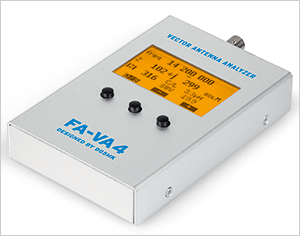
FA-VA4 Antenna Analyzer Kit. The FA-VA4 Antenna Analyzer is an improved version of the IV-Meter from DG5MK, based on his article published in QEX May/June 2017. It has a frequency range 100 kHz to 100 MHz and costs $140. This looks like a very cool project to me.

K3NQT for Vice Director. Lloyd Roach, K3NQT, is running for Vice Director of the ARRL Atlantic Division, and he’s advertising on QRZ.com. I was especially interested in this ad because I (unsuccessfuly) ran for Vice Director of the Great Lakes Division several times in the early 2000s. While Lloyd seems qualified for the position, I found his vision to be a little vague. I emailed him, hoping to get some clarification on what he’d actually do as Vice Director, but he didn’t seem interested in engaging in a discussion with me.

Another interesting twist is that he’s running against Riley Hollingsworth, K4ZDH, the former FCC Special Counsel, who was responsible for enforcing the Amateur Radio Service rules during his last ten years at the FCC. Both men are highly qualified, and this will be an interesting race.

Filed Under: Antennas, ARRL, Elmering, Gear/Gadgets, Online Resources, Test Equipment Tagged With: antenna analyzers, ARRL Board of Directors

The Great Antenna Analyzer Bake Off, Part I

September 16, 2017 By Dan KB6NU 5 Comments

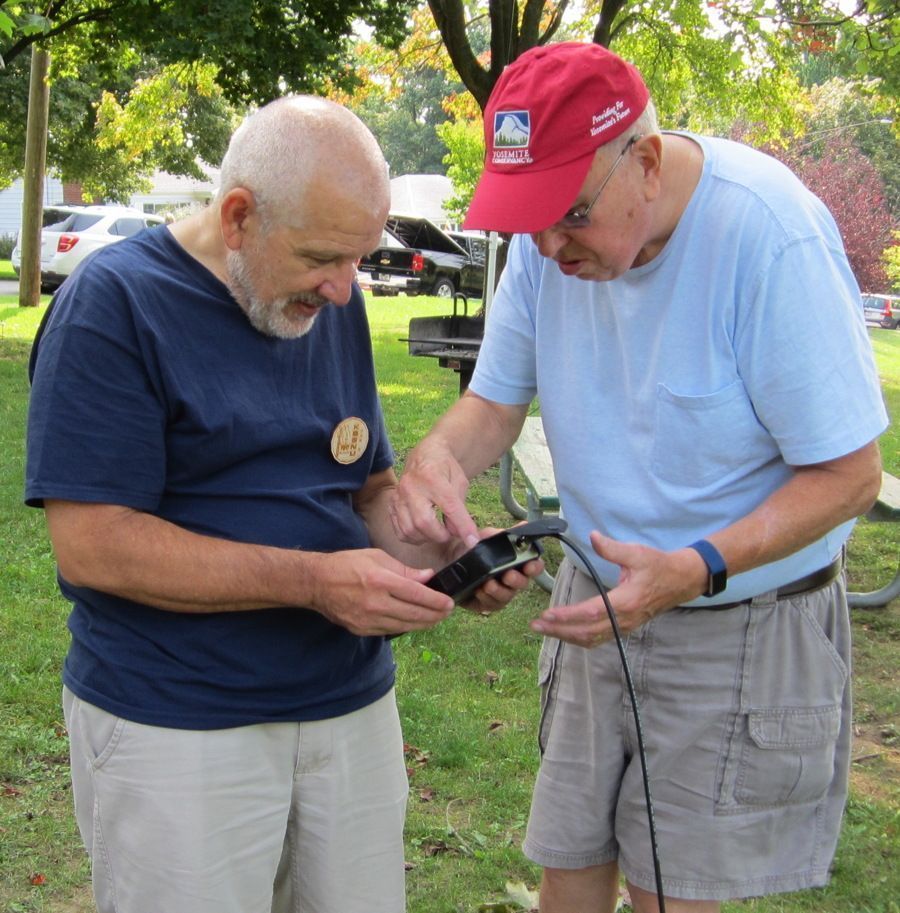
For years, I’ve wanted to gather a bunch of hams and compare antenna analyzers. Today, at long last, I got the chance to do this. After the monthly ARROW breakfast, nine of us including Bruce KE8FSP, Dinesh AB3DC, Don AC8TO, Ed AB8OJ, Harvey KB8MUP, Rich KA8BMA, Sam K8NOS, Ul N4IYL, and yours truly gathered in a city park near my house to compare antenna analyzers.

We took measurements on two different antennas: a 2m/70cm vertical and my 40m/20m inverted V antenna that I set up at Field Day and other events. I haven’t yet analyzed all the data we gathered, but here are some photos:

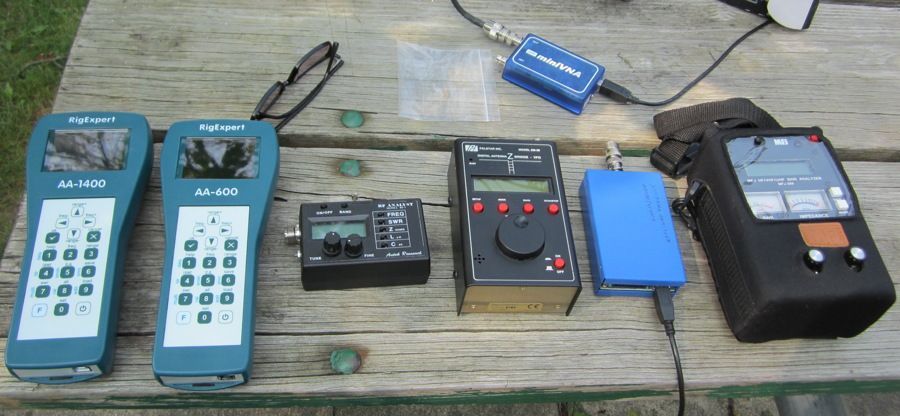
Here are the antenna analyzers brought to the bakeoff by the group. They included (from left to right) a Rig Expert AA-1400, a Rig Expert AA-600, an Autek Research RF Analyst, my Palstar ZM-30, a Fox Delta mini-VNA, an MFJ-269, an mRS miniVNA, and (not shown) a Rig Expert AA-55 ZOOM.
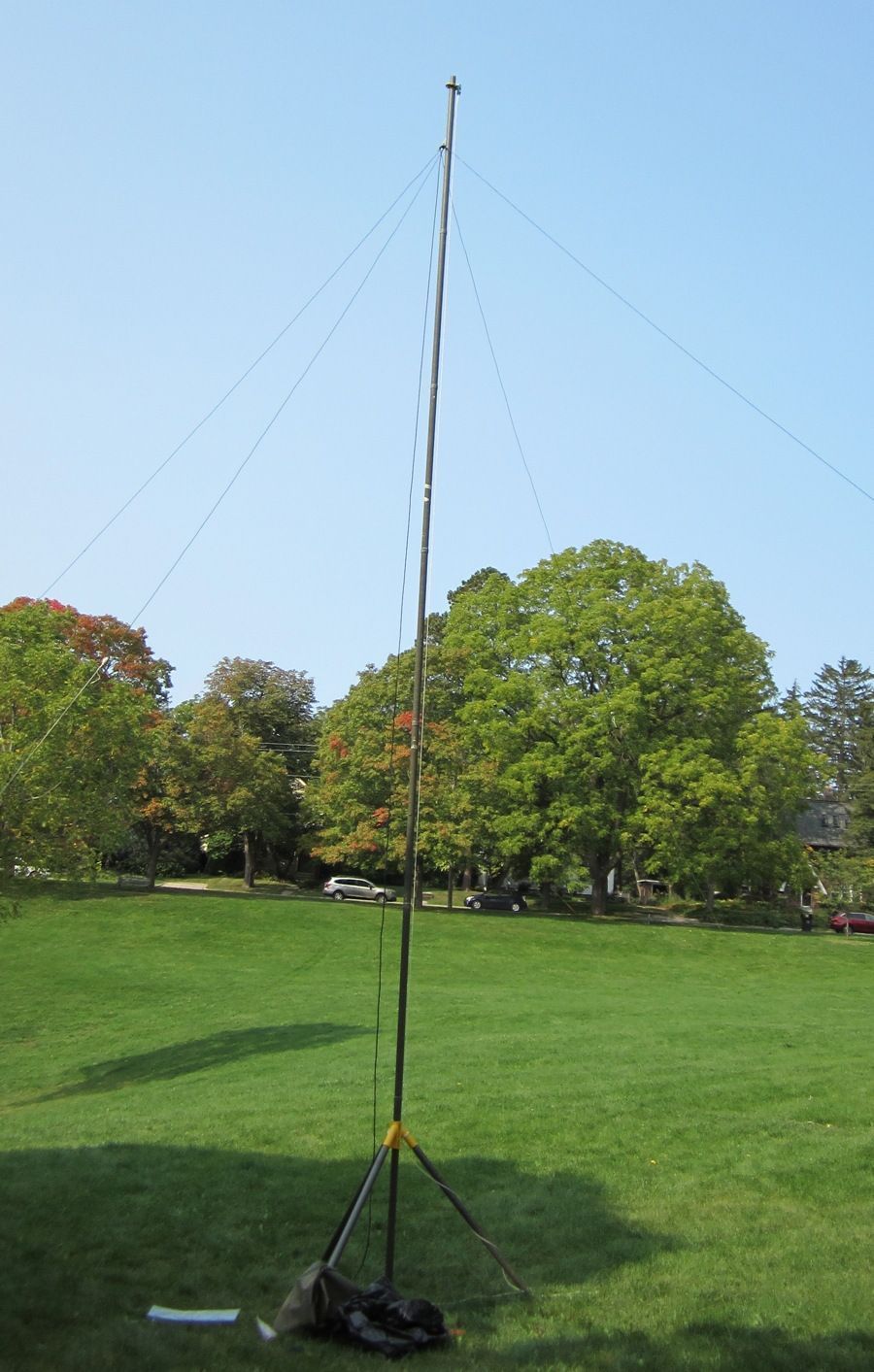
My trusty 40m/20m inverted V antenna on my fiberglass mast.
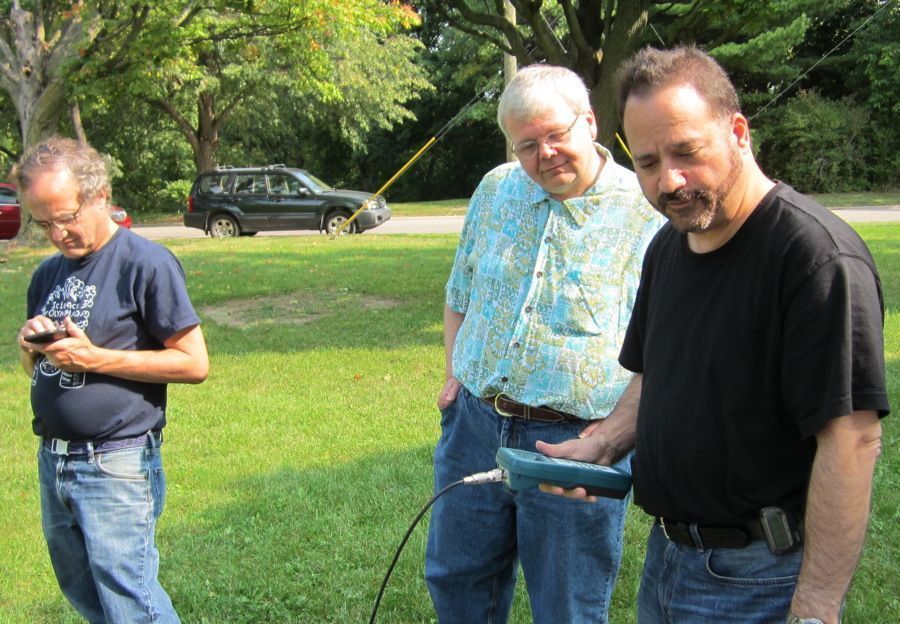
From L to R: Ul N4IYL, Rich KA8BMA, Sam K8NOS, Harvey KB8MUP.
From L to R: Don AC8TO, Ed AB8OJ, and Ul N4IYL.
Rich KA8BMA (right) showing me some of the features of his Rig Expert AA-55 ZOOM.

We really had a blast comparing the antenna analyzer measurements and features. I’ll be writing a lot more about this in future posts. Stay tuned.

Filed Under: Antennas, Gear/Gadgets, Test Equipment Tagged With: antenna analzyers

  • « Go to Previous Page
  • Page 1
  • Interim pages omitted …
  • Page 3
  • Page 4
  • Page 5
  • Page 6
  • Page 7
  • Interim pages omitted …
  • Page 15
  • Go to Next Page »

Primary Sidebar

No Nonsense Technician Class License Study Guide (for tests given between July 2026 and June 2030)

New No Nonsense Technican Class Study Guide now available!

The 2026 version of my Tech Class study guide is now available, and as always, the PDF version is FREE!. The ePub version costs $11.97, and a Kindle version and paperback version will be available on Amazon shortly.

Click here to get all of my "No Nonsense" study guides.

Also available: The CW Geek's Guide to Having Fun with Morse Code

W5SWL.Com
Retevis Ailunce H1 DMR Radio
DXpander: Cobweb antennas, Laser Cutting

You’ve got mail!

Enter your email address below and get an email every time I publish a new post.

Email


I frequently teach classes to help newcomers get their licenses. The next class will take place on Saturday, February 7, 2026 on the University of Michigan campus. Click here for more information.

If you can't make the class, subscribe to the mailing list to be notified of when the next class will be held.

You can always download my free study guide, and if you have any questions about the classes, or amateur radio in general, please feel free to email me directly.

Support KB6NU.Com

Donate $7.30 and get two of these cool stickers. Measuring 4.25-in. W by 2.75-in. H, it's perfect for your car, your shack, or wherever!

Contact me

If you have a question or comment about one of my blog posts, or a question about any of the material in my study guides, or just a question about ham radio in general, you can email me at [email protected].

Blogs You Should Also Read

  • AE5X: A CW-centric blog from Kingswood, Texas
  • K0LWC Blog
  • LA3ZA Ham Radio Blog
  • Little Radios, Big Fun – WB3GCK
  • Mr. Vacuum Tube's Blog
  • Radio Artisan – K3NG
  • The K0NR Weblog
  • VE3WDM's QRP Ham Radio Blog
  • W2LJ’s Blog

Ham Radio Websites

  • Dashtoons – The Hammin' Comedy by Jeff K1NSS

Podcasts

  • ICQ Podcast
  • Linux in the Ham Schack
  • No Nonsense Amateur Radio Podcast
  • Resonant Frequency Amateur Radio Podcast

Recent Comments

  • Michael Burkhardt on One lump or two (or three)?
  • Eric on POTA notes, 7/27/26
  • Steve KB3JC on How to “ragchew” on CW
  • Dan KB6NU on Yaesu FT-710: What’s the big deal?
  • Andrei on Yaesu FT-710: What’s the big deal?

Meta

  • Log in
  • Entries feed
  • Comments feed
  • WordPress.org

Footer

Copyright © 2026 Daniel M. Romanchik, KB6NU · Log in