• Skip to primary navigation
  • Skip to main content
  • Skip to primary sidebar
  • Skip to footer

KB6NU's Ham Radio Blog

KB6NU's Ham Radio Blog
  • HOME
  • Study Guides
  • Teach a One-Day Tech Class
  • W8SRC Repeater Guide
  • Advertise
  • Hire Me

Test Equipment

App notes and white papers from Rohde & Schwarz

September 14, 2017 By Dan KB6NU 1 Comment

Rohde & Schwarz (R&S) has been in business for 80 years, and is one of the pre-eminent test and measurement companies. As such, they have a lot of expertise that they can share with electronics engineers and amateur radio operators.

Here are some app notes and white papers that you might find interesting:

  1. Introduction to RF Design. R&S says that this is the most dowloaded paper on RF design. This white paper provides insight into how these technologies work, and, after reading this paper you’ll have practical knowledge on the entire process for designing an RF system.

  2. Measuring with Digital Storage Oscilloscopes. This educational note covers the theory and practice of digital storage oscilloscopes based on concrete measurement examples that address authentic everyday tasks. The theoretical portion of this paper begins with an explanation of the basic operating concepts for digital oscilloscopes, followed by a discussion of the most important parameters to be considered when setting up and performing the exercise measurements. The final portion of the theoretical section prepares the reader for the subsequent practical exercises containing detailed measurement tasks. These exercises are intended to demonstrate and reinforce the knowledge gained in the theoretical portion. The exercises build upon one another demonstrating measurement tasks that are encountered frequently by engineers in their daily work.

  3. Spectrum Analyzer Fundamentals – How modern spectrum analyzers are designed and how they work. Spectrum analyzers serve as an essential RF test tool for characterizing signals and making frequency measurements. In this primer you will learn about the basics of spectrum analysis, time and frequency domains, different types of spectrum analyzers, and how to make different types of measurements with a spectrum analyzer.

When you click on the link, you may be asked to give your contact info, but it’s worth it. What I do, when asked to give a company name, is to simply type in my call sign. I’ve never had a Rohde & Schwarz salesman contact me. :)
Filed Under: Gear/Gadgets, Test Equipment Tagged With: oscilloscopes, RF design, Rohde&Schwarz, spectrum analyzers

Radio Frequency Hunters: Saving Your Cell Signal

September 7, 2017 By Dan KB6NU Leave a Comment

This just appeared on the IEEE website, and I thought you all would be interested in seeing it. These guys are serious about “fox hunting.” Note the fancy spectrum analyzer that the tech is using. Lots of companies are selling portable spectrum analzyers, including the Keysight, Rohde&Schwartz, and Aim-TTI (sold by Saelig, one of my advertisers).

Most of these cost thousands of dollars, but the Seeed RF Explorer 3G Combo is only $275. I wonder if anyone’s used this instrument and if it’s any good. It might be a useful tool for tracking down noise sources.

Filed Under: EMI/RFI, Test Equipment

DIY antenna analyzers, revisited

August 10, 2017 By Dan KB6NU 6 Comments

Over the course of the last 24 hours, a Twitter conversation that I was part of morphed from a discussion of testing snap-on ferrite chokes to DIY antenna analyzers. Antenna analyzers are, of course, the instrument that one uses to make the necessary measurements.

We got around to DIY antenna analyzers when several of us suggested that a Rig Expert antenna analyzer would do this job nicely, and one of the participants balked at the expense. Then, someone suggest building your own.

Two years ago, I blogged about this. At the time, I could only find one kit and one DIY antenna analyzer project and wondered why there weren’t more DIY antenna analyzers. Now, however, there are several options for DIYers:

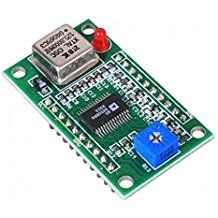
A DDS module that includes an AD9850 IC like the one above is, along with an Arduino microcontroller, the basis for DIY antenna analyzers. On eBay, they go for $10 or less, but you can even buy them on Amazon!
K6BEZ Antenna Analyzer. This is the grand-daddy of DIY antenna analyzers. It combines a microcontroller—either an Arduino or a PIC microcontroller—with an inexpensive direct digital synthesis (DDS) module using an AD9850 chip and a bridge circuit to measure the SWR. You can make one of these for around $50.

K6BEZ/HamRadio 360/Workbench Antenna Analyzer. The HamRadio360 podcast guys featured the K6BEZ design on their podcast. They even designed a printed circuit board for the the project. As you might expect, it sold out really fast. All of the documentation, including the PCB design files, are available, though, on the Workbench Podcast website.

DIY No Frills AD9850/Arduino Antenna Analyzer. This project appeared on Hackaday. It also uses an Arduino and an AD9850 DDS module. The Hackaday post claims that it can be built for less than $40.

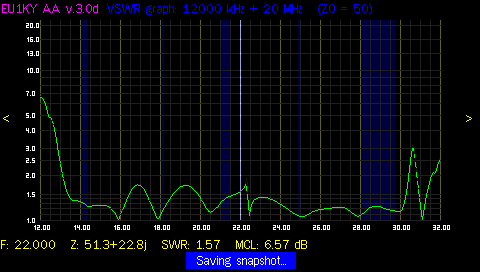
EU1KY antenna analyzer. Someone in the Twitter thread turned me on to this antenna analyzer. The EU1KY antenna analyzer is an open source design, and all of the documentation is available on the website. It differs from the other analyzers in this blog post in that version 3 uses an Si5351 module instead of the AD9850. This allows you to use it up to at least 160 MHz. It also uses a big, color TFT LCD with a capacitive touchscreen (see below) that allows the unit to display scans over a wide range of frequencies..

‘Tenna Dipper. Finally, I’ll mention this this little device. It’s not really an antenna analyzer, in that it uses a set of fixed frequencies, but it is really cheap and you can do quite a bit with it. For most guys, this may be all you need.

I’m quite happy to see that there are now quite a few options for DIY antenna analyzers. If you have had any experience with any of these designs, or know of others, please let us know by commenting below.

Filed Under: Antennas, Building/Homebrew, Gear/Gadgets, Test Equipment

6 essential tips for getting the most out of your oscilloscope

August 3, 2017 By Dan KB6NU Leave a Comment

The price of oscilloscopes has gotten so low that any amateur radio operator can now afford one. And, these are great scopes, too, packed with lots of features that earlier generations of analog scopes just couldn’t provide.

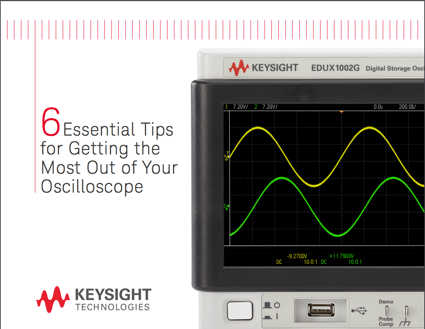
To  help new scope users take advantage of these features, Keysight, which used to be Agilent, which used to be Hewlett Packard, just published an app note, 6 essential tips for getting the most out of your oscillocope. You have to fill out a form to get this app note, but it’s worth it.

The six tips are:

  1. Get started with basic triggering.
  2. Remember probing matters.
  3. Scale signals correctly.
  4. Use the right acquisition mode.
  5. See more detail using advanced triggering.
  6. Use integrated protocol decoders for advanced serial busses.

Aside from perhaps the last one, these tips will help ham radio operators make better measurements, even if you don’t have a Keysight scope.

Filed Under: Test Equipment Tagged With: Keysight, oscilloscopes

My VHF/UHF SWR meter recommendation

July 28, 2017 By Dan KB6NU 8 Comments

Yesterday, one of my recent Tech class students emailed me, asking me how he could measure the SWR of a 2m antenna that he had:

I happen to have an older magnetic mount mobile antenna with a UHF connector attached. I was thinking of trying out this antenna with my Baofeng HT.  The only issue is that I don’t have a SWR meter. I believe you said you do.  Do you have any recommendation?  I did a search on eBay, and got more than 1,200 hits, with costs from $4 to $600+. 

So, I did a little Googling, then replied:

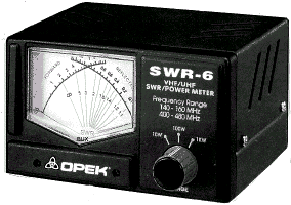
The one I have is an Opek SWR-6 Unfortunately, they don’t make this model anymore. I think I paid about $60 for it. It works well for a cheap meter.

Unfortunately, the SWR-6 is no longer in production.

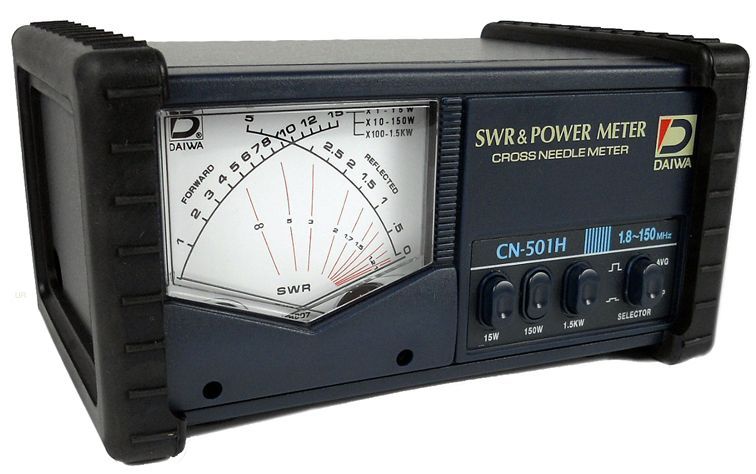
Opek now sells SWR-8L. On Amazon, it costs $110. A similar meter is the Daiwa CN-501V. It will set you back $100. MFJ sells a bunch of SWR meters that purport to measure SWR on the 2m band, but because my experience with MFJ equipment has been less than satisfactory, I do not recommend MFJ. 

The Daiwa CN-501V is in production, but costs $100.

Having said all that, you may not really need a VHF SWR meter. You can usually guess the SWR from the output power reading. If it’s lower than full scale, then the SWR is high. :)  You’re not going to damage the radio because even the Baofeng has high-SWR protection circuits. You could also use an inexpensive HF SWR meter to make this measurement.

If you really want to spend some money, consider purchasing an antenna analyzer that covers the 2m band. You’ll have to spend more, but you’ll get more, too. For example, the RigExpert AA-170 costs $334, but you can also analyze HF and 6m antennas as well.

So, what do you all think? Did I steer my Elmeree in the right direction? It doesn’t seem to make sense to me to spend $100 for a VHF SWR meter when you could purchase an antenna analyzer for not too much more. Are there any other VHF/UHF SWR meters or antenna analyzers that you would recommend?

Filed Under: Test Equipment, VHF/FM/Repeaters

New Heathkit power meter

July 21, 2017 By Dan KB6NU 10 Comments

Heathkit has finally announced their next amateur radio product – the HM 1002 Precision RF Power Meter. I say announced because it’s really not available yet. Instead, you can “pre-order” it for shipment in “late summer.”

Here’s what the HM-1002 web page says:

The HM-1002 Heathkit® Precision RF MeterTM is our first new amateur radio station accessory and our first test equipment product in over 30 years. This is a solder kit, suitable for people with no prior electronics experience. We believe it is a landmark in RF meters, in both technical features and price/performance.

Initial early pre-ordering is available for devoted fans, patient experienced kitbuilders and Heathkit Insiders, with payment by check, USPS money order, or eCheck. Regular sales may not open for a month or more.

Final product specifications, and product price for future orders, are subject to change. If lab tests show our design achieves our target goals for accuracy (better than nominals below), the price for orders placed later may increase. [[The pre-order price is $575….Dan]] Pre-orders are limited to two units per customer.  Price shown includes one power+frequency sensor.

THIS KIT WILL START TO SHIP IN LATE SUMMER 2017. 
This product will not ship when you order. You will be waiting but “first in line.” Orders will be processed on a first-paid first-shipped basis. 
Due to high expected demand, the earliest pre-orders have an estimated ship date of August or September. That’s an estimate, not a confirmed ship date, and if you wait to order and are not among the first 1,000 orders you likely will receive yours later than that. Initial pre-orders are a make-to-order, and it takes time to manufacture the First Production Run of a groundbreaking new product.

I’m just as befuddled by this product as I was by their first product—a $150 TRF AM radio. I just don’t see a big demand for this product when there are already so many good wattmeters on the market already, not to mention all of the Bird wattmeters floating around. Sure, this may have better specs than some of those wattmeters, but hams don’t need that kind of accuracy even if they could figure out what to do with it.

Hack-a-Day seems equally befuddled. For their take on the HM-1002, read Heathkit’s New RF Meter. Who is it for?.

Have any of you built one of the new Heathkits? If so, I’d like to hear your take on your experience building the kit and whether it was worth the money.

Filed Under: Gear/Gadgets, Kits, Test Equipment Tagged With: Heathkit, wattmeter

From my Twitter feed: Homemade radio that really works

July 5, 2017 By Dan KB6NU Leave a Comment

BoysLife's avatarBoys’ Life magazine @BoysLife

 #BLWorkshop: How to make a homemade radio that really works bit.ly/2pD8uTD @arrl
Media preview

Siglent_Tech's avatar

SIGLENT TECHNOLOGIES

@Siglent_Tech
 New to measurements? Here is a great tutorial on oscilloscope basics: youtu.be/CzY2abWCVTY

EA1CS's avatar

EA1CS @EA1CS

 El futuro de La radioafición buff.ly/2u2Hlrs #hamradio #dx
Media preview

Filed Under: Building/Homebrew, Test Equipment

Ham Ads: June 2017 QST

June 5, 2017 By Dan KB6NU Leave a Comment

I recently renewed my ad in the classified section (Ham Ads) of QST. I also geeked it up a bit, and the new ad’s first appearance is in the June 2017 issue. It reads:

KB6NU’s “NO NONSENSE” LICENSE STUDY GUIDES have helped 1000s get their first license and upgrade to General and Extra. They can help you, too. KB6NU.COM/STUDY-GUIDES/

While checking to make sure that I didn’t make any typos, I found a couple of other interesting ads there:

  • CW Operators Learn to copy Morse code in your head. n7agk.com.

    The second most common question that I get about CW is, “How do I learn to copy in my head?” One way might be this program from Carl, N7AGK. On his website, Carl writes, “I have created a program to assist you in learning to copy Morse code in your head. Everything you need will be contained on a single USB flashdrive that I will provide to you. In the program there are audio Morse code presentations followed by a visual display. The visual display shows the information in large print and upper case letters. The visual display verifies that you have received the Morse code correctly.” Carl’s program costs $20.

  • LEARN CODE by Hypnosis. www.success-is-easy.com. 561-302-7731.

    This course is the brainchild of Peter, WB2D, whose QRZ.Com page says that he “has served as a full-time staffer for both CQ Communications and ARRL.” There are a number of different offerings ranging from $18 to $30.

  • HAM KITS for sale at www.HecKits.com. L/C Meter, SWR Bridge, ESR Meter, 2-Tone Gen, FET DIP Meter.

    The HecKit website says, “HecKits is operated by Darrel Heckendorf, WA7OIB, in Austin, Texas. Our goal is to provide simple to build and easy to use small test equipment for radio amateurs.” Nothing costs over $100, and

  • W4GKH Multiband HF End Fed Antenna – works on any band 160-6 meters. Stealthy. Excellent for HOAs, QRP, Field Day, portable & EmComm. Hand made in the U.S.A. Details & ordering: http://www.W4KGH.net

    For $47, you get a 53-ft. wire, a 9:1 unun mounted in a plastic box, a dog bone insulator, and some paracord for hanging the antenna. You can, of course, make this yourself for a lot less, but it certainly isn’t all that expensive.

Filed Under: Antennas, Building/Homebrew, CW, Kits, Test Equipment

From my Twitter feed: QRP wattmeter, TAPR forum, new TX Factor

June 3, 2017 By Dan KB6NU Leave a Comment

tindie's avatar

Tindie @tindie
#NEW QRPoMeter tindie.com/products/NM0S_…#DIYElectronics


TAPRDigital's avatar

TAPR @TAPRDigital
2017 Dayton Hamvention TAPR Forum Video… fb.me/webrmUa2


ke9v's avatar

Jeff Davis @ke9v
 In case you missed it – TX Factor Episode 16. Best 51 minutes you’ll spend on YouTube this week – youtu.be/je3jisi-CIw @txfactorshows

Filed Under: Digital Modes, On the Internet, QRP, Test Equipment

Interesting gadgets I wish I had time for

March 23, 2017 By Dan KB6NU 3 Comments

  • I’m on a lot of mailing lists and participate in a bunch of amateur radio forums. As a result, I see a lot of interesting gadgets that guys are buying or are thinking about buying. Here are three of the latest that look interesting to me. I wish I had time (and money) to purchase all of these and try them out.

Android antenna analyzer

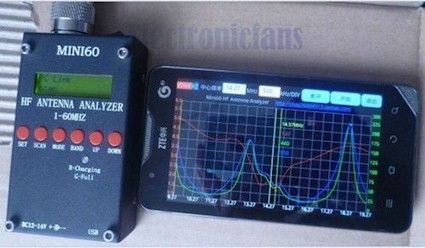
On Reddit, some of the guys have been talking about the Mini60 Antenna Analyzer. Its frequency range is 1 – 60MHz, but the cool thing about this device is that you can use it standalone with the built-in LCD display or with some software and a Bluetooth device to get fancy frequency vs. SWR plots as shown above.

Of course, this is made in China, but how can you beat the price? It costs less $120 shipped.

Multi-functional component tester

Here’s another marvel of Chinese engineering and manufacture – a smart component tester for only $25, shipped. This isn’t the first one to hit the market, but the unique thing about this unit is that it has a graphical display that not only identifies the type of component that you’ve connected to it, but also draws the schematic symbol of the part. See the video below:

Make your RPi into a desktop PC

Newark/element 14 will soon start selling a kit of part that will make it easier to turn your Raspberry Pi into a desktop PC. The kit includes:

  • Intelligent and Safe Power Controller
  • Interface to connect mSATA SSD (upto 1TB)
  • Real Time Clock to keep track of time
  • Heat Sink
  • Enclosure

They don’t list the price just yet, but this might be what I need to actually make use of the Raspberry Pi 3 I bought several months ago.

Filed Under: Antennas, Computers, Gear/Gadgets, Test Equipment

  • « Go to Previous Page
  • Page 1
  • Interim pages omitted …
  • Page 4
  • Page 5
  • Page 6
  • Page 7
  • Page 8
  • Interim pages omitted …
  • Page 15
  • Go to Next Page »

Primary Sidebar

No Nonsense Technician Class License Study Guide (for tests given between July 2026 and June 2030)

New No Nonsense Technican Class Study Guide now available!

The 2026 version of my Tech Class study guide is now available, and as always, the PDF version is FREE!. The ePub version costs $11.97, and a Kindle version and paperback version will be available on Amazon shortly.

Click here to get all of my "No Nonsense" study guides.

Also available: The CW Geek's Guide to Having Fun with Morse Code

W5SWL.Com
Retevis Ailunce H1 DMR Radio
DXpander: Cobweb antennas, Laser Cutting

You’ve got mail!

Enter your email address below and get an email every time I publish a new post.

Email


I frequently teach classes to help newcomers get their licenses. The next class will take place on Saturday, February 7, 2026 on the University of Michigan campus. Click here for more information.

If you can't make the class, subscribe to the mailing list to be notified of when the next class will be held.

You can always download my free study guide, and if you have any questions about the classes, or amateur radio in general, please feel free to email me directly.

Support KB6NU.Com

Donate $7.30 and get two of these cool stickers. Measuring 4.25-in. W by 2.75-in. H, it's perfect for your car, your shack, or wherever!

Contact me

If you have a question or comment about one of my blog posts, or a question about any of the material in my study guides, or just a question about ham radio in general, you can email me at [email protected].

Blogs You Should Also Read

  • AE5X: A CW-centric blog from Kingswood, Texas
  • K0LWC Blog
  • LA3ZA Ham Radio Blog
  • Little Radios, Big Fun – WB3GCK
  • Mr. Vacuum Tube's Blog
  • Radio Artisan – K3NG
  • The K0NR Weblog
  • VE3WDM's QRP Ham Radio Blog
  • W2LJ’s Blog

Ham Radio Websites

  • Dashtoons – The Hammin' Comedy by Jeff K1NSS

Podcasts

  • ICQ Podcast
  • Linux in the Ham Schack
  • No Nonsense Amateur Radio Podcast
  • Resonant Frequency Amateur Radio Podcast

Recent Comments

  • Michael Burkhardt on One lump or two (or three)?
  • Eric on POTA notes, 7/27/26
  • Steve KB3JC on How to “ragchew” on CW
  • Dan KB6NU on Yaesu FT-710: What’s the big deal?
  • Andrei on Yaesu FT-710: What’s the big deal?

Meta

  • Log in
  • Entries feed
  • Comments feed
  • WordPress.org

Footer

Copyright © 2026 Daniel M. Romanchik, KB6NU · Log in